I’m an engineer and building consultant. When I get a call from a lawyer about a construction problem, it’s usually not a good situation for either the homeowner or the builder.
One recent case was no exception: The state building inspector had already noted several deficiencies that the builder had failed to correct by the time I arrived on site. While I wasn’t too worried about the use of finger-jointed studs (the original cause of the homeowner’s concern about the quality of the job), I noticed other problems — studs fastened to the plates with only one or two nails, missing blocking — and began to look more closely, snapping photos as I went. It turned out that the homeowners had plenty of cause to be suspicious of the quality of work being done.
Truss Framing Errors
Truss framing isn’t difficult, but it has to be done right for the engineering to work correctly. A common error is to toenail the bottom chords of trusses to partition wall framing (below left); truss clips should be used instead. Otherwise, truss uplift — which occurs when cold upper-truss chords gain moisture while warm lower-truss chords dry out, making the whole truss curve like a bow — can lift the interior wall off the floor and cause problems with the drywall. It can even lead to a split in the bottom chord, creating the potential for truss failure under snow loading.
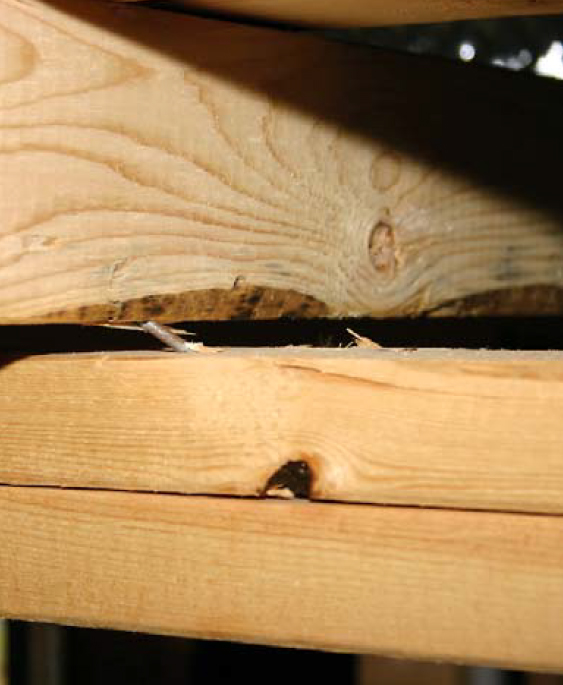
The framing carpenter on this job also failed to provide adequate bearing under the ends of a couple of trusses (above ). Instead, the trusses bear on an interior partition wall, resulting in cantilevered truss ends that “float” above the wall plate. Unfortunately, they won’t float for long.
Inadequate Girder Truss Support
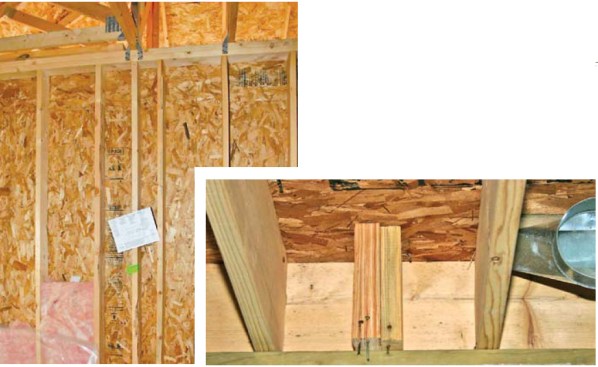
A girder truss is engineered to support heavy roof loads and carry them to the points where the girder bears on the wall plates. These significant point loads need to be directly supported by columns with sufficient strength and stiffness to transfer the loads to the foundation wall. In this project, the point loads should have been borne by — at the very least — doubled 2-by posts properly nailed to both the top and bottom plates, not by a single loose stud propped into place (below left).
Adding to the problem, load-transfer blocks below the girder truss support on the upper floor hadn’t been cut to fit properly (below right). Because they are too short and not tight to the subfloor, they will allow the wall plates and truss support columns to settle, which can result in cracked drywall and possible structural damage.
Improper Shimming
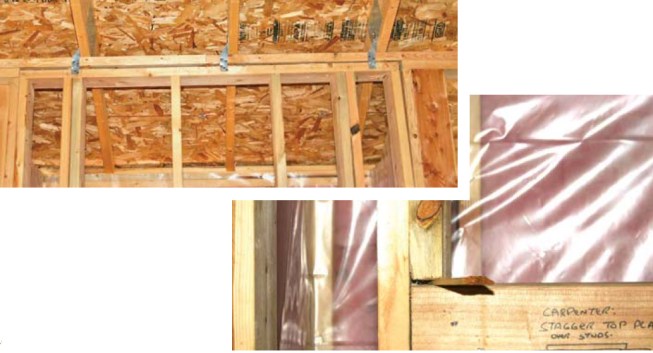
Wood is strongest when loads are applied parallel — rather than perpendicular — to grain. White cedar shims, of course, are made from a light and porous wood and are cut with the grain; they simply don’t have enough compressive strength to be used in structural applications. On this house, the framing carpenter improperly used them to fill in gaps between the top plate and a header wall for a fireplace (below left), and between load-bearing studs and the lintel header (below right; note the state building inspector’s drawing indicating the proper framing for this wall). Under normal roof loads, the fibers in these cedar shims will be crushed.
Blocking and Nailing
An important part of the framer’s job is to install proper blocking. On this house, none of the rough openings for bath fixtures had any blocking, and some of the ceiling blocking was either missing or loosely nailed in place (below). Such gaps can lead to movement, and then cracking of the drywall.
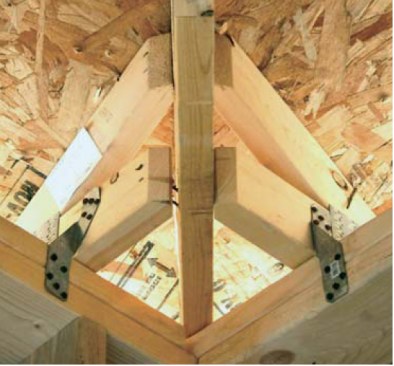
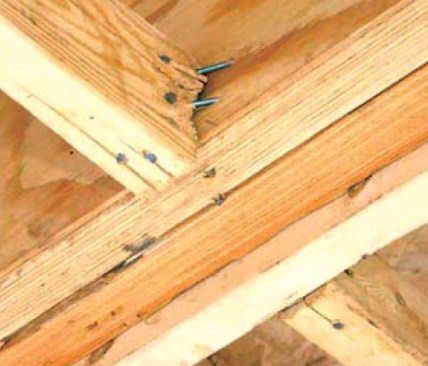
It’s also important not to overnail a framing member. For example, this porch ceiling joist (below) has about 10 toenails shot into it, which shredded the end of the 2×4. Without a joist hanger to hold the pieces together, there’s no way this joist end will be able to support the weight of the ceiling.
Donald Cohen is an architectural engineer and building consultant living in West Bend, Wis.