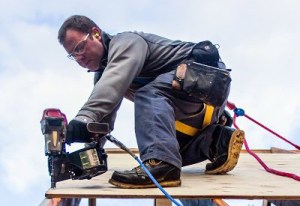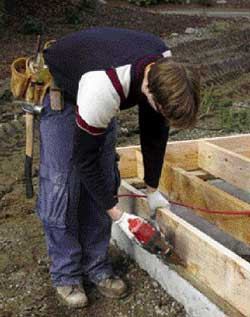
Recently, JLC asked me to try out Max’s new PowerLite framing system. The timing was excellent because our company’s four-man crew was scheduled to frame 15 to 20 custom homes this year. That’s twice what we normally build, so we were looking for ways to increase production.
The system we tested included a PowerLite framer HN90 coil gun, a 100-foot PowerLite hose, and an AKHL 1050E PowerLite compressor. Most framing guns operate at 100 psi and run off compressors that produce 120 to 150 psi. The HN90 operates between 170 and 330 psi and is connected to a 400-psi compressor.
The added pressure allowed Max (Max USA Corp., Mineola, N.Y.; 800/223-4293, www.maxusacorp.com) to decrease the size and weight of the gun without decreasing nailing power. High-pressure systems are new to the U.S. market, but, according to the manufacturer, they have been used in Japan for a decade.
Stick vs. Coil
Our crew prefers stick nailers because they’re lighter, more maneuverable, and easier to toe-nail with than coil guns. But coil guns hold more fasteners, and that speeds production by decreasing the need to stop and reload. We use coil guns to nail sheathing and subflooring because those tasks require us to drive a lot of fasteners in a short period of time. Before we had the PowerLite framer, we used stick nailers for everything except sheathing.
The HN90 is so small and light that there’s no reason not to use it for everything. It’s smaller than an average siding or fence coil nailer and, at 5.2 pounds, is 40% lighter than the average stick framer. You can fill it with 10d nails, and it will still be lighter than a stick gun. This gun is very compact (14x5x11 1/2 inches), so it fits in places where framing nailers won’t go.
The PowerLite framer holds up to 300 15-degree wire-welded or plastic-collated round-head nails. It accepts fasteners from 2 inches to 3 1/2 inches long and between .099 inch and .148 inch in diameter. The top of the magazine is clear, so you can see how many nails are left.
Power
When we got this gun, we dropped in a coil of 10d nails and started using it to frame walls. The first thing I noticed was that there was almost no recoil. It felt like using a finish gun. The HN90 has more power than any nailer I’ve ever used. We used it to nail LVLs together, and it always drove the nails home. The first time I used it to nail off subfloor, it blasted the 8d ring nails right through the sheathing. I backed off the depth of drive, but it still set the nails a little too deep. We played around with the pressure setting and the depth of drive and decided that 275 psi was a good compromise for framing and shear nailing. If it was really cold outside and the lumber was frozen, we’d crank it up another 10 psi.
Depth of drive. Some of the municipalities we build in require shear nailing inspections. A certain number of nails is required, and they can’t be overdriven. We’ve had trouble with this in the past, but the HN90 allowed us to get a consistent penetration. It has a depth-control dial below the trigger that’s similar to those on other models from Max. We already own a couple of Max nailers, and the dials usually work well. The dial on this one froze up, however, and I had to pry it free. I attribute this problem to the record amount of rain that fell during the time we were testing this system.
Modes of operation. Like many nailers, the HN90 is available with two triggers, one for contact trip and the other for sequential. Both versions are equipped with a trigger lock and an antidouble-fire mechanism that prevents you from accidentally firing a second shot in single-fire mode. To activate that mode, you depress the nosepiece before squeezing the trigger. The gun won’t cycle until the trigger is released. This is a handy feature for toe-nailing.
The tool we tested had contact trip and could be bounce-fired by squeezing the trigger and depressing the nose. With all the other nail guns I’ve used, if you go too fast, the nails stand proud. This was not a problem with the Max; it nailed as fast as I could move.
Compressor
The AKHL 1050E compressor is light and compact. It weighs 52 pounds, which is less than my sliding miter saw. According to the specs, it puts out 3.0 cfm at 360 psi. The 2.6-gallon tank holds compressed air at 400 psi, about the equivalent of an 8-gallon tank at 125 psi.
One of the best things about this compressor is that it works with high-pressure and conventional guns. It’s equipped with two regulators and three gauges. One regulator and gauge control the pair of high-pressure fittings that feed the PowerLite guns. The other regulator and a second gauge are for the low-pressure side of the system, which takes conventional fittings and can be used to power the nailers you already own. The third gauge tells you how much pressure is in the tank.
The PowerLite compressor is very compact, only 13 3/4×23 1/2×11 1/4 inches. According to the manufacturer, it puts out 80 decibels of sound. I didn’t measure it, but this machine was definitely quieter than the compressors I’m used to. It takes a few minutes to fill the tank, but that’s to be expected when you’re going to 400 psi.
Hose and Fittings
You wouldn’t normally expect to hear about the hose in a nail gun review, but in this case, it’s an important part of the tool. Max’s high-pressure nailer uses a special small-diameter hose, and the fittings are different from those on a conventional compressor.
The hose is light and flexible and seems durable. Unlike a conventional rubber hose, it does not catch on things and is easy to coil and uncoil. The gun’s air fitting is equipped with a built-in filter. Dirt can’t get in and is blown back out of the fitting when you unplug the hose.
| | |
| |
One of our most frequent job-site repairs is fixing the kink that appears when a hose is bent too many times near the gun. Max’s gun is equipped with a swivel fitting that greatly reduces trauma to the hose. It’s not a make-or-break feature, but we like it because we’d rather frame than repair tools.
On one occasion, we put a hole in the hose by nicking it with a saw. We tried patching it with tape, but that didn’t work because the pressure was way too high. It could have been repaired at the nearest Max distributor, but it was more convenient to get a replacement. According to the manufacturer, a kit will soon be available for repairing hoses in the field.
Pros and Cons
Most new tools are only slightly different from their predecessors, but Max’s high-pressure system changed the way I think about framing guns. Six of us used it, and we agreed that it was close to perfect — light, powerful, and easy to maneuver. The depth of drive was consistent, and we couldn’t outrun the compressor. The only problem we encountered was the sticky depth-control dial. Our one complaint was that like most guns, this one lacks a belt or rafter hook.
Cost. The most serious problem is the cost. Max distributes the PowerLite system through a small number of regional suppliers. The suggested retail price for the gun is $650. The hose costs $119, and the compressor goes for $1,200.
It’s hard to justify that kind of expenditure when conventional guns and compressors are so cheap. Even so, I’m seriously considering buying one of these systems — if the price was lower, I’d buy it tomorrow. Max is the only company currently selling high-pressure nailers, but Porter-Cable and Hitachi are working on systems of their own. Hopefully, the competition will bring prices down. Tim Uhler is a lead framer and exterior trim carpenter for Pioneer Builders Inc. in Port Orchard, Wash.