
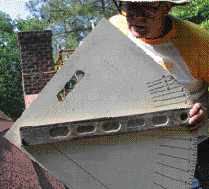
I built this jig about 10 years ago while waiting on a job site for a building inspector. The parts — laminate countertop scrap and an old 2-foot wooden level kicking around the back of my truck — were cheap.
After cutting the countertop roughly to size, I drew a baseline along the bottom edge and marked a pivot point at one end. Then I measured over 24 inches and made a second mark, drew a second line perpendicular to the baseline, and marked this line every 2 inches.
Since the run is 24 inches instead of 12 inches (to give the jig more accuracy), each mark corresponded to a whole-number change in pitch (2-inch rise/24-inch run = 1-in-12 pitch).
Next, I drilled holes and bolted the level to the countertop through the pivot point. To read the pitch using the top of the level, I had to shift the position of the pitch marks upward on the jig. I did this by marking the free end of the level to correspond with the position of the pivot point; then I aligned this point with each of the marks of my original pitch layout as I marked the new pitch lines with a felt-tipped pen, using the top edge of the level as a guide (see illustration).
After the ink dried, I erased the pencil lines of the original layout, then sprayed the countertop surface with clear lacquer to preserve my final marks.
By trimming the countertop along the arc scribed by the level, I made the jig a little more compact; I also cut a handle into it so it would be easier to carry up to a roof.
To use the pitch finder, I rotate the level until it reads level, then clamp it in place with a spring clamp. I usually take three or four readings on different parts of the roof, using the average result to ensure that a local dip or bulge doesn’t give a false reading.
Over the decade-plus that I’ve used this site-built tool, it has proven to be very handy and accurate.
John Carroll is a builder in Durham, N.C., and the author of Measuring, Marking & Layout.
Lumber-Hanging Trick
If you gang-cut rafters, or even if you cut them one at a time, sooner or later all those parts have to be hauled up to the roof and installed. Framers Will Holladay and Nick Ridge used an efficient method for making this happen on a site in Oakland, Calif. Will’s job was to precut the entire roof on the ground, while Nick and his crew nailed the pieces up. As Will cut the pieces — blocks [1] and rafters [2] are shown here — he hung them with nails along the plates or girders where they were being installed.
This makes for very efficient framing as long as all the parts are there. Because they’re hanging exactly where they go, the roof cutter can tell at a glance if he’s missed any pieces simply by looking at what’s hanging from the wall. The carpenters assembling the roof just reach down from the plates and grab the next piece they need.
The method doesn’t work for hanging long rafters, but you can still hang the blocks and stack the rafters near at hand [3]. — David Frane
Skyhooked
Faced with the prospect of backing down a twisting, half-mile-long mountainside driveway, the driver of this 40-foot flatbed tractor-trailer was looking for a place to turn around. The crane operator, who had just hoisted into position the truck’s load of precast concrete planks, volunteered to hook up and help out. With the back wheels of the flatbed trailer lifted several inches off the ground [1] and the crane operator deftly maneuvering the trailer into position, the truck driver easily negotiated the tight corner around the edge of the foundation into the turnaround [2]. Then, as the truck pulled out of the turnaround, the crane lifted the back wheels again, swinging the trailer over several feet to clear a pile of boulders and point the rig on its way [3].
Total elapsed time: about five minutes, which considerably sped the arrival of the next truck waiting at the bottom of the hill with another load of concrete planks. — Andrew Wormer


