
Q. Are ledger lag-bolting schedules that were developed for 2-by rim joists adequate for engineered rims? It seems that lag bolts would pull out of a thinner engineered rim more easily than out of a thicker 2-by Doug fir rim joist.
A. Christopher DeBlois, a structural engineer with Palmer Engineering in Tucker, Ga., responds: You’re right. Lag bolts don’t get the same purchase in a 1 1/4-inch-thick engineered LSL (laminated strand lumber) rim joist as they do in 1 1/2-inch-thick framing lumber. If a lag bolt is properly installed, with its tip well through the rim joist and only the threads engaged in the band, its capacity relative to pull-out forces depends on the thickness of the band and the density of the wood. Because LSL rim joists are typically built up of the same wood species used for framing material (and thus have the same approximate density), the big variable is the thickness. A 1 1/4-inch-thick LSL is five-sixths as thick as 1 1/2-inch-thick 2-by stock, and thus has 16 percent less holding capacity. To provide the same total pull-out strength, you’d need to provide six-fifths the number of bolts, an increase of 20 percent.
Although there may be other variables, the end result for shear and pull-out strength to carry the weight of a deck or porch will be similar — 20 percent more bolts in a 16 percent thinner band will provide about the same capacity. (See “Load-Tested Deck Ledger Connections” [3/04] for bolting schedules for 2-by ledgers.)
Instead of using more lag bolts, an alternative approach (if you can plan ahead) would be to use 1 3/4-inch LVL material for bands or rim joists wherever you will be bolting a deck or porch to the house. That’s the method I used for my own house, and the small increase in materials cost was well worth it when I added the deck a few years later.
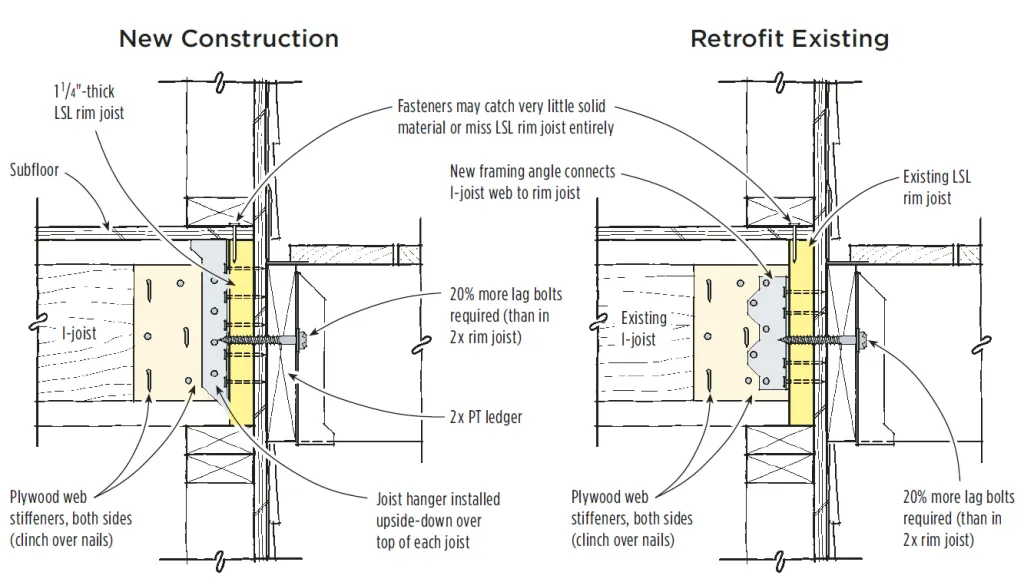
To me, a bigger concern than pull-out strength is the strength of the connection between the band and the joists and subfloor when an LSL rim joist is used with wood I-joist floor framing. Because I-joist webs are so thin, the connection between each joist to the LSL band is weak; therefore, you must rely on the connection of the subfloor to the top of the band to keep from pulling the rim joist off the house. But since this band is thinner than 2-by material, it’s a little bit easier for screws or nails from the subfloor to miss the band entirely, or to catch very little solid material. I’ve seen a deck literally collapse away from a house, taking the LSL rim joist with it. And if the rim joist is at the end of a cantilever or overhang with no wall below, the potential for this type of failure increases dramatically.
To ensure that the rim joist itself is well secured to the floor framing (at least where joists bear on the outside wall), I recommend reinforcing the connection from the joists to the band. In new construction, this can be done by adding plywood web stiffeners on both sides of each joist at their outer end so that they finish flush with the I-joist chords, and by nailing from one side through the OSB web into the stiffener on the opposite face (clinching over any nails that poke all the way through). Then install joist hangers upside-down over the top of the end of each joist before you set the subfloor, nailing the hanger off to both the I-joist and the rim joist to complete the connection (see illustration).
For existing framing, install light-gauge framing angles (such as Simpson’s L70s) to connect the web of each I-joist to the rim joist.


