- Q. I often see roof loads calculated based on the horizontal run of the roof. But isn’t it more accurate to figure the weight of snow and roofing materials by measuring along the actual length of the rafter? Thus, as the roof gets steeper, the rafter gets longer, and the weight of roofing materials increases.
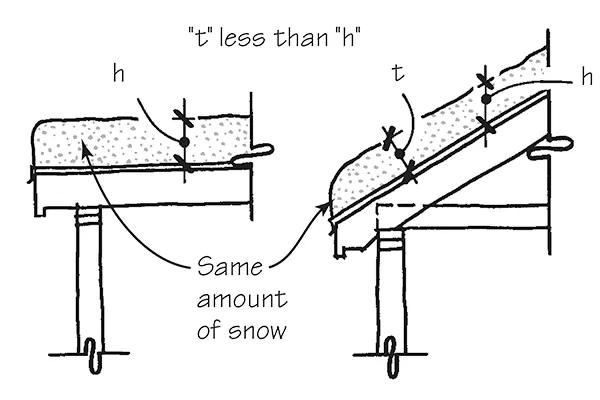
A. Actually, with snow, you don’t get more load along the slope of the rafter; you get the same load as a flat roof with the same run would get. This is because as snow falls vertically it spreads itself further along a sloping rafter and so accumulates less depth. The BOCA code recognizes this and allows you to use the horizontal projection of the roof when calculating snow loads. BOCA also allows you to reduce the snow load for roofs with slopes greater than 30 degrees, presumably because snow will slide or blow off steeply pitched roofs.
For dead loads, you are correct. Technically you should use the actual rafter length when adding up the weight of roofing materials. However, in my practice, I typically use the horizontal run of the roof for both types of load. To do this, I use conservative (too heavy) dead loads and full snow loads regardless of pitch. I ignore the slope factor altogether for snow load reduction which adds another measure of conservatism. (Slope length cannot be ignored for wind load analysis, though.)
—R.R.
Calculating Loads on Sloped Roofs
"Four engineers shed light on common framing mysteries, myths & misconceptions"
1 MIN READ