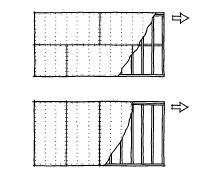
- Q. I’ve always heard that installing plywood sheathing horizontally (perpendicular to the direction of the studs), with joints staggered, is stronger than installing it vertically. True? Is this true of roof sheathing too?
A. This is true for wall sheathing in many instances, but not for roof sheathing. To understand why, we need to look at how the grain of the plies is oriented relative to the direction of the applied force. Each layer of wood in plywood is oriented either parallel or perpendicular to the long direction of the sheet. Most of the shear force is resisted by those plies whose grain runs parallel to the direction of the applied force. So for 3-ply plywood, for instance, which has two face plies running parallel with the long dimension of the sheet, and a single central ply running perpendicular, most of the wood fibers are oriented parallel to the length of the sheet, so that is the plywood’s stronger direction.
This fact is reflected in the Uniform Building Code’s nailing schedule for structural panel shear walls (1997 UBC, Table 23-II-I-1), which permits the allowable shear for 3/8-inch and 7/16-inch panels, if oriented horizontally across the wall studs, to be increased to that of corresponding 15/32-inch panels. As plywood gets thicker, this rule is less important because the overall percentage of fibers running parallel with the long dimension decreases as the number of plies increases [Ed. note: Similar information about nailing schedules for shear panels can be found in Table R602.3(3) in the 2021 IRC].
Note that the UBC table applies only to fully blocked shear walls; in other words, all the plywood edges have to be supported by a minimum of 2-by framing. Regardless of plywood orientation, a plywood panel fully supported at all edges is always stronger than a panel with some edges unsupported (see “The Strength of Plywood Sheathing,” Practical Engineering, 11/96).
So far we’ve talked only about wall sheathing, which mainly resists lateral loads from high wind or earthquakes. Roof sheathing is another matter, since roofs experience forces applied both parallel and perpendicular to the long direction of the plywood. We could, in theory, credit a plywood panel installed perpendicular to the rafters with the higher shear force in that one direction, but we would be forced to accept the basic code value in the opposite direction. In such a case, the designer generally assigns the lower shear value to the plywood in both directions. If a greater shear value is needed, the designer may specify increased nailing or thicker plywood. —S.M.
Horizontal vs. Vertical Sheathing
2 MIN READ