Q. I’m the project manager for a construction company that’s building a series of townhouses. In one of our designs, the garage walls are only 10 inches wide. There isn’t any room to expand these walls, but they still need to be reinforced to prevent racking. Is there a prefabricated shear panel we can fit into a 10-inch-wide framed wall to solve our problem, or do we need to find an engineered solution?
A. Christopher DeBlois, a structural engineer with Palmer Engineering in Tucker, Ga., responds: This is a problem frequently encountered in townhouse construction, with the fundamental difficulty arising from the fact that townhouses must be designed structurally as if each unit were a completely separate building.
Fire separation can’t be compromised, so there can be no positive structural connection between units. Add to that the standard architectural desire for narrow, deep units with lots of glass on the front and rear walls and big garage-door openings at the lowest level in front or back, and you have a recipe for serious structural trouble.
There are a number of tools available to resolve racking problems. In addition to standard shear walls with exterior plywood or OSB sheathing, we can use interior shear walls (almost always needed in the long direction of each unit, often detailed for the rear wall of garages); double-sided shear walls (not a favorite among plumbers, electricians, and hvac crews); proprietary narrow shear-wall systems, such as Simpson Strong-Walls; and moment frames of steel or reinforced concrete.
But this is not an issue for a project manager, a framer, or even an architect; this is one of those instances where a structural engineer should be consulted, preferably early in the design phase of the project.
As far as I know, there aren’t any prefabricated shear panels that will work with a 10-inch wall; the narrowest one I’m aware of is 12 inches wide.
What you’ll need is a structural-steel moment frame with steel I- or rectangular tube columns that can fit in the 10-inch space on either side of the garage-door openings, as well as a steel beam across the top of the garage door between the two columns. Special rigid connections — called “moment connections” — should be used to connect the beam to the columns.
To provide adequate anchorage to the foundation, given the limited space available, you may need special details at the column bases. Also, the connections from the front framed wall above to the steel beam will require special attention to ensure that wind and seismic lateral forces from the upper portion of the building can be properly transferred to the moment frame (see illustration).
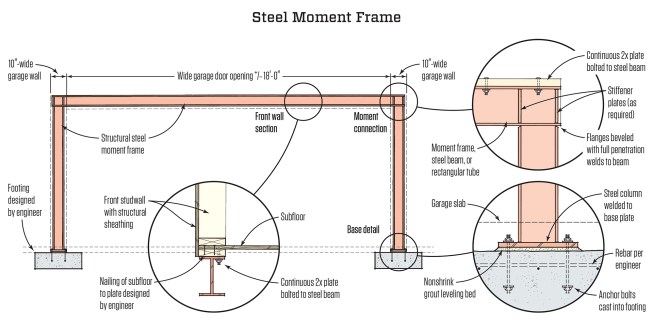
A moment frame can be used to provide shear strength for narrow-walled structures when standard framing solutions are inadequate. In all cases, beam and column sizes and connection details need to be designed by a structural engineer. (Illustration updated 2022)
Early collaboration between architect and engineer to establish key firewall details and identify opportunities for lateral bracing can head off these kinds of structural problems. If the architect is relatively flexible early on, an engineer can ensure that the building is not.But if — as in this case — the problem must be solved after the plans are set (or worse, after construction is well under way), the solution is likely to be complex and expensive.
Narrow Shear-Wall Solution
3 MIN READ
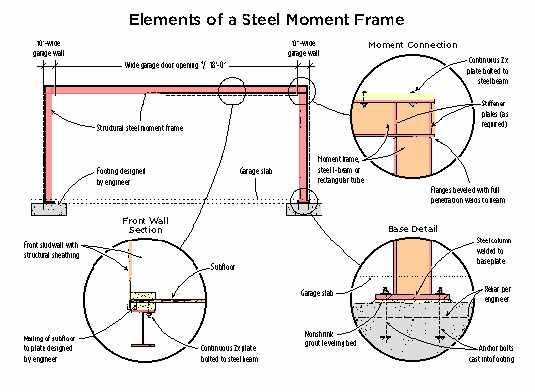
A moment frame can be used to provide shear strength for narrow-walled structures when standard framing solutions are inadequate. In all cases, beam and column sizes and connection details need to be designed by a structural engineer.