Q. When I’m laying out the seat and heel cuts on a rafter, how large should the notch be?
A. Tim Uhler, a lead framer for Pioneer Builders in Port Orchard, Wash., responds: According to the IRC, rafters and ceiling joists need to have at least 1-1/2 inches of bearing when supported by wood or metal (R802.6, 2006 IRC). [Editor’s note: This bearing size remains in each version of the IRC through 2024.] While this clearly establishes the horizontal seat cut’s minimum length, its maximum length varies according to the size of the rafter and the pitch of the roof.
For example, the IRC allows the ends of rafters to be notched as much as one-fourth their depth (R802.7.1), but on a shallow-pitched roof, this can result in a seat cut that’s wider than the top plate. When that happens, roof loads are carried by the toe rather than the heel of the rafter, reducing the rafter’s bearing capacity and increasing chances that the rafter will split (see illustration below). Instead, the seat cut should be no wider than the width of the plate.
Click to enlarge image below.
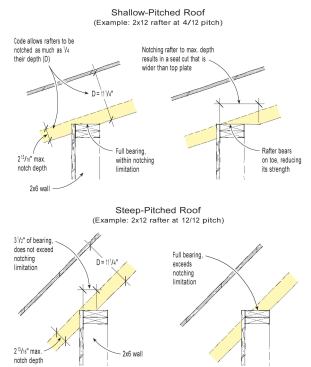
But using the width of the top plate to determine the length of the seat cut can also get you in trouble; as the roof pitch increases, so does the likelihood of overnotching.
To illustrate, a 2×12 rafter that meets the IRC’s D/4 notching limitation cannot have a notch deeper than 2-13/16 inches (11-1/4 divided by 4). This isn’t a problem on a roof with a shallow 4/12 pitch, since the seat cut could be as long as 8 7/8 inches. But for a 2×12 rafter on a roof with a steeper 12/12 pitch, the seat cut can be no longer than 4 inches before the D/4 limitation is exceeded. If the rafter is cut for full bearing on a 2×6 wall, the resulting notch would be deeper than 2-13/16 inches.
Keep in mind that even if your rafter stock is sized larger than it needs to be for its span, you still shouldn’t overnotch. This is because larger knots are allowed in 2x10s and 2x12s than in 2x6s and 2x8s; overnotching a large rafter voids the grade stamp and may compromise the stock’s structural integrity.
To simplify matters, I use the cutting capacity of my 10-1/4-inch Big Foot saw (702/565-9954, www.bigfootsaws.com) to help determine the size of the birdsmouth. I typically gang cut my rafters and, 90 percent of the time, I set the saw to 3 inches to make the seat cut for both 2×10 and 2×12 rafters.
I’ve found that making a 2-1/2- to 3-1/2-inch seat cut (depending on the rafter stock and the slope of the roof) seems to work better than trying to match the seat cut to the width of the plate, because I don’t have to worry about whether my birdsmouth cuts weaken the rafter.