
Q: Is it necessary to place splices in built-up lumber beams directly above the support posts?
A: Christopher DeBlois, PE, a structural engineer and principal at CFD Structural Engineering in Roswell, Ga., responds: The easy answer to this question is Yes, but it’s not entirely true. What is true is that you can’t run into trouble locating all splices directly over support posts.
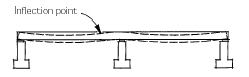
In reality, the most efficient location for splices is at points of inflection. The sketch below shows the expected deflection of a uniformly loaded beam without any splices spanning from wall to wall across a center post. Note how the beam sags near the centers of the spans, while the deflection curve turns upward over the post. The points where the curvature of the beam transitions from concave down over the post to concave up between the posts are the inflection points. At those points, stresses in the wood due to bending are lowest — in fact, they are zero. Unfortunately, shear stresses won’t be zero at these points, so if you spliced all the members of a built-up lumber beam at inflection points, you would still need some type of steel or wood shear plates nailed or bolted across the splice to transfer the loads from one section of beam to the next. That’s a trick that’s common in commercial steel construction, but that becomes a pain for wood framing.
A second problem is that wood beams aren’t flexible enough to see the shape of the curvature and reveal the inflection points; their locations must be calculated. Since the location of each inflection point depends on the relative length of adjacent spans, the number of spans, and the variations in load along the beam, there is no easy rule of thumb for locating the inflection points and hence the best location for splices.
So my suggestion is to take the safe route and set all your splices in multiple span built-up beams directly over the posts.


