
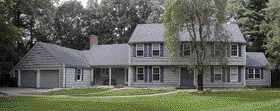
We were three months into a whole-house makeover, installing new windows, doors, exterior trim, roofing, and siding, when the homeowner, a tall man, asked if there was any way we could improve on the low, 7-foot-6-inch ceiling height throughout the house. My first reaction: No way. But the more I thought about it, the more feasible it seemed. We were already installing all-new interior window and exterior door trim, which meant that all the rooms required header adjustments, plaster patching and painting, and so on. The kitchen and baths also were being updated, with new cabinets, fixtures, and finishes. All the carpeting was going to be replaced and the wood floors sanded and refinished. Most of the work involved was already factored into the budget.
It occurred to me that if ever a house was a candidate for increased ceiling height, it was this one, a two-story, 3,800-square-foot garrison colonial. Cutting and extending the hvac ducts seemed simple enough, as did the plumbing — just cut the pipes and solder on extensions. The real issue would be with the wiring, which I knew in many cases crossed over the ceiling between walls above and below. With no code-approved method of splicing wires available, it was obvious that the entire house would have to be rewired.
I sought advice from several building movers on lifting the structure, then developed a revised plan and cost for the project that my client accepted. He and his wife had already intended to move out at some point in the original process, but this new plan meant the move would have to happen as soon as possible. We leased two large steel storage containers and placed them on the property to temporarily house the furniture and salvaged fixtures, and within three weeks began to prep the house for the first stage of the vertical stretch — lifting the main roof.
Preparing to Lift
Raising the ceiling joists and rafters above the second floor of the main part of the house would be simpler than other parts of the process and therefore seemed like a good place to start. There was less weight to consider, assuming a standard dead load of 15 pounds per square foot, and not so great a change in elevation — 9 1/2 inches vs. the 15-inch increase we’d determined for the first-floor ceilings. I chose this specific height increase for two reasons: It was proportionate to the smaller upstairs bedrooms, and it could be accomplished simply, by inserting a 3 1/2-by-9 1/2-inch engineered beam along the entire top plate of the house. Not only would that give us a uniform height, but the LVL (laminated veneer lumber) beam would also help to straighten the tops of the walls, which weren’t all that straight to start.
We began by removing a 12-inch-high strip of plaster at the top of all the second-floor walls. We then drove a flat bar between the two 2×4 top plates and cut the nails with a recip saw. This left the ceiling joists, rafters, and top-plate assembly intact, saving time and maintaining structural integrity.
Other prep work included cutting back the framing around the existing large central chimney, which served three fireplaces below. We removed the lead flashing and the original headers, which were embedded in mortar, framed tight to the bricks in the days before codes required chimney clearances. We reframed a new code-compliant opening for the chimney, allowing a minimum 2-inch clearance between the masonry and the headed-off rafters. We planned to lift the roof from underneath the ceiling joists, working from inside the second floor. The 2×8 joists were solidly hand-nailed to the rafters and toenailed to the top plate. They were also strapped with 1x3s on 16-inch centers, a typical framing detail in our region, and still covered with plaster board, making rollovers during lifting highly unlikely. To make sure they’d lift intact with the roof, we reinforced the gable-end walls with diagonal cross-bracing down from the ridge to the wall plates. We set up three rows of 4×10 Douglas fir lifting beams under the ceiling joists — at the front of the house, at midspan parallel to the bearing wall, and at the rear. That way, the roof and joists would remain supported during lifting, similar to the way they were supported in the original structure.
A major concern was making sure that the roof would stay square, plumb, and aligned over the top plates during lifting. If it was not carefully restrained, we could have trouble placing the raised section back where it belonged. We solved the problem by through-bolting 2x4s vertically to the tops of the exterior walls around the entire perimeter of the house. We notched the overhanging roof sheathing directly above to provide slots for the 2x4s, so that they’d trap the roof above the walls and keep it from twisting in the wind or wracking out of alignment during the jacking.
The second-floor footprint measured only about 45 by 28 feet, so we were able to handle this part of the work using my own crew, which, including me, numbered seven guys. We had two dozen 20-ton screw jacks on hand for the lift. I bought most of the jacks for this job, thinking they’d be a lot safer than bottle-type hydraulic jacks that could leak fluid and fail in the middle of the lift. I got them for about $129 each from Toolhauz in Needham, Mass., a great independent tool store. The jacks provided a maximum lift of 10 inches, just right for this stage.
The lifting beams consisted of three 16-foot 4x10s each, overlapped at the ends and supported on approximately 7-foot centers by the jacks. This spacing was close to the standard for column spacing under a main floor girt, which is typically calculated for a 40-psf dead load. We’d be lifting less than half that weight.
One of the early issues we had to decide was how to safely extend the reach of the screw jacks to the ceiling joists. My first thought was to place the jacks on the floor and use fir 4x4s or two 2x4s nailed together to prop under the 4×10 lift beams. But that presented a serious problem of stability — it would be easy for a post to kick out suddenly under a load, posing an unacceptable risk. We decided instead to build a quantity of structural pyramidal jack stands whose height could be supplemented as needed by stacking 4×4 cribbing under them. Some stands could serve as dead men, while others served as jack stations.
Pyramid stands. We made the stands by cutting 5-foot-long 2x8s at the requisite angle to taper from a 2-foot-square base at the bottom to a 1-foot-square top platform. We wrapped the sides, top, and bottom with 5/8-inch plywood and screwed it with 1 5/8-inch galvanized deck screws. As a final precaution, we wrapped a band of perforated, galvanized-steel strapping around the base about 8 inches up from the bottom and screwed through it into the studs with 2 1/2-inch galvanized deck screws. In the unlikely event one or more studs failed under load, we figured the band would help keep the base from spreading.
To carry the lifting loads through to the basement floor, we built temporary stud walls on the first floor and in the basement below each jack stand, perpendicular to the floor joists.
Don’t blow it. When lifting something as big as a house, you want to keep the wind in mind — the potential for the building to act like a sail could introduce big problems. In researching the job, I spoke with several professional home movers, all of whom emphasized the importance of avoiding wind on jacking day. Because it was midsummer, we didn’t have to wait long for a windless day. In breezy fall or spring weather, the wait factor could have become a more serious scheduling consideration.
Raising the Plates
With the LVL beams cut and ready for placement, we proceeded with the lift. The screw jacks allowed us to raise the roof in small, controlled increments. We started with three rotations of each screw — about 5/16 inch — across the front, then performed the same step at the middle and at the back. We repeated this sequence until we were able to set the beams on the lower top plate.
Toenailing to the top and bottom of the beam provided a quick and accurate means of aligning the plates, leaving them straighter than they had been originally.
To consolidate the new and the existing framing, we cut back the plywood exterior sheathing about 15 inches down from its top edge and inlaid new, 2-foot-wide sheathing with glue and nails, tying together the existing studs, lower top plate, and LVLs. On the inside, we used 66T T-strap galvanized connecting plates (Simpson Strong-Tie, 800/999-5099, www.strongtie.com) to tie the bottom of the beams to the tops of the walls, which would help prevent the beam from rolling under lateral wind loading or during a seismic event. The connecting plates caught the LVL beam along its bottom edge on 16-inch centers and were nailed into both the wall plate and the studs.
The second lift. Once we had the roof reattached, all the connectors installed, and the exterior plywood replaced, we moved our beams and jacks downstairs. To supplement my own crew of seven, we hired two more framing crews, Brendon Lynch Carpentry and Martel Construction. On the day of the second jacking, we had a total of 14 carpenters on the job.


