
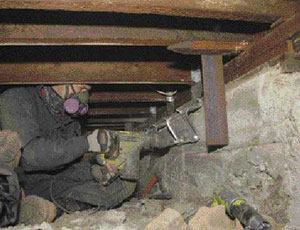
The Pacific coast of the United States is riddled with earthquake faults; sooner or later one of them will rupture with an intensity far greater than was experienced in the 1994 Northridge earthquake. That event caused more than $40 billion of property damage, half of which was due to failures of wood-framed structures.
The San Francisco Bay area, where I live, is threatened by a number of faults, including the Hayward Fault. The Association of Bay Area Governments predicts that a rupture of the Hayward Fault — with an expected magnitude of 7.2 or greater — will render 150,000 housing units uninhabitable. Other population centers on the West Coast face similar scenarios.
Earthquake retrofitting is the science of attaching a house to its foundation so that when it is violently shaken it remains standing. I started my seismic retrofit business in 1993 after a couple of stints doing residential earthquake damage assessments as a contract worker for FEMA.
The first was after the 1989 Loma Prieta quake, which caused 67 deaths and some $7 billion worth of damage in the San Francisco Bay area. The second was in 1992; I did assessments following the Ferndale earthquake on the far north coast of the state.
The Greatest Risk
The most interesting thing I learned doing inspections was how little shaking it takes to destroy or seriously damage a house that is poorly attached to the foundation, especially when it has cripple walls. In many cases, homes fell off their foundations and were damaged so badly they were uninhabitable. Houses that stayed on their foundations typically suffered little more than plaster and drywall cracks.
Cripple walls. Until about 1950, it was the style to build the first floor of West Coast homes a few feet off the foundation by supporting them with short studwalls called cripple walls. Nearly all the houses in the town where I live were built this way. It’s easy to tell: If there are more than two or three steps up to the entry door, the house probably has cripple walls. As originally built — with no plywood sheathing — older cripple walls have very little lateral strength, so a good shake can knock them down.
If you look at photos of houses where the cripple walls collapsed, you’ll see that frequently the house itself remains more or less intact. You might think it would take no great effort to lift a relatively intact house back onto the foundation. But when a house falls, it tears out the plumbing and gas connections, damages the wiring, racks walls out of square, and causes drywall and plaster to loosen or fall off. I’ve been in many homes where the fall caused cast-iron drain lines to punch up through the building, lifting toilets a couple of feet off the floor.
It’s very expensive to repair a fallen house. Frequently it costs nearly as much as building new.
In many houses, cripple walls and poor foundation connections are the weakest structural links; fix those deficiencies and the house has an excellent chance of surviving even a major earthquake. This doesn’t mean the house won’t benefit from strengthening the walls above a cripple wall — but the expense is high relative to the benefit.
A good seismic retrofit gives customers a lot of bang for the buck because the work is concentrated on the weakest part of the building — where the foundation is attached to the first floor.
The average retrofit costs $6,000, an amount many homeowners are willing to spend to protect their No. 1 investment. We have been retrofitting two homes a week in the Bay area for the past 11 years and always have a backlog of a few months’ work.
Building code. The work we do requires a building permit, but surprisingly, the building code offers little guidance on the proper way to retrofit a wood-frame home.
The topic is addressed by a single long sentence in Section 3403.2 of the Uniform Building Code. A building official once described the intent of the sentence as the “do no harm” policy, but admitted that in practice it sometimes becomes a “do no good” policy instead.
Currently, stamped engineered drawings are required if you apply for a permit and call the job a seismic retrofit. This nearly doubles the cost of a simple retrofit and discourages many homeowners from having the work done.
Many contractors get around this by not calling the work a seismic retrofit on the permit application. On these jobs, the homeowners often mistakenly think that the building department is checking to make sure the work will resist earthquakes. But in fact, the inspectors are checking only to see that the plywood and framing hardware are installed to code, not that they are installed in the quantity, size, and location required to resist earthquake forces.
Consequently, many of these homes have only partial — or no — protection from seismic forces.
To address problems in the code and make it more affordable to do the work, the city of Berkeley is currently developing the country’s first comprehensive seismic retrofit building code. It will be prescriptive, so if the project is simple, there will be no need to hire an engineer.
The Goal of Retrofitting
A single-story 1,000-square-foot house weighs about 50,000 pounds. When that much weight rocks back and forth on top of cripple walls, the cripple walls readily collapse.
Our goal in retrofitting a house is to connect it firmly to the foundation and stiffen the cripple walls by turning all or part of them into shear walls. That way, when an earthquake occurs, the lateral forces are transferred through the shear walls into the foundation.
Shear walls. In a wood-framed house, a shear wall is a studwall that’s connected to the foundation with anchor bolts, sheathed with plywood fastened in a tight nailing pattern, and tied to the floor above with shear transfer ties. All three components — foundation bolts, plywood sheathing, and shear transfer ties — must be there for the retrofit to work. If overturning forces are expected — or if the shear wall is tall relative to its width — hold-downs are added to this list.
The mudsill and bottom plate can be bolted to the foundation, but if the cripple walls aren’t sheathed with plywood, the walls can fail. The bolts and plywood can both be in place, but if the floor isn’t properly connected to the wall with shear transfer ties, it may slide sideways in a large earthquake.
How Strong Is Strong Enough?
The big questions are always “How many bolts, how much plywood, and how many shear transfer ties?” To determine the answers, it’s necessary to use a simple formula called the base shear formula, which is V = 0.185 x W.
“V” represents the shear force (measured in pounds) at the base of a building. The value “0.185” is the anticipated force of ground acceleration from a major earthquake in a particular geographic area. It’s based on proximity to known earthquake faults. You can find out the value for a particular location by calling a structural engineer.
“W” represents the weight of the building. Single-story homes weigh about 50 pounds per square foot. Two-story homes weigh about 80 pounds per square foot of first-floor area.
Designing a Solution
Here’s an example of how to design a retrofit for a house with cripple walls. Let’s say you’re dealing with a one-story house that’s 35 feet by 40 feet, or 1,400 square feet. If we multiply the area by 50 pounds per square foot, we find the building weighs 70,000 pounds. Plugging that number into the base shear formula tells us how much shear force is expected to strike the building at its base:
V = base shear force (horizontal to the base of the building)
V = 0.185 x weight of house
V = 0.185 x 70,000 pounds
V = 12,950 pounds
To simplify, let’s round the number up to 13,000 pounds. A properly designed retrofit for this home must resist at least 13,000 pounds of lateral force at each of the following places: where it sits on the foundation, against cripple walls, and where the floor connects to the cripple walls.
Shear Force at The Base of a Building
Overturning. In addition to resisting lateral shear forces, reinforced cripple walls must resist uplift forces at their ends. Engineers refer to this as overturning, the tendency of tall objects to tip over when you push against them. In an earthquake (or high wind), the house is pushed back and forth, which pulls up on the ends of shear walls. This is why hold-downs are typically installed at each end of a shear wall — to keep it from “overturning”.
The APA/Engineered Wood Association has tested various shear-wall assemblies and rated them for the amount of lateral force they can resist per lineal foot (plf) of length. These tests form the basis for shear-wall design in U.S. and Canadian building codes. A nominal 1/2-inch plywood shear wall edge-nailed 3 inches on-center with 8d nails has a shear rating of approximately 500 pounds plf.
To calculate the amount of uplift, you multiply the height of the wall (in feet) by the shear rating of the assembly (in pounds plf). The uplift on the end of a wall 8 feet high and rated for 500 pounds of shear will be 4,000 pounds (8 feet x 500 pounds plf).
Calculating uplift gets more complicated, however, because hold-downs must be sized to resist the “net uplift force,” which is uplift less the weight bearing down on the shear wall from above. Fortunately, overturning is rarely a major issue for cripple walls, because they are usually short and tend to slide rather than overturn.
Sliding of the cripple walls, as discussed earlier, can be prevented by installing anchor bolts.
What to Install
Based on our calculations, the house in our example will be attacked by 13,000 pounds of earthquake force in each direction. Retrofitting it will require the following actions.
Anchor bolts. To strengthen the connection between mudsill and foundation, we install anchor bolts. If a bolt is rated to resist 1,000 pounds of shear (its shear value), then we know it will take 13 bolts to protect the house in the north-south direction and 13 to protect it east-west. The bolts should be divided between opposing sides. Since you can’t install half a bolt, we would round up to 14 and install seven bolts on each side of the foundation wall.
Shear transfer ties. The same method is used to calculate the number of shear transfer ties needed to attach joists to the top plate of the cripple wall. We typically use Simpson H10R ties for this connection. Their shear value is shown in the column labeled 1.33/1.60 in the Simpson Strong-Tie catalog (www.strongtie.com). This particular column refers to short-duration lateral loads caused by wind and earthquakes. The H10R ties resist about 500 pounds of lateral force, so we would need 26 in each direction, or 13 per wall.
Plywood bracing. To brace the cripple walls, we typically sheath them with plywood from inside the crawlspace. If the shear-wall configuration (plywood and nailing pattern) is rated to resist 500 pounds plf, then we need 26 lineal feet of plywood on the east-west and north-south walls. Since this bracing is divided between opposing walls, each side gets 13 feet of plywood.
If the calculations showed net uplift from the overturning force, we would install a hold-down at each end of all shear walls. The strength of the hold-down is rarely an issue. The weak link is usually the old unreinforced concrete foundation; if the uplift force is large enough (more than 2,000 pounds) it may pull out the retrofit hold-down bolt, rendering it useless. One solution — an expensive one — is to shore up the building and replace that section of foundation, but it’s often simpler to pour a new footing beside the old one and install the hold-downs in it.
Anchor-bolt spacing. It’s a common mistake to space new anchor bolts evenly around the building. That approach is fine when joists land on the mudsill, but when you turn a cripple wall into a shear wall, those bolts need to be installed where the plywood panels are. We install them every 2 feet at shear-wall locations. The shear transfer ties can be anywhere along the wall; we install them near the plywood because we’re already working there.


