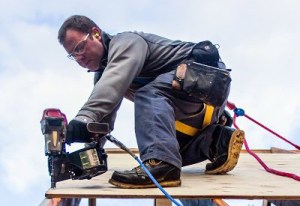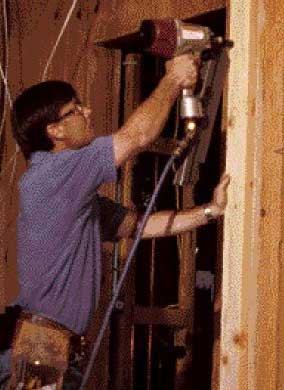
Pneumatic framing nailers have a big effect on the speed and quality of the work. Tasks that take forever with a hammer can be done in a fraction of the time with a framing gun. I run a framing crew on the Kitsap Peninsula, west of Seattle, Wash. Around here, everyone uses stick guns that take 20- to 22-degree plastic-collated full round-head nails.
For this article, my crew tested 11 round-head stick nailers from Bostitch, DeWalt, Duo-Fast, Hitachi, Makita, Max, Porter-Cable, Senco, and Spotnails. There were usually three or four of us on site, and we framed every day. I kept the guns in the back of my truck for a couple of months, and carpenters were free to use any gun they wanted. The information in this article is based on our collective experience with the tools. We all used every gun.
One thing we could not evaluate was durability. All the guns appear to be well made, but the only way to know for sure would be to use them till they started wearing out. There was no way to do that with 11 guns — by the time we finished, many would be out of date.
Power and Ergonomics
The first things I notice when I try a new gun are how much power it has, the amount of recoil, and whether it’s easy to lift and handle.
Power. A framing gun should drive fasteners all the way home, but the proliferation of engineered lumber has made it harder for guns to do this. We regularly use LVLs for ridges, hips, and valleys. Some of our older guns have trouble driving nails in engineered material, and that forces us to do something we hate — finish the job with a hammer. But none of the guns we tested had any trouble driving .131-inch fasteners, the size we normally use for framing. Several take fasteners up to .148 inch in diameter, and a few go up to .162 inch, which is a full 16d nail. The major difference in driving large versus small fasteners is that you can’t go quite as fast with bigger nails. We also felt more recoil when firing larger nails.
Recoil. None of the guns recoiled excessively, but some dampened the blow less than others. For example, three of the guns take 16d nails — the Bostitch, Makita, and Hitachi NR90AC2. They all have the power to sink those nails, but we could feel how hard the Bostitch gun was “hitting.” The vibration of the nail strike traveled up my arm, and it didn’t feel good. That didn’t happen with smaller fasteners, but you should be prepared for it if you use a lot of 16d nails.
DeWalt’s D51845 was exceptionally light, so we expected some recoil. There was none, but the crew agreed that it didn’t cushion the blow as well as other guns.
Weight and balance. Tools are easier to handle and cause less fatigue when they’re light and well balanced. I generally prefer light guns, but none of these was so heavy that it would scare me away from buying it. DeWalt’s was the lightest, and Hitachi’s NR90AC2 was the heaviest. But the Hitachi was so well balanced that it felt lighter than it was. Most of the tools felt reasonably well balanced, with the Max topping the list in this category.
Depth of Drive
We work in an active seismic zone, so the houses we build have plywood or OSB shear walls. Buildings must pass shear nailing inspections, and if too many fasteners are overdriven, the project will fail. That’s why it’s important to have a gun with a reliable, easy-to-use depth adjustment mechanism. Depth of drive is adjusted by changing the length of the contact element. In the past, this always required the use of tools, but now most guns can be adjusted without them. We much prefer toolless mechanisms: They make it easier to switch between nailing framing and shear, with no need to hunt for wrenches.
Mechanisms. Bostitch and DeWalt use a push-button release to change depth of drive.
The Max, Porter-Cable, Senco 702XP, and both Hitachi guns rely on nose-mounted thumbwheels. Makita uses a thumbwheel, too, but it’s mounted next to the trigger. All of those mechanisms will do the job. The thumbwheel type has more throw but is also more likely to stick. The push-button type doesn’t stick but is limited to a set number of indexed positions.
The Spotnails gun does not come with an adjustable depth of drive, but it can be equipped with an optional flush drive attachment. The Duo-Fast and Senco 602 still require the use of tools.
Magazines
The guns we tested will hold two strips of nails. Some tools hold slightly more, but it’s more trouble than it’s worth to break a strip of nails to top off the load.
Top vs. rear loading. Some magazines load from the top, others from the rear. Both types are easy to load, but the top-loading magazines are easier to unload. We change nail sizes a lot, so we strongly prefer top-loading tools. To load, you pull back the pusher and drop in the fasteners. To unload, you pull back the pusher, tip the gun upside down, and the nails fall out. It’s harder to get nails out of a rear-loading model. It’s no big deal, but it is aggravating when you’re in a hurry.
We had trouble with some of the rear-loading magazines. The Hitachi NR90AC2 worked fine with large nails but tended to jam when we loaded 8d fasteners. The problem occurred because the back strip sometimes lapped onto the strip ahead of it. We liked this gun for framing, but the jams were so aggravating that we stopped using it on sheathing. The magazine on Senco’s 702XP also tended to jam but nowhere near as often as the NR90AC2. We had trouble with the pusher on the Makita gun. It rains a lot around here, and when the tool got wet, the pusher sometimes stuck when we pulled it back to reload.
Firing Modes
Most nail guns can be operated in sequential or contact trip modes. With contact trip, you hold down the trigger and fire nails by pressing the contact element into the work. Contact trip allows you to bump-fire, which is the fastest way to drive nails. Sequential trip is safer, because it limits you to firing single shots: The trigger has to be released after each shot is fired. All the carpenters I know hate sequential trip, and the guys on my crew never use it.
With some guns, you have to remove and replace the trigger to change firing modes. This is true of the guns from Bostitch, DeWalt, Max, Senco, and Spotnails. It’s not difficult to swap triggers, but if you’re like most carpenters, you’ll install the one for contact trip and never take it off. Some manufacturers make it easier to go back and forth between modes. Makita, Porter-Cable, and Hitachi equipped their guns with mechanisms that allow you to change modes by activating a switch. Max’s gun has an additional safety feature, an anti-double-fire mechanism. You can still bump-fire, but if you depress the nose before firing, the gun won’t drive a second nail until you release the trigger and squeeze it again.
Additional Features
Most of these guns share the same basic features, but some models have a little extra. For example, the Max is equipped with a swivel fitting that plugs into the hose. I like it because it prevents the hose from kinking.
The Makita, Max, and Hitachi NR90AC2 have built-in air filters, which extend the life of the tool by keeping dust and dirt from getting inside.
Every gun except the Bostitch, Spotnails, and Hitachi NR83A2 has an anti-dry-firing mechanism to prevent it from being fired when the magazine is empty. Besides being bad for the gun, firing on empty may cause you to accidentally underfasten something.
Many of these guns come with nonmarring plastic tips. A tip can be installed over the end of the contact element to keep the barbs from damaging your work. My crew does very little trim, so that feature wasn’t important to us.
Rafter hook. A rafter hook may sound like a minor feature, but if you ask me, every nailer should have one. A hook makes it safer and easier to nail rafters, roll joists, and work off a ladder because you can hang up the gun when you’re not using it. You’re safer because it frees a hand, and the tool is less likely to fall and hit someone or break. DeWalt’s gun has a large plastic hook on the end of the grip. The hook rotates so you can fold it out of the way. Senco’s 702XP has a metal hook that folds out from the side of the magazine. Neither of these guns was the overall favorite, but we liked the hooks so much that we always used either the DeWalt or the Senco 702XP when we worked up high.
| | |
| |
Our Favorites
Hitachi’s NR83A and Max’s SN890-RH were clear favorites. I’d be happy to own either one. The NR83A2 is nearly identical to the older NR83A, a gun that has proven to be durable and is very popular in our area. The new model is well balanced and absorbs recoil, so it’s comfortable to handle. It has plenty of power, and we appreciated the recently added toolless depth-of-drive mechanism.
Max’s SN890-RH exudes quality. Because it’s well balanced, it feels lighter than it is. It dampens recoil, so it’s comfortable to use, and has added features that we liked, such as the built-in air filter and swivel fitting. It rarely jammed and consistently set nails to the proper depth in sheathing.
If we had to choose a second pair of guns, we’d pick Makita’s AN922 and DeWalt’s D51845. The AN922 operates smoothly and reliably sets 8d nails to the proper depth. It did a good job toe-nailing and had plenty of power. We liked it in spite of its rear-loading magazine. DeWalt’s gun is extremely light and has some very good features. Depth of drive is easy to set, and the magazine pops off to clear jammed fasteners. We wished the gun absorbed the shock of firing better but were willing to overlook that problem because we loved its rafter hook.
Tim Uhler is lead framer for Pioneer Builders Inc. in Port Orchard, Wash.
| Manufacturers | |
Bostitch (Stanley Fastening Systems) East Greenwich, R.I. 800/556-6696 DeWalt Industrial Tool Baltimore, Md. 800/433-9258 Duo-Fast Corp. Elgin, Ill. 888/386-3278 Hitachi Power Tools Norcross, Ga. 800/829-4752 | Makita USA La Mirada, Calif. 800/462-5482 Max USA Corp. Mineola, N.Y. 800/223-4293 Porter-Cable Jackson, Tenn. 800/487-8665 Senco Products Inc. Cincinnati, Ohio 800/543-4596 Spotnails Rolling Meadows, Ill. 800/873-2239 |
See Next page for Reviewer’s Comments and tool specs.