
Q. When people refer to the dewpoint in a wall assembly, are they talking about a location or a temperature? How is the dewpoint calculated?
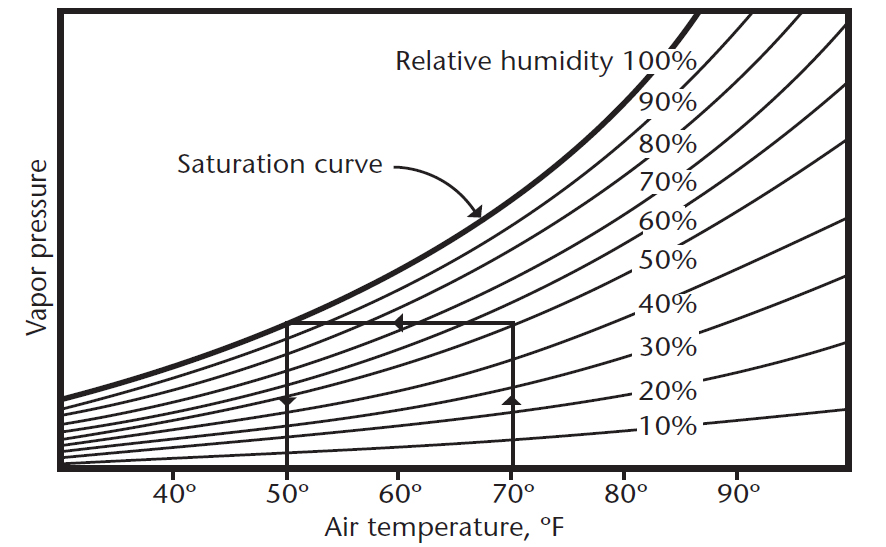
A. Energy and sustainable design consultant Andy Shapiro responds: The dewpoint is not a location; it is the temperature at which water will condense out of the air. Since the dewpoint changes with the amount of humidity in the air, as well as the air temperature, the dewpoint for a particular temperature and relative humidity is best looked up in a table or a psychrometric chart (see below).
Water from the air will condense on building components when they are below the dewpoint of the air that’s in contact with them. Cold water pipes in hot, humid summers condense water and drip. Uninsulated basement floors in hot, humid summers are often below the dewpoint of the hot, moist outside air, so water condenses on them if the space is open to the outside. In an air-conditioned building in a warm, moist climate like the southeastern U.S., the drywall can be below the dewpoint of the outside air for months on end.
Just because a building component is below the dewpoint doesn’t mean there will be a problem. Vinyl window frames and copper tubing aren’t bothered by a little moisture. On the other hand, wood window components and drywall can’t handle much moisture, especially if the wetting is prolonged and there is no opportunity for the components to dry out.
Determining whether a component in a wall assembly will ever get cold enough to permit condensation — that is, be below the dewpoint — can be complicated. If each element of a wall acted as a solid (which fiberglass doesn’t), then the calculation of the temperature at any point in the wall assembly would be fairly easy. Halfway through the insulation value of the wall, the temperature would be halfway between inside and out.
In reality, such static calculations can be misleading, since wall materials can absorb some moisture without being damaged. More accurate calculations, called dynamic calculations, take into account many additional factors but are so complex that they are best performed with computer software.
The good news is that this type of dynamic calculation is usually not needed — as long as builders employ good building practices that keep inside air out of walls in cold climates and outside air out of walls in cooling climates, and allow building components that occasionally get damp to dry out. One very good source for building details that avoid moisture damage is the Builder’s Guide series from Building Science Corp. (978/589- 5100; www.buildingscience.com).


