Like most carpenters, I learned to cope trim the traditional way, with a coping saw, a file, and sandpaper. But getting tight fits for intricate oak trim took forever, so I switched to a jigsaw fitted with the Collins Coping Foot (www.collinstool.com). This was faster, but I still had to use sandpaper and files — especially on corners and tight radii.
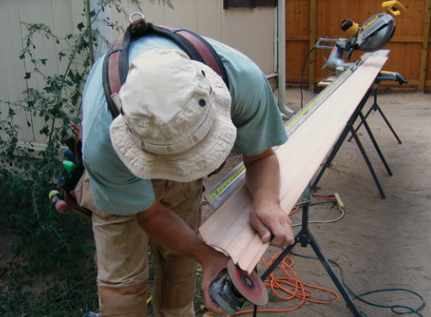
Then, two years ago, I saw a stair builder use an angle grinder fitted with a sanding disk to scribe treads. I immediately adopted his scribing technique and applied it to coping trim. With the angle grinder, I could avoid using files except on profiles with very tight radii. And after some experimentation, I found that if I used a pneumatic die grinder along with the angle grinder, I could quickly and accurately cope almost any profile — even ones with tight radii — without using sandpaper or files.
Tools and Supplies
When coping trim, it’s best to use an angle grinder that runs very smoothly. I use a 4 1/2-inch Metabo WE 14-125 Plus, a solid, vibration-free model that allows me to grind with precision. It’s a powerful, durable tool that I use not only for coping and scribing, but also for many rougher tasks.
Before you can cope, you must remove the guard from the grinder and install a 4-inch or 4 1/2-inch sanding disk kit — a $10 item at most hardware stores. If you’re fortunate enough to have two angle grinders, you can use two different grits of paper — 24 grit for rapid stock removal and 50 grit for finer work. Otherwise, use just the 50-grit paper; switching grits for each piece takes too much time.
Die grinders consume a lot of air — much more than nail guns — so be sure to use a small one that won’t overwhelm the compressor. I have an MSI-Pro 10029 gearless angle die grinder, a light model that consumes about 4 cfm. Since that’s more than a small compressor can comfortably handle except in short bursts, I use my 8-cfm wheelbarrow compressor if I have a lot of coping to do. Even then, the compressor has to run a lot to keep up.
Die grinders accept a variety of bits; I like to use a fine-tooth Kutzall tungsten carbide wood-carving burr (Oliver Corp., www.olivercorp.com) with a 1/4-inch shank. It has a long tapered head, which lets me grind the trim’s entire thickness even when I’m doing a steep back cut.
Getting Started
Because grinders generate a lot of dust, I try to set up outside — but I’ve also worked successfully in well-ventilated indoor areas. Some people prefer to wear a respirator when using these tools.
To begin, bevel the end of the stock with a miter saw, then highlight the cut line by rubbing the edge of a pencil along it. If the trim has a long, straight profile — as some baseboard does — set the miter saw to a slight back bevel and cut off the straight part. Remove as much material as you can without going beyond the cut line.
Grinding the Cope
To cope the curved part, hold the piece face-up on a bench and cut toward the cope line with a grinder. Always start with the disk — or burr — in contact with the back of the trim and then rock it forward toward the face. This makes for better control because there’s more resistance when you’re cutting through the entire thickness of the trim as you approach the face.
With the coarse disk in place (if you’re using one), rapidly remove wood until you are close to — but not touching — the pencil line. If there are any tight curves — radii of less than 3/4 inch — notch them out with the edge of the disk. Start at the deepest part of the curve and work slowly toward the edges.
Up to this point, you can be pretty fast and loose with the grinder without getting into trouble. Now, though, you want to come right up to the line — so you need to be much more careful and controlled. Switch to the finer grit disk and, starting from the back, gently roll the spinning disk up toward the face, tilting the grinder as necessary to follow the contour of the cut line.
With complex profiles, be sure to pay attention to the entire disk. It should contact the trim at a single point; if you aren’t careful, it may hit somewhere else and accidentally remove material you didn’t want to lose.
Tight curves. If the molding has sharp radii, use the angled die grinder to carefully spin the narrow part of the burr around the curve. I like to vary the speed of the grinder: fast at first to rough out the bulk of the material, and then slow for the delicate final cuts. Avoid letting the burr contact too much of the arc at once; the additional friction might cause it to catch and jump out of control.
As you enlarge the curve, you can bring the burr up higher so that the wider diameter part of it comes into contact with the wood. You can also use the die grinder to touch up areas you originally cut with the angle grinder.
Back cutting. Once the cope is cut to the line, it’s time to test-fit your work. With crown you usually need to do some extreme back cutting to get the joint to fit. It’s easier to do this with a grinder than with a saw. If you hold the grinder so the disk (or burr) is nearly parallel to the back of the trim, you can remove a lot of wood from behind the face without coming into contact with the coped line — thus preserving the shape while getting rid of unwanted material.
I like to leave a little edge at the top of my baseboard or at the bottom of crown and notch a triangle out of the noncoped pieces. I do this to make it appear as though the joint were mitered rather than butted together.
Final Notes
Die grinders are very good for coping hardwood trim, but they work on other materials, too. When grinding soft material like poplar, pine, and MDF, I switch from the fine Kutzall burr I use for hardwoods to either a coarser Kutzall burr or a standard solid carbide metalworkers’ burr; the fine burr tends to clog up and burn with softer woods.
Because I like to get as much use as possible out of my sanding disks, they’re usually so clogged and worn toward the end that they burn the wood a bit. This isn’t a problem for me because the burn marks are on the back of the trim where no one can see them — but the smoke can be irritating to breathe.
Using grinders to cope trim has required one alteration to my normal habits: I drink a little less coffee on days when I’ll be coping, because the grinder technique works best with steady hands. Also, this is one construction activity that I wouldn’t attempt without safety glasses and earplugs.
Chris Kennel works for City Side Remodeling in Denver.