
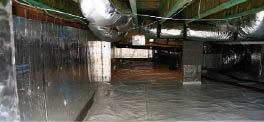
While studies have shown that properly built unvented crawlspaces stay much drier than vented crawlspaces in mixed-humid climates, questions remain about their suitability and energy use in other parts of the country. To get some answers, researchers from Advanced Energy — a Raleigh, N.C.–based nonprofit research and testing company under contract with the U.S. Department of Energy — recently monitored two sets of new homes in two different climates: a 15-home modular housing development in hot, humid Baton Rouge, La., and 12 stick-framed homes in cold, dry Flagstaff, Ariz.
At each site, four control homes were built with locally code-compliant vented crawlspaces. In Baton Rouge, hvac ductwork was located in the attic of the control homes; in Flagstaff, it was put in the crawlspace. Researchers measured crawlspace humidity and energy use in both the test homes and the control homes for more than a year in Baton Rouge and for a five-month heating season in Flagstaff.
Testing procedure. The homes were built by regular production crews, but trained technicians sealed up the unvented crawlspaces according to guidelines developed by Advanced Energy (see “Building a Sealed Crawlspace,” 10/03). After sealing gaps and penetrations, they covered the floors and walls with polyethylene vapor retarders, sealed the floor liners to the wall liners, then installed insulation and monitoring equipment.
In Baton Rouge, seven of the homes were built with R-8 Thermax foam board on the foundation walls. In three of those houses, the ductwork was located in the crawlspace; in the other four it was put in the attic. Four homes were built with R-19 fiberglass batts between the floor joists; their ductwork was in the attic. Each unvented home had a small supply duct that delivered conditioned air to the crawlspace whenever the hvac system was running.
In the Flagstaff homes, ductwork was located in the crawlspace. Four homes were built with R-30 fiberglass batts between the floor joists, and another four were built with R-13 Thermax foam board on the foundation walls.
Lower humidity, but not necessarily greater efficiency. In Baton Rouge, researchers discovered that the average daily relative humidity (RH) in closed crawlspaces barely topped 60 percent, even in summer, while in the vented control crawlspaces the RH often exceeded 80 percent.
In Flagstaff, the RH in crawlspaces in the control homes was less than 70 percent — but the sealed crawlspaces stayed even drier, with an RH that never exceeded 50 percent.
Moisture reduction is the main reason to seal up a crawlspace, and these results were consistent with past studies. But researchers also expected that sealing up the crawlspaces would result in across-the-board energy savings. It didn’t. In Flagstaff, for example, homes with insulated floors used 20 percent less natural gas than the controls did during a single heating season, but those with insulated foundation walls used 53 percent more. According to Cyrus Dastur, the Advanced Energy building scientist who directed the research, the lack of floor insulation allowed heat to radiate from the first floor to the crawlspace, robbing more heat from the house than was saved by keeping the ductwork warm. The study’s findings suggest that, in a cold climate, it’s better to insulate the floor above a closed crawlspace than to insulate the foundation walls — even if the ductwork is located in the crawlspace.
To save energy, closed crawlspaces in warm climates should have insulation installed on the walls; in cold climates, the insulation should be placed in the floor system, even when ductwork is located in the crawlspace.
Energy savings varied in Baton Rouge as well, ranging from a 6 percent savings for wall-insulated crawlspaces with supply ducts in the crawlspace to a 29 percent penalty for floor-insulated crawlspaces with supply ducts in the attic. Researchers believe that homeowner behavior accounts for much of the variation, but the location of insulation and ductwork is also important. Among the homes with attic ducts, those with wall-insulated crawlspaces performed better in some months and those with floor-insulated crawlspaces did better in other months. But homes with ducts in wall-insulated closed crawlspaces used less energy all year, suggesting that energy performance in a hot climate is optimized by locating hvac ductwork in a wall-insulated closed crawlspace.
Radon worries. Because of the discovery of elevated radon levels, the Flagstaff study was terminated early and the closed crawlspaces were revented. Dastur — like the EPA — recommends testing for radon in all homes. Where there is a known radon risk, builders should follow the EPA’s radon-ready guidelines. If testing indicates elevated radon levels after a closed crawlspace has been completed, the appropriate exhaust fan can be added. For more information about closed crawlspaces and a full copy of the report, visit crawlspaces.org. — Andrew Wormer
Advanta Pulls the Plug on Credit Cards
Promising no annual fees, a fixed APR of 7.99 percent, and perks like free additional cards for employees, the Advanta small-business credit card advertised in the pages of JLC looked like a good deal to Holland, N.Y., contractor Joe Rauscher. Of course, like all card offers, this one came with some fine print: His rate rose to 9.99 percent when Rauscher activated his Advanta card in 2007, thanks to the cash-back reward option he selected. And even though Rauscher kept his account current, the company kept adjusting his APR, prompting him first to complain and then, earlier this year, to pay off the balance and stop using the card. Over the past several months, other JLC readers with Advanta cards have reported similar problems, including sudden rate increases on existing balances to as high as 27 percent. In mid-May, Advanta announced that it was shutting down its credit-card business altogether. A statement mailed to customers of the Spring House, Pa., company warned that May 30th was the cutoff date for all new transactions, including purchases, balance transfers, and automatic bill payments. According to the company’s Web site, cardholders won’t have to pay off their accounts immediately, but they do have to continue making payments over time as required by their card agreements. Since the company isn’t going out of business, it will continue offering online account management and customer service as it tries to collect on its debts and wait out the downturn.
Advanta, the nation’s 14th largest card issuer, reported a delinquency rate of over 11 percent in March and April, more than double the rate of a year ago. With a $76 million loss in the first quarter of 2009, it isn’t the only bank struggling with late payments, but Rauscher and other JLC readers say the company may have made its problems worse by jacking up rates and alienating its best customers. In fact, huge rate increases, excessive fees, retroactive rate hikes, and murky fine print have become standard practice in the credit-card industry, prompting Congress to pass new credit-card rules. Unfortunately for Advanta customers, the provisions in the recently signed Credit Card Accountability Responsibility & Disclosure Act won’t take effect until next year, and — for now — apply only to consumer accounts.
Advanta’s move will leave more than a million small-business account holders scrambling for new sources of credit, even as traditional lenders remain wary of taking on new debt. Contractors like Rauscher have come to rely on credit cards as an easy way to borrow, with some carrying multiple cards and issuing duplicates to their employees. In fact, David Robertson, publisher of the credit-card industry newsletter The Nilson Report, estimates that about 11 percent of all Visa and MasterCard purchases are now made with small-business credit cards, up from about 3 percent a decade ago. But unless Congress expands the credit-card reform laws to cover small businesses as well as consumers, contractors will need to be wary of opening any new accounts and pay very close attention to the fine print as they try to work their way out of this recession. — A.W.
Offcuts
A team of University of Michigan MBA students recently won MIT’s $200,000 Clean Energy prize for their patented process of converting rice husks into high-efficiency insulation panels. An agricultural waste product, rice husks are a low-cost source of silica, the basic ingredient used to make aerogel, an extremely low-density solid often used for spacecraft insulation. Husk Insulation, the students’ startup company, says its rigid vacuum-insulated panels are even more thermally efficient than aerogels, with R-values of 30 to 50 per inch. The company plans to target its first commercial efforts at the refrigeration industry; its Web site claims that replacing 4-inch polystyrene panels with Husk Insulation’s 1-inch-thick panels can boost refrigerator efficiency by up to 50 percent.
Sencorp, the parent company of Senco Products, recently reached a purchase agreement with an investor group led by Wynnchurch Capital as part of a Chapter 11 bankruptcy organization. The air tool and fastener manufacturer once employed more than 1,000 workers in two Ohio plants, but global competition and the housing downturn forced the company to slash employment and outsource much of its production overseas in recent years. Senco believes that the $41 million transaction, once approved, will allow it to restructure its debt without disrupting operations or customer service.
Bark beetles are devastating softwoods in the western United States, with a 95 percent kill rate reported in some lodge-pole pine forests. Entomologists estimate that more than 5 million acres of spruce, pine, and fir in Colorado, Wyoming, Utah, and New Mexico and 35 million acres of forest in western Canada will be decimated by the beetles over the next decade. Forest-management practices may be partly to blame, as mature stands of trees of a single species are more vulnerable than stands with a mix of species and age groups. Already battered by depressed lumber markets, the region’s remaining sawmills are now faced with a glut of nearly worthless bug-killed timber, useful only for the manufacture of wood pellets for heating stoves.
Moorish builders once used coatings made from powdered animal bones to protect their fortress walls. Archeologists recently confirmed this after discovering the remains of a high-temperature clay oven next to a pile of bone and ash while restoring a rampart not far from the Alhambra, a noted 14th century Moorish palace in southern Spain. Both the rampart walls and the oven contained trace amounts of hydroxyapatite, a mineral that is the main component of bone. Made mostly from pigs, the bone powder would have strengthened the wall’s coating better than any other substance available at the time, says Granada University geologist Carolina Cardell, who headed the research project.


