

This article is part of the Radiant Heating Skills Workbook.
Q. How much insulation is necessary under a typical radiant slab?
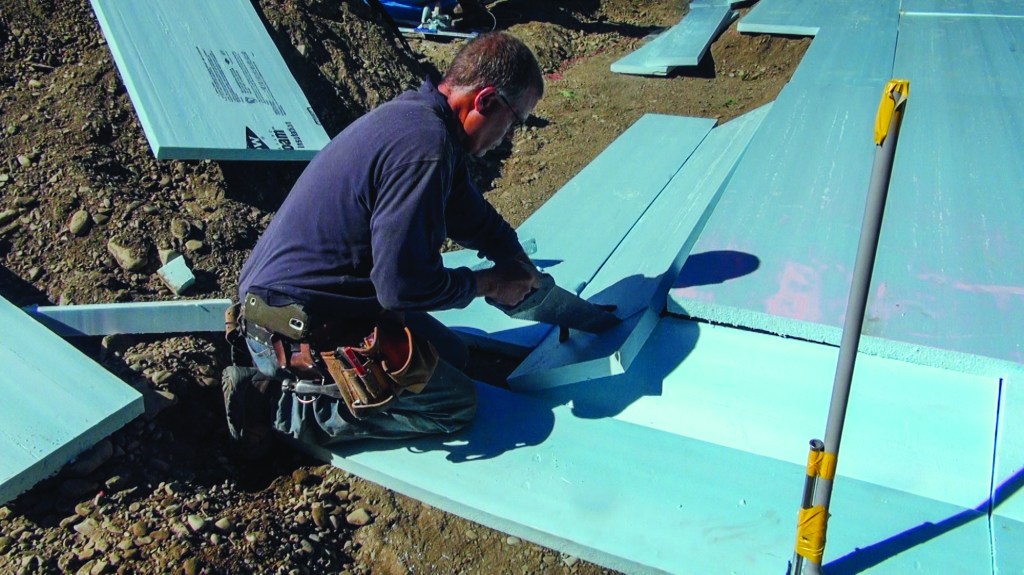
A. John Siegenthaler, a consulting engineer who specializes in hydronic-heating-system design, responds: Downward heat loss from a radiant slab should not exceed 10 percent of upward heat output, a ratio derived from European installation standards for floor heating systems. It’s possible to calculate the R-value needed to meet this goal while accounting for such factors as floor coverings, soil temperature, and required upward heat flux. But lately, I’ve begun simply specifying a minimum of 2-inch extruded polystyrene insulation under all heated slabs, even those in basements with no floor coverings. Here’s why:
In my area, the cost difference between 1-inch-thick and 2-inch-thick extruded polystyrene insulation board is currently about 48 cents per square foot. Using 2-inch rather than 1-inch extruded polystyrene adds about $720 [2009 prices] to the cost of insulating under a 1,500-square-foot slab.
To maintain a seasonal average slab temperature that is 10°F above the seasonal average soil temperature through a heating season lasting from October 1 through April 30, a slab insulated with 1 inch of foam would lose 7.1 million Btu more than a slab insulated with 2 inches of foam. Although the rates of downward heat loss from the slab differ by only about 0.93 Btu per hour per square foot, this difference translates into a lot of money over the course of the entire heating season.
Assuming heat was supplied from fuel oil purchased at $3.75 per gallon (a high price for 2009; for current average fuel oil prices, see the EIA ) and burned in a boiler with an AFUE of 85 percent (a very low AFUE), the savings associated with the thicker insulation would be $224 per year. That makes the simple payback on the 2-inch underslab insulation about 3.2 years, which far surpasses the economic returns associated with solar energy systems, wind turbines, and quite a few other more “newsworthy” energy alternatives. For more efficient boilers and either less expensive oil markets, or markets with a range of less expensive fuel options, the payback is even faster.
Be sure to check out the rest of the Radiant Heating Skills Workbook.


