
Q. After replacing both a condensate pan and a pump, the plumber fixing my client’s leaky air-conditioning coil finally determined that the problem was actually in the condensate drain. The drain’s small trap was clogged with a mucuslike substance; unclogging it was a simple repair that took just a few minutes, but (needlessly) replacing the pump and pan cost my client a couple of service visits. Is the trap really necessary or is it just a way for hvac installers to set up nuisance service calls?
A. Dave Yates, a plumbing contractor in York, Pa., responds: One way for corner-cutting hvac installers to avoid clogs — and eliminate altogether the expense of traps and condensate pumps — is to simply drill a hole in the concrete floor and drain the condensate directly into the stones under the slab. But this is a bad idea, for a couple of reasons.
First, instead of clogging the drain trap on its way to the condensate pump, the condensate will collect in the subslab. To get rid of it, a pro will need to come and pull the line, cement the hole shut, and — yes — install a condensate pump and trap.
Second, terminating an untrapped condensate line in the subslab zone creates a pathway for radon to be drawn into the air stream and delivered directly to the living quarters. Even if radon gas isn’t present, air streaming up through the A/C coil can — through a weak venturi effect — create a pressure differential that draws air in through the condensate drain and blocks condensate from flowing out. The condensate will overflow the drain pan and spill down onto the furnace heat exchanger, shortening its life considerably.
Because condensate drain traps often clog, a close inspection should be a routine part of an annual service agreement. It’s not hard to pinpoint problems in the condensate system: If the condensate pan under the coil is full, it’s not cracked. If the condensate pump is not overflowing, it’s either working properly or nothing is getting to it from the AC pan. To test the pump, pour enough liquid into the reservoir to trip its float switch and observe how well it pumps. If the pan is overflowing and the pump is working properly, the drain is clogged and must be cleared.
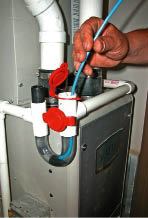
To make inspection and cleaning easier, we typically include an access point at (or near) the condensate trap. We also like to install condensate traps with clear see-through bends, an easy access port, and a flexible brush to facilitate cleaning, such as the EZ-Trap EZT-110 (see photo, 800-231-3345 RECTORSEAL.COM). Such traps cost about $17 compared with about $15 for a plain-Jane PVC trap.


