
When we first worked with ICFs, we — like most
contractors — used the foam forms only for foundations
and simple structures. Eventually, though, we began to build
entire houses with them.
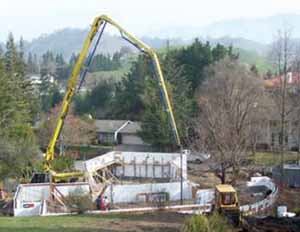
The Alamo, Calif., custom home featured here was such a
project. The plans called for curved walls with large arch-top
openings. Given that combination — curved walls and
arched windows — most builders would have chosen to
stick-frame. But the house was also designed to be extremely
energy-efficient, with triple-glazed windows, radiant-barrier
roof sheathing, a NiteBreeze ventilation system for cooling,
and vacuum-tube solar collectors backed up by on-demand water
heaters for hot water and hydronic heating. For all these
elements to work, the walls would have to be airtight and well
insulated — which made ICFs a good fit.
The house sits on a hill — two stories in front, and one
in back — with a crawlspace, garages, and mechanical
rooms below and a single level of living space above. The upper
floor is framed with I-joists attached to the ICF walls (see
illustration, below). The exterior finish is synthetic stucco
applied directly to the ICFs.
The home's foundation — a poured-concrete grade beam on
poured concrete piers — is typical for hillside
residences in this area. Because the piers are designed to
carry the weight of the house, the grade beams don't need to be
as wide as conventional footings; on this house, most are 12
inches wide. We took great care to lay out and form an accurate
foundation so we could install the ICFs flush to the outside
face of the grade beams. In the few places where the grade
beams were wider, we used the more standard method of
installing the blocks to snapped lines.
Stacking the Blocks
Our company uses Logix blocks (888/415-6449,
www.logixicf.com). Like
most brands of ICF, they're based on a 48-inch-long by
16-inch-high module and come in a variety of wall thicknesses.
On this job we used 11 1/2-inch blocks, which have a 6-inch
cavity flanked by 2 3/4-inch EPS foam.
When setting blocks, we start from corners and work toward the
center. Ideally, the length of every wall would be a multiple
of 48 inches so we wouldn't have to cut blocks. That almost
never happens, but we can usually limit cuts to one per course
(see Figure 1). The problem with cuts is that you lose the
tongue or groove that keys one block to the next, which leaves
a weak joint that might blow out during the pour. These joints
have to be reinforced, so we either glue them with canned spray
foam or screw a plywood gusset to the plastic webs in the
foam.
Figure 1. To minimize cutting, the crew
works from the corners toward the middle of the wall and fills
in the last piece. Here a carpenter trims (top) and installs
(bottom) the last block in a course.
Two at once. We lay the first two courses at once,
fastening the first course together with zip ties, snapping in
the horizontal rebar, then stacking the second course on top
and zip-tying it to the course below (Figure 2). This gives us
a long run of blocks that can be positioned and leveled as a
unit. We use a laser to check the wall for level, then shim or
trim the bottom edge as necessary. Once the wall sits straight
and level on the foundation, we glue it down with low-expansion
polyurethane foam.
Figure 2. The author prefers to fasten
the first two courses together (top), using zip ties (middle).
He then straightens and levels the two courses as a unit, which
he glues to the footing with spray foam (bottom).
Each successive course keys onto the one below and is secured
to it with zip ties. We install the horizontal rebar as we go,
according to the plans, and every few courses we put in "form
lock" — zigzag wire bracing that snaps into the plastic
webs and helps straighten and stiffen the forms. When the ICFs
reach the top of the vertical rebar — which starts at the
footing — we splice on new pieces with tie wires so that
the reinforcing is continuous to the top of the wall.

Curved walls. We considered special-ordering
curved ICFs for the home's 30-foot radius walls, but for budget
and schedule reasons ended up fashioning the curved blocks
ourselves, from straight ones. We followed a table in the Logix
manual that shows how to make various curves by shortening the
inside face of standard blocks.
By flexing the blocks slightly, we were able to get them to
follow the desired curve. Continuous bracing along the grade
beam — kerfed 2x10s — held the bottom course in
place; then each succeeding course mated with the nibs of the
one below (Figure 3). Considering that they were made from
straight blocks, the curves were surprisingly smooth. There
were a few lumps and bumps, but nothing we couldn't fix with a
belt sander.
Figure 3. The crew creates the curve by
cutting the inside faces of the block slightly shorter than the
outside faces and flexing the pieces into an arc. Kerfed 2x10
braces hold the bottom course in line with the grade
beam.
Fastening Ledgers
Floor joists in ICF buildings have traditionally hung from
ledgers fastened with cast-in anchor bolts. On this job, we
saved time by using Simpson's ICF ledger-connector hardware
(Figure 4). In accordance with this method, we inserted the
legs of an ICFVL wall plate through slots cut in the foam; the
concrete anchors the plate. To install the 2-by ledgers, we
placed them against the wall plates, lapped them with ICFVL-W
hangers, and drove structural screws through into the plates.
Hangers for LVL ledgers are also available, while light-gauge
steel ledgers can be screwed directly to the plate.


Figure 4. The upper floor hangs from
ledgers attached with Simpson hardware designed for ICFs. The
legs of the metal plate — punched so that they will key
into the concrete — are inserted into slots in the foam
(top), then the plate is fastened with a screw so it can't fall
out during the pour (bottom left). After the concrete cures,
the ledger is positioned against the wall and fastened to the
plate with structural screws driven through a special hanger
(bottom right).
We spaced the wall plates 32 inches apart, taking care to
locate them so that the ledger hangers wouldn't interfere with
the joist hangers.
Door and Window Openings
If the door and window openings in this house had been
rectangular, we could have used vinyl bucks. But because the
heads were arched, we built wooden bucks on site (Figure
5).
Figure 5. Carpenters plumb and brace the
buck for an arch-top window (top). The buck for the garage
opening is supported on a temporary stud wall; the
pressure-treated side jambs will remain in place for fastening
the overhead door tracks (bottom).
Often, door and window bucks can be left in place after the
pour. But the doors and windows in this house were inset
— and the exterior jambs finished with stucco — so
the bucks would have to be removed. To make this easier, we
fastened the bucks with metal framing angles and screws (Figure
6).
Figure 6. To make it easy to remove, this
window buck was assembled from the inside with framing angles
and screws. Note the sloped sill; the inspection holes allow
carpenters to verify that concrete has filled the blocks
below.
For the arch-top openings in curved walls, we made the bucks
straight but much thicker than the wall, to accommodate the
radius (Figure 7).
Figure 7. The arched bucks in curved walls
were made extra wide to accommodate the radius.
Bracing and Pouring
Solid bracing is of course key to a successful pour, because
wet concrete places a lot of pressure on the ICFs. We used the
standard adjustable metal bracing designed to hold staging
planks (Figure 8) and added wood bracing at those locations
where the connections were the weakest — at cut blocks,
for example, and at inside corners and the ends of walls. The
smaller bucks were faced with solid sheets of OSB and were
stiff enough to resist the force of wet concrete. The bucks in
the larger openings required additional vertical and horizontal
bracing.
Figure 8. In preparation for concrete, the
window bucks were reinforced with additional pieces of OSB and
the wall thoroughly braced.
We stacked and poured the walls in stages. The first stage
brought the walls to just above the main floor level. After a
week of curing time, we framed and sheathed the floor, and then
we formed and poured the rest of the way up.
Concrete. We used a 5-inch-slump five-sack mix
containing 3/8-inch pea gravel and 20 percent fly ash.
Normally, we wouldn't drop concrete more than 3 feet, but the
forms contained so much rebar the concrete more or less rolled
to the bottom. There wasn't room to use a tremie pipe. To avoid
blowouts we worked our way around the perimeter — placing
concrete in 3-foot lifts and vibrating as we went (Figure 9).
We drilled witness holes through the bottoms of the window
bucks so we could see whether the concrete had flowed
underneath; if need be, we inserted a rod through the holes to
move the concrete.
Figure 9. The amount of rebar in the ICFs
made it impossible to use a tremie pipe to place the concrete.
Instead, one worker handled the hose at the top of the wall and
another followed behind with the vibrator.
Plumbing and Electrical
ICF plumbing penetrations are simple: You can sleeve through
the form before the pour or drill through after. Drains and
vents of up to 2 inches in diameter will fit in a channel in
the side of the foam form; we cut the sides of the channel with
a recip saw and then rake out the foam with a pry bar.
Electrical wire is run in smaller channels, which we fill with
spray foam once the wire's in place. Electrical boxes can be
cut into the foam and screwed to the concrete. Logix ICFs are
ribbed on the inside; we've found that if we cut through the
foam and remove the concrete ribs with a cold chisel, a
standard electrical box will come out flush with the
drywall.
Exterior Finish
To keep the below-grade portions of the building dry, we
waterproofed the foundation with Tremproof 250 GC (Tremco,
800/321-7906,
www.tremcosealants.com),
then covered it with MiraDrain 2000 (Carlisle, 888/229-0199,
www.carlisle-ccw.com),
a polyethylene air-gap membrane that drains water away from the
wall.
Though ICF homes are often finished with lap siding, stucco is
preferred in our area. With ICFs, we use the same synthetic
stucco materials used with EIFS, which can be applied directly
to the foam without paper and lath.
Our plastering sub applied a base coat of Parflex 304 (Parex,
800/537-2739, www.parex.com)
with an embedded layer of fiberglass reinforcing mesh, followed
by a second coat of the base-coat material. The top coat was
Fino Alto (Variance Acrylic Finishes, 888/323-6404,
www.variancefinishes.com),
an integrally colored acrylic plaster.
Finally, to protect any areas of exposed foam between the top
of the waterproofing and the stucco, we parged with Thoroseal
(Thoro, 866/518-7171,
www.thoroproducts.com).
Victor Rasilla is a working supervisor for
Brinton Construction in San Leandro, Calif.

