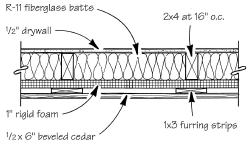
- Q. We were recently called in to make siding repairs on a five-year-old home. The wall system consisted of 1/2×6-inch beveled cedar siding fastened over 1-inch foil-faced polyisocyanurate foam, 2×4 studs with R-11 unfaced fiberglass batts, and an interior poly vapor barrier covered by 1/2-inch drywall.
The siding was cupped towards the interior of the building, and the stain originally applied to the siding was peeling off in many areas. When we removed the siding, there was no visible moisture on the back. What could have caused the siding to fail, and how can the problem be corrected? A.Henri de Marne responds: Siding applied directly over rigid insulated sheathing has a history of failures. The consensus seems to be that rigid-foam sheathing is so impermeable that moisture absorbed by the siding (from direct rainfall or “splash back” at horizontal surfaces) cannot be buffered by temporary absorption in the underlying wood framing elements. The rigid insulation also prevents the wall framing from absorbing any of the heat generated by exposure to direct sun.
Depending on the action of the rain, sun, and temperature, the siding cups as moisture is driven back and forth through the siding. In this case, the peeling of the latex stain indicates that a solid-color stain was used. The surface film of stain lifts off the siding when underlying moisture tries to escape by migrating through the surface of the siding.
Inward cupping results when the interior surface of the siding is drier than the exterior surface, and the back of any siding exposed to direct sun will often be “baked dry” when the foam sheathing blocks heat transfer to the underlying framing.
The first line of defense against these types of problems is to thoroughly back-prime the siding. Field-cut ends should also be coated with stain or preservative. The siding should be installed over furring strips, creating what is called a “rain screen” cladding system (see illustration, above). The resulting air space allows both heat and moisture to dissipate. This buffering effect can be increased by venting the air space at top and bottom.
Henri de Marne is a consultant in Waitsfield, Vt., specializing in moisture-related construction problems.
Rain Screen Siding
Q&A: Cupping Clapboards Over Foam Sheathing
Simple Standby Hot Water
2 MIN READ