- Q. As part of the gut remodel of a 1940 house near Houston, Texas, we installed 3/4-inch rigid foam over the exterior wall sheathing, followed by vinyl siding. On the interior, we exposed the 2×4 studs and installed fiberglass batts. Then we installed 1/2-inch foil-faced rigid foam followed by drywall. In that climate, will these “foam sandwich” walls trap moisture?
A.Joe Lstiburek, an engineer and principal with Building Science Corp. in Westford, Mass., responds: Installing a vapor barrier on both sides of a wall is never a good idea in any climate. In the Houston climate, a vapor barrier should be located on the exterior, so your choice of exterior foam sheathing was a good one. The concern is the foam sheathing you installed on the interior.
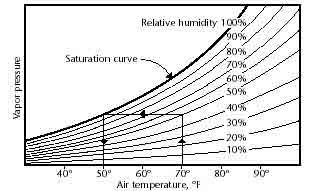
The good news is that because of the thermal resistance of the interior foam, the wall cavity will rarely be below the dewpoint temperature of the exterior air (see “Psychrometric Chart,” below). The bad news is that if moisture ever gets into the wall — say, due to a window leak or negative pressure caused by leaky attic ductwork — it won’t be able to get out easily.
Should you take the foam sheathing off of the inside? That’s a hard question. I say don’t. If possible, watch the walls over the next few years; each year, cut open a small hole in several spots and look. If you did a careful job with exterior rain control and window and duct installation, the walls probably won’t develop mold. If you get mold, you know what to do. But don’t build a wall this way again, okay?
A psychrometric chart provides the dewpoint for any given air temperature and relative humidity. Say you have a relative humidity of 50% at 70°F. On the horizontal scale, locate the air temperature and move up to the curve that represents 50% relative humidity. Then move left to the saturation curve and down to find the dewpoint — 50°F in this case.
Q&A: Double-Side Vapor Barrier
2 MIN READ