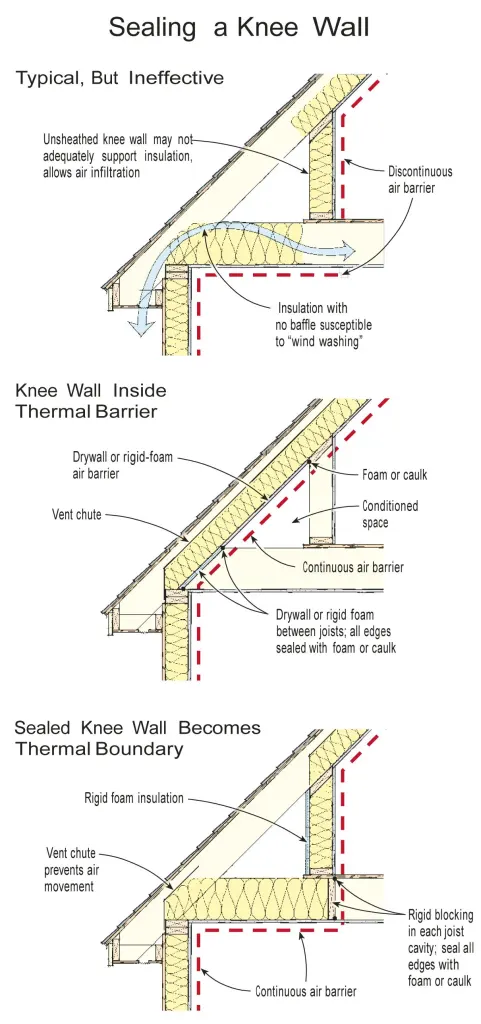
- Q. What’s the best way to insulate a knee wall?
A.Bruce Harley, technical director of Conservation Services Group in Westboro, Mass., and author of Insulate and Weatherize, responds: In this notoriously leaky and difficult-to-insulate area, both the insulation and the air barrier must be continuous to prevent outside air from moving freely through the knee wall and into the rest of the house. While fiberglass batt insulation is effective when installed properly, it won’t stop air infiltration, regardless of how much is added to the knee-wall cavity. Without a continuous air barrier, outside air can enter through soffit vents, wash through insulation, and flow through joist bays.
While it’s possible to insulate the knee wall and floor, I prefer to align the thermal boundary with the weather shell of the house by insulating the rafters, particularly if there’s mechanical equipment, ductwork, or storage in the knee-wall space. Sprayed urethane foam can be used to provide both insulation and air barrier; note that vent chutes may be required by some codes before the foam is installed. Foam is expensive, but in remodeling jobs or where there is a lot of knee-wall area with dormers and other complex geometry, the time and energy savings are well worth the investment.
Alternatively, after installing vent chutes and carefully insulating the rafters with properly sized fiberglass batts, a rigid or semirigid air barrier must be installed that is sealed from the top plate of the knee wall and down the rafters to the top plate of the first-floor exterior wall. You can make this air barrier using drywall or 1-inch rigid foam insulation, but I don’t recommend using poly. The tricky part is notching around the floor joists; it’s important to have a can of urethane foam or some caulking to seal this area carefully where the air barrier meets the floor framing. As a bonus, access doors into the conditioned space behind the knee wall won’t need insulation or weather stripping.
If you can’t get at the underside of the rafters, or if creating a continuous air barrier would be impractical (for example, with truss roof framing), then you’ll need to insulate the knee wall itself. In this case, after insulating the stud cavities with fiberglass batts, use 1-inch (minimum) rigid foam insulation to cover the back of the knee wall, which will prevent attic air from circulating around and through the insulation. Be sure to notch the rigid foam over the floor joists and run it all the way down to the drywall or plaster, or tuck separate 2-by or foam-board blocks between the joists to provide air stops in the joist bays, and seal all gaps with canned foam or caulking.
And, of course, insulate the floor of the space with plenty of loose-blown cellulose or two layers of fiberglass batts. Since the space behind the knee wall isn’t conditioned, you should insulate and weatherstrip access doors.
Insulating a Knee Wall
2 MIN READ