
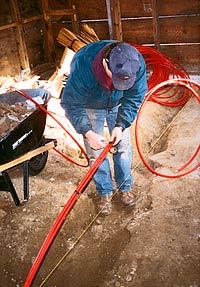
Hangers and Supports
PEX has to be supported every 2 to 3 feet on horizontal
runs, and every 4 to 5 feet on vertical runs. The common hanger
styles that are used to support copper tubing can be used for
PEX. However, because PEX is soft, we only use plastic or
plastic-coated hangers. Each manufacturer also sells special
clips and brackets as part of its system (Figure 6.
Figure
6. Various clips and supports are available from pipe
manufacturers to help support PEX runs (left). Where possible,
individual tubes should be bundled together for support and a
neat appearance (right).
PEX should be run with a little slack in the lines to allow
for linear expansion and contraction due to temperature
changes. Going from room temperature to 120°F can make a
hot water line grow by as much as 5% in length.
When we run lines, we try to "take the high road," running
our PEX on top of natural supports like framing and other
plumbing. A note of caution, however: Never run PEX above, or
anywhere near, high-temperature pipes like exhaust flues. The
tubing will soften and droop if it gets hot. Years ago, a
section of PEX tubing I ran too close to a hot flue sagged down
onto the flue pipe and melted right through. I’ve never
repeated that mistake.
By the same token, you can’t connect PEX directly to a
boiler or water heater. Most codes call for a 3-foot run of
copper at the water heater, or a 7-foot copper run at the
boiler, before switching to PEX.
Pros and Cons of PEX
PEX tubing comes in all standard nominal sizes (1/8 inch
through 2 inches). National plumbing codes mandate certain
minimum pipe sizes to each fixture or bathroom group, but they
also mandate maximum line pressures in pounds per square inch
(psi) and minimum flow rates in gallons per minute (gpm)
— after all, it’s the flow at the faucet that
really determines whether the customer’s needs are
met.
In this regard, manifold systems using PEX tubing often give
better service than copper systems, because they provide better
flow rates. The major difference in flow between equal runs of
PEX and copper comes when you add fittings to a copper pipe
layout to accommodate corners and bends — each fitting
reduces flow and pressure.
In calculating required pipe sizes for copper water supply
lines, plumbers use tables that account for numbers of joints
as well as lengths of run. In terms of flow restriction, each
copper elbow adds the equivalent of 10 linear feet to the
"developed length" of a run. Piping layouts with fittings
necessitate larger diameter pipes to provide the required
volume to the fixture. PEX has the same flow rate as copper
tubing per equivalent size and length, but because it easily
bends around obstacles and snakes through framing cavities, PEX
lines generally run all the way from the manifold to the
fixture with no joints, and thus less pressure drop or flow
reduction.
Even the straight joints that are needed to make long
straight runs with copper pipe can reduce the pressure and flow
in the pipe, if (as often happens) the ends of the pipe are not
properly reamed out before each joint is made: Resistance to
water flow really occurs at the inside surface of the tube, and
turbulence around the rough joints causes significant pressure
drops in a straight pipe.
Parts and labor. Every sweated
joint in a run of copper pipe takes time. Plastic tubing is
only a little cheaper to buy than copper, but with so few
joints to make, it’s much cheaper to install.
On the other hand, copper fittings are a fraction of the
cost of equivalent PEX fittings. So for short, simple runs with
few joints, copper is the more economical choice.
Reliability. In addition to
reducing flow and pressure, the many elbows you often need to
run copper lines to a fixture are a potential source of leaks.
Leaks usually happen at joints, and with copper, the joints are
often buried in a wall or floor. To fix a leaking joint can
mean destroying and repairing finish work — usually the
biggest expense involved. With PEX, the only joints are usually
at the manifold or at the fixture, easily accessible in case of
a leak. For underslab work, we have to use PEX — no
joints are allowed beneath a slab, and concrete will corrode
copper pipe.
Plumbing leaks often happen because someone — a
carpenter, drywaller, or homeowner — punctures the tube
with a nail or screw. Believe it or not, that is much more
likely with copper than with PEX. The average nail-banger can
easily make a hole in a rigid copper pipe, but PEX is so
flexible that it will usually slide out of the way rather than
suffer a puncture. PEX gets a hole only if it’s trapped
and can’t move.
If PEX is punctured, repairs are simple. Snip the tube,
slide in a fitting, crimp the ring, and you’re done
— no fire, no solder, no chemicals. I’ve even
repaired tubes when the water pressure couldn’t be shut
off. I got good and wet, but I fixed it. That’s not so
easy with copper.
Workmanship counts. Performance
problems are rarely an issue with PEX. However, customers will
notice a sloppy job. The flexible plastic tubing tends to droop
and sag, and when it’s exposed to public view it leaves a
sense of unprofessionalism. PEX also expands and contracts
quite a bit from changes in temperature, so no matter how neat
it looks when it’s installed, it may move around later
and not look as nice. For reasons of appearance, I switch to
copper when running lines through occupied space.
No matter where our lines run, we always bundle our tubing
together with plastic tape as we go, then go back later with
pull-ties. That way, the tubes support one another and keep
each other from moving around as much. This makes for a
professional-looking job.
The movement of PEX sometimes causes a noise problem. When
hot water moves through the tube, the tube’s linear
expansion will cause it to slide slowly through the holes in
joists or studs, making a noticeable "tick, tick, tick" sound.
To prevent that, suppliers make a soft foam insert to wrap
around the tubes where they pass through framing members (a
rolled-up piece of cardboard also works).
The word "PEX" is an acronym for "cross-linked
polyethylene." PEX plastic is made up of the same molecular
polymer chains as ordinary polyethylene, but in PEX tubing, the
long plastic molecules are physically bound to one another
along their lengths — cross-linked. Cross-linking makes
the plastic stronger and more durable.
Different kinds of PEX.
Two different methods are currently used to produce PEX tubing
for the U.S. market. In the "Engel method," used by Wirsbo, and
Rehau, the plastic feedstock is mixed with a peroxide chemical
that causes cross-linking at the moment the tubing is
extruded.
"Silane PEX," a newer type of tubing recently introduced in
America by Qest (a division of U.S. Brass) and Vanguard, is
made by adding silicon to the raw materials before
extruding.
Qest and Vanguard developed Silane PEX because they needed a
substitute for PB, which is no longer available because of
performance problems and major lawsuits. They manufacture their
Silane PEX using the same extrusion equipment they formerly
used for making PB.
My understanding is that both manufacturing methods produce
an acceptable product. In my experience, all brands of PEX
tubing perform the same in service, so I purchase based on
price and availability. However, it’s worth noting that
Wirsbo’s Aquapex has by far the longest track record of
the bunch. Wirsbo has had test plumbing assemblies under
continuous observation at 200 psi and 180°F since the early
1970s, with no sign yet of failure. While it’s reasonable
to expect the newer brands of PEX to perform the same way,
Wirsbo’s 25-year guarantee is clearly based on long-term
testing and field experience, not just predictions. If a
customer wants the added security of that guarantee, I stick
with Wirsbo on their job. But that Wirsbo guarantee only
applies when the material is installed by a Wirsbo-trained and
Wirsbo-certified contractor.
HEPEX and PEPEX.
PEX
tubing comes in different varieties for heating and plumbing.
HEPEX, the type primarily used for heating, is coated with an
oxygen barrier to prevent corrosion of metal elements like
tanks and pumps. PEPEX is uncoated tubing primarily used for
potable water.
HEPEX and PEPEX tubing are clearly labeled as such.
Companies that do both heating and plumbing, like mine, need to
take care not to mix the two. HEPEX generally isn’t
permitted for a fresh-water distribution system: Although
it’s the same material as PEPEX, it hasn’t passed
the appropriate ASTM testing process. And using PEPEX in
heating systems would lead to corrosion problems.
PEX vs PB
.
Superficially, PEX tubing is similar to polybutylene, the
infamous gray plastic tubing (no longer being manufactured)
that experienced a rash of failures resulting in
multimillion-dollar lawsuits. Both tubings are plastic, but
that is where the resemblance ends. PEX and PB are very
different types of plastic, manufactured differently, and with
different performance characteristics.
My own company has stopped using polybutylene, although we
have a continuing problem with some of our past polybutylene
installations, particularly in high-temperature situations. But
we are entirely satisfied with PEX — we have found it to
be significantly more reliable than copper.
Sources of Supply
IPEX
7346 S. Alton Way, Suite G
Englewood, CO 80112
800/473-9808
| U.S. Brass
17120 Dallas Pkwy.
Dallas, TX 75248
800/872-7277
|
Rehau
1501 Edwards Ferry Rd.
Leesburg, VA 27076
800/247-9445
| Vanguard
Industries
831 N. Vanguard St.
McPherson, KS 67460
800/775-5039
|
Stadler Corp.
3 Alfred Circle
Bedford, MA 01730
617/275-3122
| Wirsbo Co.
5925 148th St. West
Apple Valley, MN 55124
800/321-4739
|


