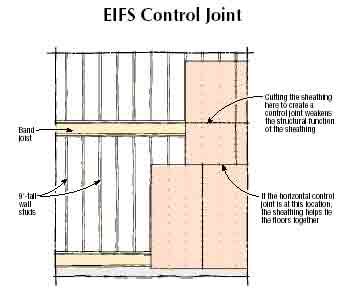
- Q. We’re building a three-story house with plywood sheathing that will be covered with EIFS. Because the house has 9-foot ceilings, the horizontal sheathing joints don’t fall near the band joist area. The EIFS rep says we have to plan for joist shrinkage by establishing a control joint, and he wants us to cut through the plywood sheathing at the floor line. I think the plywood sheathing is structurally important, and I’m reluctant to cut the sheathing where it ties the floors together. What should we do?
A.John Edgar, senior technical services manager at Sto Corp., a manufacturer of EIFS systems, responds: When EIFS is installed on a wood-frame building, EIFS manufacturers recommend the installation of a horizontal joint in the sheathing at floor lines (see “Success With EIFS,” 11/01). The purpose of the joint is to accommodate the cross-grain shrinkage in the floor joists, as well as any settling. (This type of shrinkage can cause problems with many types of cladding, including EIFS, brick veneer, and vinyl siding.) In addition to providing a gap in the sheathing, a flexible joint is provided in the EIFS cladding, to accommodate the movement that occurs as the sheathing joint closes.
This standard detail is problematic when the sheathing spans the floor line to structurally tie the upper floor to the lower floor, as is often the case in seismic zones and high-wind coastal areas. In such cases, the EIFS joint should be installed at the nearest horizontal joint in the sheathing, even if that is not at the floor line. As the joists shrink, the stress will probably be focused at that sheathing joint.
This is the best solution, but it is not ideal. The stresses are somewhat unpredictable — if the sheathing is securely restrained above and below the floor line and the shrinkage is severe, the sheathing may bulge as it is compressed, causing the EIFS also to bulge out or crush at that point.
More information can be found in the EIMA Guide to EIFS Construction, which is posted at the website of the EIFS Industry Members Association at www.eima.com.
Q&A: Shrinkage Joints in EIFS Cladding
2 MIN READ