A few years ago, while looking for ways to grow our small
construction company, we began installing kitchen cabinets for
the local Home Depot. Though well aware of the potential
difficulties of dealing with a large home center, we wanted
small, quick, profitable jobs that we could work on between
larger projects. Our goal was to stay busy, and we hoped these
jobs would lead to larger projects and repeat business.
It turned out to be a good business decision. Not only did the
home center provide us with eight to 12 kitchen installations
each year, but our business foundation has been considerably
strengthened by the contacts we've established with homeowners,
real estate agents, interior designers, and architects. The
large addition we are currently working on can be traced back
to a home-center kitchen we did three years ago.
But working with a home center means dealing with stock
cabinetry and designers with varying degrees of experience. To
sell our services in this low- to medium-priced kitchen
renovation market, we needed a set of procedures that would
minimize our risk and make our installations more efficient and
profitable.
Working With the Designer
Early on, we learned that a good relationship with the designer
— regardless of his or her experience — is an
important part of the process. During our initial site visit,
we spend as much time as necessary reviewing the design to make
sure it will work with the stock cabinets typically used by
home centers. Afterward, we help the designer tweak the layout
so that the actual installation will go smoothly.
Site visit. The first thing we do when we receive a
kitchen design from the home center is contact the customer and
arrange for a site visit. At the home, we carefully measure the
kitchen to double-check the designer's layout dimensions. We
also find out if the homeowners want any additional work done
besides the removal of existing cabinets and the installation
of new ones (typically, our kitchen-renovation referrals range
from simple cabinet replacement to full guts), which must be
factored into the estimate.
We also discuss the schedule. A realistic time line up-front
helps avoid unrealistic expectations later on.
As part of the initial design review, we note existing
lighting, switching, and box locations, and compare them with
any new electrical plans and appliance specification sheets. If
the plans require any electrical work (most of them do), we'll
ask the electrician to install undercabinet wires 54 inches off
the finished floor and countertop boxes 44 inches off the
finished floor. We specify that locations are measured off the
floor's high point. And because so many of our kitchen splashes
are tiled, we specify depth-adjustable countertop receptacle
boxes.
To help identify and keep track of potential electrical,
plumbing, and other problems, we've developed a checklist.
Sharing this list with the homeowners during the site visit is
a good way to let them know what to expect.
During the preliminary site visit, the author uses a
simple checklist to help manage common kitchen-cabinet
installation issues.Estimate. After the site visit, we call the
designer to discuss any problems we've identified, such as a
sink cabinet that doesn't center under a window, or inadequate
allowances for door and window casings. Sometimes we fax a
summarized version of our checklist as well. Then it's up to
the designer to make any necessary changes with the homeowners
and amend the cabinet order.
We also generate a standard Home Depot estimate based on the
initial plan and our site visit, which the designer presents to
the owners. If the homeowners still want to proceed, they can
then purchase the cabinets and the installation as a package,
charging it to their credit cards if they like. Up until now,
our work is speculative (close rates vary; ours ranges from 65
percent to 70 percent). Installers don't get paid until the
cabinet installation is complete.

Essential tools for efficient cabinet installation include
an assortment of drills and drivers, Pony Cabinet Claw clamps
(left), and telescoping support poles (right).
Cabinet Design Review
When a custom-designed kitchen plan doesn't work out, the
installer stands a good chance of escaping blame. But when a
stock-cabinet design for a home center doesn't work out, the
installer may be faulted for not identifying the problem early
on. So we carefully check the kitchen dimensions used by the
designer against those we gathered during our site visit.
First, we verify that the linear inches of cabinets specified
by the designer fit into the actual space. We also double-check
corner clearances, blind cabinets and sink bases, appliance
openings, and cabinet reveals at windows and doors.
Stock cabinets are available in a limited range of sizes,
typically in 3-inch increments. Wall cabinets rarely exceed 36
inches in width, while base cabinets are usually less than 45
inches wide. To make everything fit together, we use fillers
supplied by the manufacturer.
Available in 3-inch and 6-inch widths, fillers are handy not
only for completing cabinet runs, but also for solving numerous
problems and measuring mistakes. We use them to center sink
bases on windows, set blind cabinets, align base and wall
cabinets at appliance openings, and provide cabinet-drawer or
dishwasher-door clearance with opposite-corner cabinet handles.
We always ask the designer to include extra fillers in the
order.
Sink base. Nine times out of 10, the sink base is
centered on the window above it. We find the center of the
window and plumb down, marking the center line to the floor.
After dividing the sink base width in half we measure left and
right the appropriate distance to spot the sink base's exact
location. From the sink base, we measure the cabinet run in
both directions to determine if any fillers are needed to align
cabinets at appliance openings or to evenly end wall and base
cabinet runs.
Corner clearances. In L-shaped and U-shaped kitchens,
appliances and cabinet drawers and doors on opposing corners
must clear each other when they are open. We like to specify at
least 2 1/2 inches of face frame or filler at each corner,
which allows enough clearance for 3/4-inch-thick overlay doors
with 1-inch-deep handles.
Occasionally the door of an appliance — such as a
dishwasher, range, or compactor — may need to clear a
cabinet handle; it too will need to be installed 2 1/2 or 3
inches off the corner. When necessary, we can add a filler to
the cabinet face frame to achieve the proper clearance.
Blind units. Stock wall or base blind units, which are
installed at corners, are often listed as measuring 33 or 45
inches, but they actually measure 31 or 42 inches. This
difference allows the installer to adjust the cabinet off the
wall enough to attain proper corner cabinet clearance. Any
space between the wall and the cabinet will be hidden by the
adjoining cabinet (in the case of a wall cabinet) or by the
countertop (in the case of a blind base).
Appliances. Ranges with microwaves or fans above
require that wall and base cabinets line up evenly to create
the proper opening. Undercabinet appliances — like
dishwashers, compactors, and wine coolers — require only
the appropriate width between base cabinets.
Stock cabinets sometimes need to be modified to fit site
conditions. Removing a section from the back of this corner
cabinet (left) allowed it to fit around a duct chase
(right).
We pay particular attention to refrigerators because they vary
in both width and height. We've found that designers and
homeowners usually get the refrigerator width right but
occasionally miss sizing the cabinet height above; the taller
the refrigerator, the smaller the cabinet height.
While measuring cabinet runs, the sink-base location, and
appliance openings, we also check cabinet distances from all
windows and doors. For visual symmetry, cabinets should be an
equal distance from door and window openings. Once again, we
use fillers to help align cabinets at windows, doors, corners,
appliances, and ends of runs.
Sometimes there are situations that can't be addressed with
fillers, such as a pipe chase. While a custom cabinet can be
built to fit around such irregularities, a stock cabinet must
be cut on site to accommodate them.
Installing the Cabinets
To reduce mistakes and increase efficiency, we try to make our
kitchen-cabinet installations logical and orderly, regardless
of whether we're installing stock or custom cabinets. We start
by checking the floor and ceiling (or soffits) for level,
corners for square, walls for plumb, and walls for bulges and
depressions.
The author uses filler strips at corners, where cabinets
and appliances need at least 2 1/2 inches of clearance for
drawers and doors to open properly (top). When filler strips
aren't wide enough, a face frame can be assembled from filler
strips to complete the run. The one above will be finished with
a special-order matching door.
Layout. We start the layout from the floor's high
point to ensure a level run. From the high point, we measure
off the finished floor 34 1/2 inches and 54 inches, and level
around the room at both heights with a 4-foot level. These
heights represent the top of the base cabinets and the bottom
of the wall cabinets.
Stock wall cabinets come in heights of 30, 36, and 42 inches,
resulting in heights off the finished floor of 84, 90, or 96
inches. An out-of-level ceiling can present a visual problem
for 30-inch and 36-inch cabinet heights. But when the kitchen
has 8-foot ceilings and the design calls for 42-inch-tall wall
cabinets, out-of-level ceilings become an installation problem.
So we're careful to establish the ceiling or soffit low point,
lowering the wall-cabinet level line (and therefore the height
of the splash area) as necessary to compensate.
When we discover problems like these, we consult the homeowner
as early as we can in the project. This helps establish a good
line of communication and avoid surprises later on. We review
all our level, square, and plumb findings with the owner before
any cabinets go up, and offer any solutions we may have to
solve the problems.
Next we mark wall stud layout and the locations of the base and
wall cabinets. Once we've determined the cabinet layout lines,
stud locations, level lines, and corner and wall conditions, we
can determine the number, location, and size of fillers needed
(if any) to make the installation work.
Upper cabinets. Usually we start our installations in
a corner, especially for L-shaped or U-shaped kitchens. We
prefer to hang the wall cabinets first, simply to avoid leaning
over base cabinets. Also, if we drop a tool, the only damage
will be to flooring that will be covered later by
cabinets.
To minimize the influence of the room's imperfections —
out-of-square corners, wall bulges, wall depressions, and the
like — we assemble individual cabinets into larger single
units. Most face frames extend 3/16 inch past the sides of the
cabinet box, so we use 3/8-inch-thick blocks at the back of the
cabinets to keep them square.
When we have to install finish fillers at the cabinet fronts,
we block out the backs of the cabinet with mirror fillers
(usually cut from No. 2 pine). Fillers that are used to end
runs must be scribed or ripped to fit the space, and are
installed after the main cabinet runs are in place.
For assembly and installation, we use six cordless drills. Four
are set up for cabinets (each with a different bit: a Phillips
head bit, a square drive bit, a countersink, and a drill bit
for predrilling) and two are set up for handles (one with a
Phillips bit and one with a drill bit). We also have on hand an
assortment of levels, a small compressor and a finish gun for
installing moldings, a table saw, a sliding-compound miter saw,
a 4-foot ladder, and support poles.
We begin assembling wall cabinets by removing doors and
shelving. Besides lightening the load and protecting the door
finish during assembly and installation, this makes it possible
to use Pony Cabinet Claw clamps (312/666-0640,
www.adjustableclamp.com) to put the cabinets together.
Available for both face-frame and frameless cabinetry, these
indispensable clamps pull cabinet stiles tightly together while
flushing up the faces, and include a drill guide and pilot hole
for predrilling frames.
Repairing cabinets that arrive on site damaged is often
quicker than waiting for a replacement. After removing a
damaged section of cabinet (top), a carpenter glues and fastens
a section of filler (bottom). To make the repair less
noticeable, the wall cabinet will be installed upside down and
the door rehung.
To fasten cabinets together, we use stainless steel
square-drive trim-head deck screws. Though these color-coated
screws are expensive, they're strong — which minimizes
snapping or stripping — and they blend in well with most
cabinet colors. We countersink before driving the trim heads
home.
Under- and overcabinet lighting wires (if any) must be brought
through the wall cabinets before they can be fastened. We
transfer lighting locations from our layout to the cabinetry,
then bore holes through the recessed top and bottom lips to
feed the lighting wires through as the cabinets are lifted into
place. And if the wall cabinets are finished with crown molding
(or a similar molding), we add any necessary nailers to the
ceiling or top of the cabinets before installation.
Moldings give stock cabinets a built-in look. Here, a
carpenter fastens a nosing to the upper cabinets (top left).
Crown molding hides gaps between the cabinetry and an
out-of-level ceiling (top right). Wiring for the light over the
sink runs through the double-sided divider in the valance
(middle). The same molding profile links the refrigerator
recess and adjacent cabinetry (bottom).
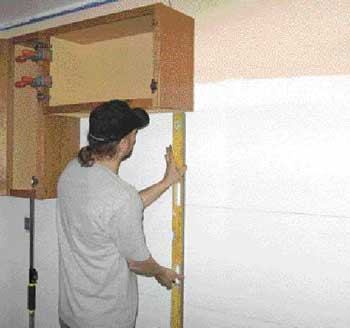
To make installation easier, we fasten a temporary ledger along
the 54-inch level line. It helps carry the weight of the
cabinets, allowing one man to hold the run in place while the
unit is fastened to the wall. We use telescopic cabinet poles
in conjunction with the ledger for additional support.
Most of the wall cabinets we install have recessed tops and
bottoms, so we try to fasten the cabinets through the recess
lip instead of from inside the cabinet. This makes it easy to
see stud locations and helps hide the fasteners (which is
particularly important on cabinets with glass doors). We use
3-inch-long #10 truss-head screws (available in nickel and
almond), predrilling and countersinking before fastening the
cabinet to the wall.
Of course, cabinets usually have to be shimmed. We identify
existing wall conditions during our initial review, then shim
as necessary during installation so that the cabinets are
plumb. It helps to have someone holding the cabinets at the
ledger who can also check for plumb as the cabinets are
adjusted.
Base cabinets. Just as we did with the wall cabinets, we
assemble base cabinets into units. Then we move the cabinets
into place, shim to the level line 34 1/2 inches off the floor,
and shim the cabinets plumb and level.
The three lines of cabinets carried by our local Home Depot all
have built-in base toekicks, so we shim directly under the side
walls to get maximum surface contact between shims and
cabinets. When properly installed, base cabinets should be
level from side to side and from front to back, and plumb
across the cabinet fronts.
The sink base requires utility-line cutouts. To get our hole
locations, we measure from the level line down to water-supply
and waste lines protruding from the wall, and use the cabinet
center line to measure right to left. We then transfer those
numbers to the back of the cabinet and set the cabinet as close
to the pipes as possible for a visual check before cutting.
Using hole saws (which make fast, clean cuts), we start cutting
from the back where our marks were made, then finish from the
inside to minimize blowouts on the interior.
Islands and peninsulas. To ensure that freestanding
cabinets don't move or tip over, we fasten them to cleats
attached to the floor. When we reposition the cabinets and
screw through the kick and back to secure the unit, the
fasteners will be concealed by the kick cover and the back
screws by the plywood skin accompanying the cabinet
order.
Knobs and handles. Whereas knobs require only one
hole, pulls require two holes drilled straight and level. We
use combination squares to mark center lines for hardware
holes, measuring off the bottom and side of the door to locate
the center of each hole. We start drilling with the door
closed, then pull it open to make sure the drill bit clears the
face frame. (A door can be replaced easily, but a damaged
cabinet frame is a bigger problem.)
When a cabinet run stops at an appliance, an end panel can
furnish a finished look. This panel will be capped with a small
matching section of stone when the granite countertops are
installed.
When we're done, we fit spacers to appliance openings to fix
the cabinets in place. Then we do a walk-through of the cabinet
installation with our client, verifying clearances and
dimensions and that the cabinets are plumb and level. That way,
if painters, flooring subs, or appliance installers knock our
cabinets around later on and we have to come back and fix the
problem, we can charge.
Rob Corbo is a building contractor in
Elizabeth, N.J.