
Download PDF version (567.5k) Log In or Register to view the full article as a PDF document.

Image

Image

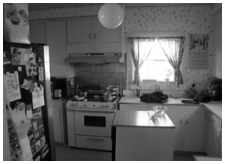
Several months ago, the owners of a 1918 Craftsman-style residence here in the Oakland area asked me to remodel their kitchen. Small and dark, the room had last been renovated many decades earlier. A partition separated it from a butler's pantry, which held a corner sink and a tiny toilet room. The toilet hadn't worked for years, and the pantry was used for general storage. All told, the kitchen and pantry contained nine doorways, plus a set of stairs leading to the basement and the second floor (Figure 1).

Image

Figure 1. To create a more efficient layout, the author eliminated a toilet room, removed the partition between the kitchen and the butler's pantry, and stole space from a redundant stairway.

Not surprisingly, all of the cabinets were in poor condition; probably the nicest thing you could say about them — assuming you liked history — was that they looked really old. As it happened, my clients did like history and wanted their new kitchen to feel as though it might have belonged to their grandmothers.

Same Area, Better Space

To stay within the budget, we decided to avoid structural changes and leave the plumbing where it was. However, we did tear out the water closet and the partition between the kitchen and the butler's pantry. What had been the toilet compartment became the location for a new 32-inch-wide refrigerator.

We couldn't rip out the wall to the right of the toilet because it contained plumbing for the upstairs bath. Instead, we reframed it, making it thick enough to accommodate a bookcase. Now it holds cookbooks and defines the entry area (Figure 2).

Image

Figure 2. The original water closet's plumbing wall contained pipes for the second-story bath, so it was retained and fattened into a bookcase.

Storage in the Stairway

The stairs in the corner of the butler's pantry consumed valuable floor space. Although we couldn't alter the ones going down to the basement, we could steal space from the ones going up because they weren't the only set to the second floor; they led to a landing where a door opened onto the main staircase — a design common in older homes.

Removing the back stairs was not an option (the flight to the basement runs directly underneath), so we decided to frame around them to create as much storage space as possible. The landing became a closet accessed through the existing door from the front stairs. Above the treads we framed three openings: one for a built-in wall cabinet, one for a large alcove, and one for a pair of drawers that open into the hallway (Figure 3).

Image
Image

Figure 3. The back stairs (left) were turned into storage space. The landing became a closet, accessed from the home's main staircase, while the space above the treads now houses a wall cabinet, a niche, and — around the corner — a pair of drawers (right).

Across the hall from the stairs was an existing closet that also served as a mechanical chase. To avoid having to rework the mechanicals, we left the closet there but gave it a new door that matches the ones on the kitchen cabinets.


Period Details

Next to the closet, the wall jogged back 12 inches (Figure 4). We would have liked to have pushed it far enough back to install 24-inch base cabinets, but we couldn't, for a couple of reasons: It contained plumbing, and the space on the other side was occupied by a built-in china cupboard that served the dining room.

Image

Image

Figure 4. Since a built-in dining room cupboard made 24-inch-deep base cabinets on the kitchen side of the wall impossible (top), the author instead designed shallow apothecary-style cases. Continuous trim ties them to the adjacent closet (bottom).

So we decided to fill this area with custom-made 12-inch-deep cabinets designed to resemble the apothecary cases found behind the counter of a 1930s-era soda fountain. To add to the vintage effect, we used punched-tin panels in some doors (Figure 5); they are available from Country Accents (570/478-4127, www.piercedtin.com) for about $10 each.

Image

Image

Figure 5. To create a period look, some of the cabinet doors were fitted with inexpensive punched-tin panels (top). Cubbies in the narrow cabinet to the right of the prep sink feature hopper-style doors (bottom).

The cabinets along the kitchen's exterior walls are more conventional but feature the same traditional details: inset doors and drawers, ball-tip butt hinges, and old-fashioned glass drawer pulls (House of Antique Hardware, 888/223-2545, www.houseofantiquehardware.com). We helped make the units look old by ordering them primed and then brush-painting them on site.

Doors and windows are trimmed with the flat casings found elsewhere in the house; to unify the room, we added a simple crown around the upper cabinets and walls.

Recycled sink. Down the wall from the apothecary cabinets — where the corner sink used to be — we installed a wall-hung prep sink that the clients bought at a recycling center for $75. We rebuilt the valve assemblies, but to maintain the vintage look we did not rechrome the faucet or reglaze the porcelain.

To the right of the sink we installed a tall wall cabinet with cubbies — most with downswing doors supported by chains. The cubbies serve the oven area and hold spices and baking supplies. A small counter on the base cabinet provides a work surface.

Lighting and electrical. The owners purchased vintage light fixtures and had them rewired by a local shop. Modern light switches would have looked out of place, so we installed UL-listed reproductions of the old push-button-style switches (Classic Accents, 800/245-7742, www.classicaccents.net). We still had to use modern GFCI receptacles, but — as with the switches — we made them appear older by trimming them with raw brass cover plates.

Appliances. The refrigerator is a restored vintage appliance, as is the kitchen's centerpiece, a 1948 O'Keefe & Merritt range (Figure 6). Because an exposed range hood would have looked too modern, we used a wall-vented hood liner (Vent-A-Hood, 800/331-2492, www.ventahood.com) that we concealed within the cabinetry.

Image

Figure 6. Vintage appliances serve as focal points; the range's exhaust hood is concealed inside cabinetry above the stove. The Marmoleum floor's border echoes similar borders on hardwood floors in the rest of the house.

Cameron Habel is a remodeling contractor in Oakland, Calif.
