I spend a lot of time traveling around the country meeting with remodelers. I find that most are eager to talk about their business — until, that is, I ask them how much their field employees are costing them and what data they use to set their labor rates. Based on my experience, it’s safe to say that no number is more misunderstood than the true cost of labor.
Getting a Handle
Let’s assume that your carpenters get paid for 40 hours a week. But not all of those hours are billable — time spent in company meetings or cleaning the shop, for example. Still, you’ve got to have some way to recoup the cost of them.
Furthermore, maybe you give your employees paid vacation and holidays, like we do in my company. That means that instead of working 260 billable days per year (52 weeks x 5 days), your crew may be working only 244 days per year, even though you’re paying them for the other days.
Not only are you unable to bill for all the hours your employees work — you’re also probably paying more than you think for each hour of labor. Most likely you include the obvious cost of taxes and health insurance in your labor rate, but do you take into account the other costs associated with keeping workers in the field — things like training, tools, and uniforms? And don’t forget overhead, the indirect costs of keeping a crew in the field: office expenses, the salaries of nonfield employees, even your own salary. A percentage of these costs should also be recouped with every billable labor hour.
Last, after covering all costs, you still need to make a profit, so labor rates should include a profit component.
Labor Burden
In my company, we calculate labor burden — the costs directly associated with keeping the employee in the field — as a percentage of the hourly labor wage for labor, and then add that percentage to the wage to arrive at our true labor cost. We calculate overhead and profit as a percentage of sales, then add that additional percentage to our true labor cost to arrive at the billing rate.
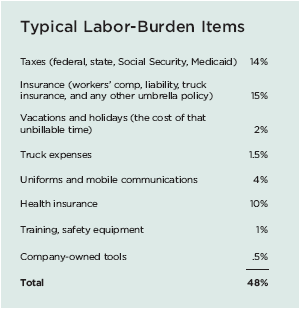
Labor-burden percentages vary from company to company, so you will need your accountant or company bookkeeper to determine them. The items we include in burden and the percentages we use are shown at left in Figure 1. Note that they add up to a total burden of 48 percent, which must be added to the employee’s base pay.
Figure 1. The rate at which you bill for labor should reflect all the costs directly related to keeping your crew in the field. The author adds the items listed here as a percentage of his base rate.
To illustrate, let’s say you pay a carpenter $18.25 per hour. Adding in the labor-burden percentage ($18.25 x 148%) gives the true cost: $27.01.
Markup for Overhead and Profit
Now you have to mark up that $27.01 to cover overhead and profit. According to industry statistics, indirect costs for remodeling companies average around 25 percent of sales, so I’ll use that figure. A realistic profit target might be 8 percent of sales. That means 33 percent of the sale price of any job is earmarked for overhead and profit. That’s your gross margin.
In order to achieve that 33 percent gross margin, you have to mark up true cost of labor by 50 percent (Figure 2). Using the example above, that means you should be billing for that carpenter’s time at $40.51 ($27.01 x 150%). Anything less and you’re losing money.
At my company we think labor is worth more, so we use a higher markup — 67 percent — than for other direct costs. That means that if our true cost of labor is $27.01, our target labor rate needs to be $45.11 per hour ($27.01 x 167%).
Justifying Higher Rates
One reason we treat labor differently is that most of our jobs are complex and require highly skilled workers who also represent our company well to our customers. Doing business in this manner has earned us a good reputation among the kinds of clients we want, and has resulted in more referrals than we could ever have gotten by offering low prices.
Figure 2. Like any direct cost, your labor rate — including labor burden — should be marked up to cover overhead and profit (gross margin). Note that to achieve a 33 percent margin, you have to apply a 50 percent markup.
Many other remodelers have learned the same lesson. One business owner I helped out was charging $30 per hour for labor — the amount that he thought his market would bear. He was especially frustrated that his labor costs — including taxes, benefits, and comp — were $27 per hour, leaving just $3 for the company.
After helping him calculate his total labor burden and adding the proper markup, I suggested that he raise his rates to $45 per hour. He insisted that he couldn’t get away with charging that much, but reluctantly agreed to try.
The results were encouraging. When we first started working together, most of his customers were concerned with one thing: price. A year later he was doing bigger jobs for better clients, and price had dropped to fourth place on their priority list. He was offering a better warranty, paying his help more, and still making a profit.
Learning his true labor cost was the first step in the transformation of his business.
Tom Swartz is president of J.J. Swartz Co., an 86-year-old remodeling and restoration company in Decatur, Ill.