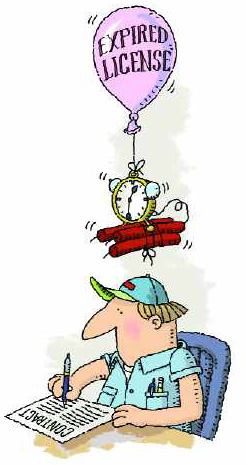
An Expired License
The case involved a subcontractor who signed a contract, began working on the project, and then discovered he had allowed his license to lapse. He immediately filed the necessary papers to get relicensed, but he had already done part of the work while unlicensed.
Can’t sue if unlicensed. Like most states, California has a law that prevents unlicensed contractors from suing customers for payment. When the sub wasn’t paid, he sued the contractor to the tune of more than a million dollars.
“You can’t sue me, you weren’t licensed,” said the contractor.
“Hey,” the sub said, “I was licensed for most of the work, so even if I can’t sue for the work I did while I wasn’t licensed, surely I can sue for the work I did while I was licensed.”
Reason Loses
It sounds like a reasonable argument to me, but guess what? The subcontractor lost.
According to the California court, if you aren’t licensed when you start the job, you can’t come to court — period.
I disagree with this position for several reasons.
Purpose of the law. First, the purpose of the no-sue law is to force contractors to get their licenses. Since states don’t have platoons of inspectors cruising the streets looking for unlicensed contractors, they provide motivation to get that license by saying, in effect, “If you don’t have a state license, don’t expect the state courts to help you get paid.”
But this guy did get his license. Maybe he didn’t do it in the timeliest fashion — but there didn’t appear to be any intent to evade the requirement of the law.
Consumer protection. Another argument against this decision has to do with the intent of the law.
In some states, such as California, licensing laws have evolved into “consumer protection laws.” In addition to pressuring contractors to get their licenses, these laws are intended to protect consumers from guys who think they’re carpenters just because they own a hammer.
That’s why in most states you have to pass a test before you can get a license. Requiring a test is supposed to protect the consumer from guys who really don’t know what they’re doing.
But in this case, the guy who was trying to collect was a sub. He wasn’t trying to get money out of some naive consumer; he was trying to collect from another contractor.
Did this contractor need to be protected from an unlicensed sub? Sounds to me like it was the other way around.
Unjust Enrichment
Which brings us to the next argument. What about the customer who stands there and watches the work being done, knowing that the contractor will not be able to sue when the customer doesn’t pay — so the customer doesn’t pay?
Isn’t that fraud, or at least unjust enrichment?
I would argue — and did successfully argue some years back in another state — that this outcome was not intended by the licensing law. To allow someone who has benefited from work done for him to evade all payment is inequitable. (That’s a legal word meaning not fair.) It would be unjust enrichment.
Different standard of payment. A lawsuit based on unjust enrichment is different from one based on debt collection. In an unjust-enrichment lawsuit, the nonpaying customer has to pay for the value of what he received, not what he originally promised to pay.
For example, let’s say you were the unlicensed contractor and were suing for payment of the $100,000 contract price. In a lawsuit based on unjust enrichment, the court would ignore the contract price and instead focus on the fair-market value of what the customer received.
So if you built a beautiful pergola, expecting $100,000 in payment, and the court determined that the value of that pergola was only $20,000, you would win — but only $20,000. That would be true even if $20,000 didn’t cover the cost of your materials and labor.
But in the case of the subcontractor whose license lapsed, the California court specifically rejected those kinds of unjust-enrichment lawsuits on the grounds that if the state legislature had intended to provide for such a situation, the statute would have been worded differently.
Take No Chances: Renew!
So what’s the most important lesson you should take away from this case? That if you’re careless about keeping your license up-to-date, you could find yourself in a boatload of trouble.
“Not me,” I hear you saying. “I don’t live in California.”
Okay, but how do you know the courts in your state won’t suddenly rule on this the same way the California court did?
This kind of thing happens all the time: A judge in one state sees the way a judge decided a case in another state and is influenced by it.
If you get careless with those renewal dates, you may find out that your state court judge thinks the California decision was a good one.
So just do it right in the first place.
And here’s another word of warning: Although the state usually sends you a renewal notice, don’t rely on that happening. If for some reason you don’t receive the notice, it’s unlikely you’ll be able to use that as a defense for being unlicensed.
So get a calendar — paper or electronic — and mark down those renewal dates. File for renewal in a timely manner and then check to see that the state follows through by calling or by visiting the state Web site that allows customers to check their contractor’s license.
Believe me, this is trouble you don’t want to know about from personal experience.
Quenda Behler Story, author of The Contractor’s Plain-English Legal Guide, has practiced and taught law for more than 25 years.