Consider this scenario: During the course of a project, the homeowner pays the contractor, but the contractor doesn’t pay his subs or material suppliers. One of the subs or suppliers then files a construction lien on the property. The homeowner, of course, goes crazy. He has already paid, he says, and clouding his title is unlawful. He threatens to sue the sub for damages. Which begs the question: Can he do that? Can he sue the sub for trying to enforce a construction lien?
The quick answer is no — but since this is a legal question, the long response is a little more complicated. In fact, there is such a thing as a lawsuit based on clouding a title, and someone who puts a lien to which he was never entitled on someone’s property could be sued for it.
But that does not necessarily mean that an unpaid sub is taking a risk when he tries to put a construction lien on the property where he did the work, or that he will get into legal trouble if the property owner has already paid the contractor.
Be Careful About Signing Lien Waivers
If you are a sub who hasn’t been paid, go ahead and put a lien on the property — but be aware of one big “if” that has nothing to do with whether the property owner paid the general contractor: You cannot put a construction lien on the property if you, an unpaid sub or material supplier, have signed a lien waiver — which you may have done simply because the GC told you to. I am always amazed at how many guys sign when they have not yet been paid.
When you sign a lien waiver, you are giving up the most powerful tool you have to ensure that you get paid — and you could be exposing yourself to legal problems if you then go ahead and try to collect from the property owner with a lien. I’m not saying that collecting the money under those circumstances would be an absolute impossibility, but you would definitely need the help of an attorney who specializes in construction law.
Also, by signing a lien waiver, you may be giving up the only way to collect your money if the contractor disappears or goes bankrupt.
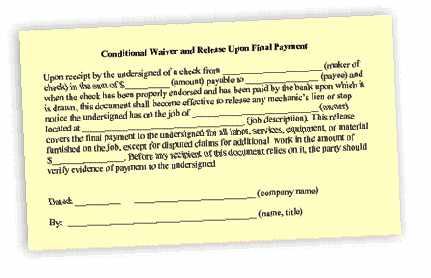
For these reasons, I always recommend that the sub sign the waiver only after he’s received the money. But if for some reason you have to sign before you are paid, make sure that the waiver is contingent on payment, either partial or final (see the example).
This lien waiver is conditional and takes effect only after the sub who signs it receives a check and the check clears.
And when receiving progress payments, waive lien rights only for work you did before the date of the invoice, not for work you have yet to do — and have not been paid for.
Not Breach of Contract
When someone sues to collect an unpaid debt, it is usually a breach-of-contract lawsuit. However, a sub can’t sue the property owner for breach of contract, because his contract is with the general contractor, not with the property owner. The sub can sue the GC, but the only way to collect directly from the property owner is by filing a construction lien.
| When you sign a lien waiver, you are giving up the most powerful tool you have to ensure that you get paid. |
I have always suspected that some people’s willingness to just go ahead and sign a lien waiver reflects their fear of the paperwork involved in a construction lien. And in fact there is a lot of paperwork, and it has to be exactly correct and within the statutory time limits or the lien will fail.
Lien Rights
Still, you shouldn’t let your fear of technicalities stop you.
Let’s go back to the original example. Say you’re the sub. You didn’t sign a lien waiver, but the property owner already paid the contractor, who did not pay you. Are you going to get into trouble if you try to enforce your lien rights? No.
Will the property owner have to hand over payment twice? Once to the contractor and once to the unpaid sub who filed a construction lien? Maybe. In some states, the answer is yes, but even in those places, the construction lien must be prepared absolutely correctly.
Keep in mind, though, that filing a lien incorrectly and having your lien vacated — because you filled out a line wrong or missed a deadline or happen to work in a state where the property owner never has to pay twice — is not the worst thing that could ever happen to you.
For instance, it does not mean the property owner can sue you for clouding his title. (That is, he can’t sue you except to the extent that anybody can sue anytime for anything — but a halfway-decent lawyer should be able to get the lawsuit thrown out PDQ.)
If you did the work and you weren’t paid, you are entitled to file a lien, even if you don’t file it correctly. If you make a mistake in the procedure, you simply won’t be able to enforce that particular lien.
And frankly, based on what I have seen over the years, just filing the lien papers — correctly or not — often gets immediate results. The property owner learns two things he perhaps didn’t know before: first, that his contractor isn’t paying the subs or suppliers; and second, that he could wind up paying twice because of it.
That kind of wake-up call usually gets results.
Quenda Behler Story , author of The Contractor’s Plain-English Legal Guide, has practiced and taught law for more than 25 years.