
Carpenters often lament the scarcity of old-growth wood, which they prize for its dimensional stability and natural rot resistance. Most of the oldest old-growth wood available today is only about 2,000 years old when it’s cut.
But the truly ancient stuff is out there; you just have to know how to find it. Bob Teisberg, of Ancientwood Ltd. in La Pointe, Wis., imports kauri pine lumber from New Zealand that’s more than 50,000 years old.
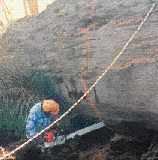
Preserved after falling into prehistoric bogs in New Zealand’s Northland many millennia ago, the huge logs are in surprisingly good shape. Teisberg attributes that to their oxygen-deprived burial. Getting the monsters out of the ground and onto trucks is a challenge; some measure as much as 12 feet in diameter. “Moving them to the mill and sawing them has generated some rather clever solutions, most of which came from plain old lumberman’s ingenuity,” says Teisberg.
Since the wood emerges from the earth with a 100 percent moisture content, it’s often air-dried for two years or so before it’s suitable for millwork or furniture. Most of the logs are found on grazing land. Once they’re removed, the site is graded and seeded; a couple of months later there’s little evidence of the excavation.
According to Teisberg, kauri has a tight, consistent grain and density similar to cherry. In terms of cost, 4/4 finished boards go for $25 per board foot, turning blocks for $32 per board foot, and pieces of stump for $25 per board foot. Offcuts, slabs for countertops, and veneer stock are also available.
For more information, contact Ancientwood Ltd. at 888/201-7544 or www.ancientwood.com


