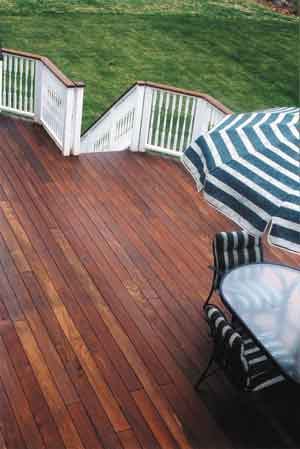
Forget face-nailing — upscale decking calls for a new bag of tricks
Aside from the fact that many people don’t like to see them, visible deck fasteners invite problems. Splitting at board ends, corrosion and rust-stains, and water penetration leading to rot can all be blamed on face-nailing. Plus, nail pops and loose boards create unsafe conditions. So what’s the best way to fasten a deck surface without making a feature of the nails or screws?
Hidden deck fasteners reduce or eliminate the visual and physical defects of face nailing by fastening the decking boards at their edge or underside. Whether you’re using an expensive tropical wood or ordinary pressure-treated pine, a nail-free surface simply makes a nicer-looking job. Keep in mind that the following systems, although they vary in method, all cost more and take more time to install than a conventionally fastened deck surface.
Starting and Finishing
Most hardware systems fasten the decking by its edges, though a couple work from the bottom. All concealed fasteners share a minor quandary: How do you start the first board, whether the deck abuts a building or is open-sided, without showing any fasteners? You don’t, exactly. The easy answer, whether they work from the edge or from underneath, is to drive and set finish nails through the face of the starter board, then fill the holes with colored putty. Or, you can cut matching wood plugs to cap recessed screws.
You can’t use a hidden fastener at the outer edge of the last decking board, either. A face-nail or screw must be used here as well. Another option is to toe-nail the outer edge of the decking to the frame and cap the deck’s perimeter with a trim board.
Choosing the Right Fastener
Dimensional irregularities in lumber spell trouble with the self-spacing systems. It’s not unusual, especially with treated yellow pine, to find discrepancies in board width as great as 1/4 inch. Depending on the surfacing material you plan to work with, you may want to choose a system that allows you to customize the board spacing.
Moisture in lumber can also be a problem, particularly with edge-fastening systems. Too-wet lumber, installed in a sunny location, can undergo a radical transformation in a matter of days. Warping and shrinkage may exceed the tolerances of some edge-clip systems. It’s best to determine that the lumber you’re using is at the ideal moisture content for your region, before installation (“Wood Facts & Fictions,” 12/99). To minimize the likelihood of problems, avoid wet or unseasoned lumber when building a deck, regardless of the fastening system used. If you think warping or cupping problems are likely, a bottom-fastening system may be your best option.
Whichever system you choose, don’t be misled by claims that there’s no labor penalty involved. I’d set aside any benchmark deck installation numbers you have and think through the steps involved in the system of choice. New methods call for new numbers. And, the decision to conceal the fasteners indicates an intention to raise the quality, and thus the cost, of the deck job.
Dave Holbrook is an associate editor for The Journal of Light Construction, following a 20-year career as a builder on outer Cape Cod, Mass.
DBTC
Simpson’s newly redesigned DBTC (Deck Board Tie — Concealed) looks promising. The tie is intended for 2-by and 5/4 softwood or wood-composite decking and is installed using a proprietary tool.
Butt joints pose a challenge to some fastening systems. A single DBTC fastener simply spans the joint. | |
To install the tie, you fasten the outer edge of the first deck board by conventional means, then position the installation tool with the DBTC against the board and over the joist. Striking the disposable polypropylene tool’s face with a hammer drives the clip’s sharp dual prongs into the board’s edge. The tool is intended to last for about 100 fasteners. (It’s currently undergoing a slight redesign to beef up the grip, according to the manufacturer). You secure the tie to the top of the joist with a single #7×1 1/4-inch corrosion-resistant deck screw, purchased separately.
To create even board spacing, you have to use a temporary 3/16-inch spacer at each joist between subsequent boards. The force of driving the tie into the open side of the next board drives the board’s back edge onto the two exposed prongs of the preceding DBTC. Make sure the board remains in solid contact with the joist by standing on it as you drive it into position — no portion of the tie separates the decking from the joist. Nothing extra is called for at butt-joints; a single tie can span the seam. A two-person team could develop an efficient installation rhythm with the DBTC, with one installer driving the ties and the other running the screwgun.
The sharp-edged 18-gauge steel tie is available in a triple zinc coating or may be special-ordered in stainless-steel for projects on or near salt water. For $20, the DBTC comes in boxes of 100 with an installation tool. You’ll need about two ties per square foot of 16-inch joist centers, 5/4 or 2×4 deck surface.
A disposable polypropylene tool, good for about 100 fasteners, is needed to drive the sharp-edged DBTC home. At 20¢ per clip, this is one of the least expensive systems available. |