Over the last ten years or so, residential designers have made tremendous progress in offering open floor plans. Eliminating long hallways and unnecessary walls are both good ways to impart a spacious feel. Too much emphasis on openness, however, can lead to a floor plan that looks great on paper but doesn’t work very well for the homeowner.
Traffic Patterns and Privacy
One of the most critical elements of any floor plan is its handling of traffic patterns — the routes that occupants follow as they travel from one room to another. Fortunately, it’s not difficult to determine how well a given floor plan performs in this respect: Just imagine living in the house and walking from one area to another.
As you enter the home from either the front door or the side entrance, for example, how convenient is it to walk to the kitchen? Do you have to cut across the family room to get there? What if you want to move from the living area to the master bedroom? Ideally, you should be able to move from one area to another without crossing directly through any other room along the way. Traffic-pattern conflicts are especially common in and around centrally located family rooms, which frequently double as circulation areas.
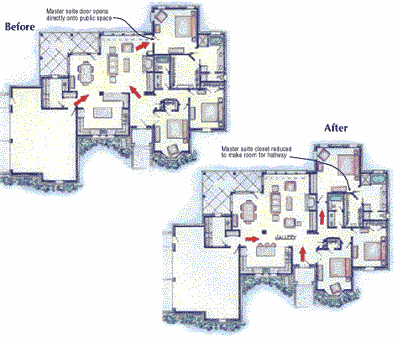
The poor plan layout in the original version forces traffic to swing around a kitchen peninsula that juts out into the family room.
This limits furniture placement and makes the family room much smaller than it might be. The absence of hallways in the plan introduces another problem: Note how the master suite, although tucked away at one end of the house, opens directly onto the family room. Obviously, there’s a serious lack of privacy here.
Addition by Subtraction
Even a very small hallway can create a sense of privacy for a bedroom. In the improved version, a walk-in closet has been scaled back to make space for a short hallway linking the master suite to the front of the house. To smooth out the traffic flow and make better use of the family room, the kitchen has been altered to get rid of the protruding peninsula.
Both improvements illustrate an important point: Open plans are appealing because they make it possible to fit a lot of living space into a given footprint. But that compactness can also tempt a designer to cram more amenities into a plan than it can comfortably hold. When evaluating a floor plan, keep an eye out for unnecessary or oversized elements. Eliminating or downsizing them can be a net gain if it leads to a roomier, more functional design.
Circulation Galleries
Where a hallway isn’t needed for privacy, a designated traffic area, or gallery, can be an excellent way to improve circulation. In effect, a gallery is a hallway without the walls — a planned pathway that promotes efficient movement without detracting from the open feel or restricting natural light.
To see how that can work, consider the original version of the plan. Someone walking from the back door area to the bedrooms has to walk around two sides of the family room to get there, and because there’s no clearly defined pathway between those points, people are likely to encroach on the family-room space by cutting the corner. Another problem is the awkward access to the kitchen, which can only be reached through the dining room at one end or the breakfast nook at the other.
In the revised version, a few relatively minor changes make a big difference in comfort and efficiency. Relocating the back door and creating a new opening to the kitchen form a pair of logical traffic pathways that meet at a central “intersection.” The floors of the resulting galleries have been covered with tile to further establish the designated walkways and prevent foot traffic from spilling over into adjoining areas. (An added practical benefit of this approach is that the hard-surfaced gallery floors are easy to keep clean and resist wear better than carpeting.)
Finally, the columns in the revised plan could be configured in several different ways, depending on the effect desired.
Connecting the columns with a header that meets the wall at a pilaster tends to separate the passageway between the bedrooms and the kitchen from the adjoining family room. Another option would be to eliminate the header and pilaster and run the columns to a flat ceiling plane for a more open feel.
Larry Garnett is a designer in Glen Rose, Texas.