- Q. I need to build three pairs of swinging barn doors to fit 8×7 openings. I’m looking for suggestions for a lightweight but sturdy door that won’t fall apart. My approach was a sheet of 3/4-inch mdo with an applied 5/4 stile-and-rail effect. My main concern is the weight problem. Can you recommend any other approaches?
A.Finish carpenter David Frane responds: It’s tempting to use plywood to make big doors, but, unfortunately, it (even mdo) won’t stay flat when exposed to the weather. Here are three other ways to make doors the size you want:
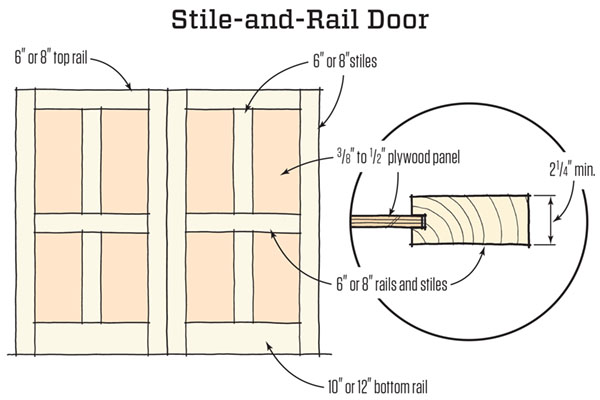
The best way is to make real stile-and-rail doors. But that requires skill at joinery and better stock than you can get at most lumberyards. For doors this size, I’d want stiles and rails that were a minimum of 2 1/4 inches thick. You’d have to start with thick, dry material and use a jointer and planer to straighten it and bring it down to size. The panels could be 3/8- or 1/2-inch plywood. This will give you the best doors, but they’ll be expensive and time consuming to build.
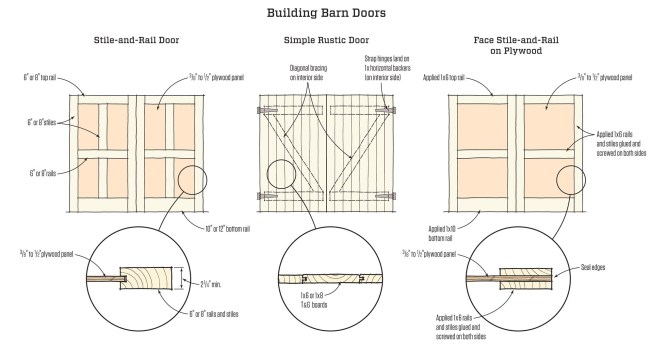
A simple rustic option would be to make old-fashioned shed doors out of T&G boards. Most lumberyards stock this in a #2 grade spruce or pine. The vertical face boards are fastened to horizontal backer strips. Diagonals are applied to the back side to keep the doors from sagging. The doors will be only as straight and flat as the backers. Old-time carpenters clinch-nailed the face boards, but I’d use galvanized drywall screws to hold them. Some of the face boards will cup, and the doors will rot if you don’t do a good job of sealing and painting the edges.
If you’re determined to make plywood doors, use something thinner than 3/4-inch mdo. The sheet will want to warp, and it’s easier to restrain thinner material. The doors will be less likely to warp if you apply the fake stiles and rails to both sides of the sheet. The applied pieces should be straight, flat, and dry. For $30 to $40 you can get 3/8- or 1/2-inch mdo, but be sure to get the kind with paper on both faces. If it was me, I’d spring for okoume or exterior-grade birch, which are more stable than mdo because they have more plies. They come in metric thicknesses and are about twice the price of mdo.
Building Barn Doors
2 MIN READ