- Q. I’m trying to find plans for cutting a solid door slab and making a Dutch door. Any help would be appreciated.
A. Finish carpenter Dave Frane responds: The upper half of a Dutch door can be operated without opening the lower half. Dutch doors are often seen in barns and greenhouses, but they are also used by people who want to open part of a door without allowing pets or small children to get in or out of the room.
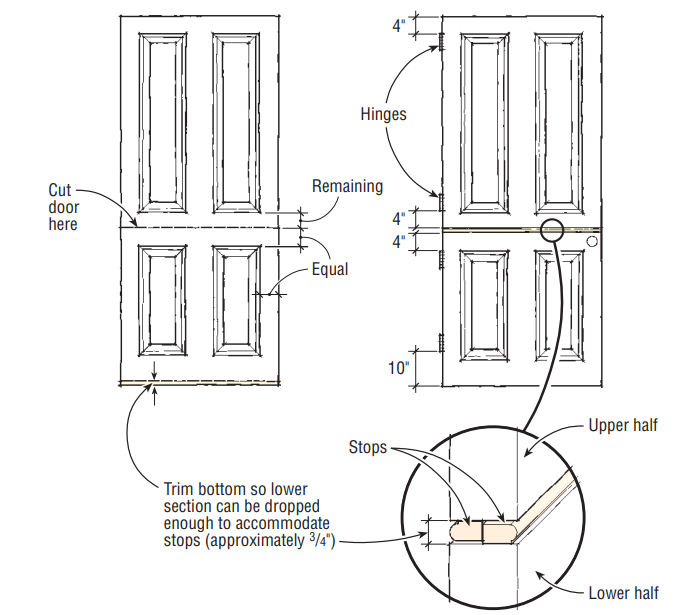
Odds are it’s cheaper to buy a ready-made Dutch door than to convert an existing panel on site. But if for some reason you have to convert an existing door, first you’ll need to figure out where to split the door. The passage set goes in the lower half, so you should cut the door a couple of inches above the knob. You’ll need to trim about 3/4 inch from the height of the door to make room for stops between the halves. The lower stop is mounted near the face that closes against the jamb stops. The upper stop is mounted near the in-swing face.
If it’s a solid-core door, you’ll have to remove some of the exposed particle-board core and replace it with a wood filler. Ideally, you’d remove about an inch and replace it with a glued-in wood strip. The best way to remove the core is with a router and a straight or rabetting bit. A straight bit will cut deeper, but a rabetting bit is easier to control because there’s no need to balance the router on the narrow edge of the door.
You can skip this step if you use a wood panel door. However, you’ll have fewer choices about where to split the panel because you have to do it somewhere on the lock rail. Cut too low and you crowd the passage set. Cut too high and the upper half ends up with a skinny lower rail. To maximize the width of the remaining rails, make room for the stops by trimming the bottom of the lower half and dropping it lower in the jamb. This means remortising the existing hinges, but you’d have to do that anyway because the hinges need to be closer to the top and bottom edges than normal. If they aren’t, the short wide door halves will sag in the jamb. Each panel will have two hinges, and the halves will be tied together by a slide bolt on the in-swing face of the door.You should not convert a fire door to a Dutch door. There is such a thing as a fire-rated Dutch door, but it has special gasketing and has been designed and approved for the purpose.
Making a Dutch Door
2 MIN READ