
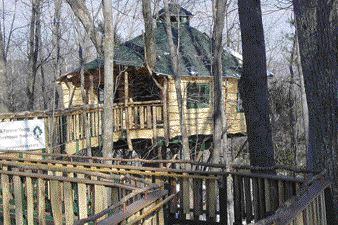
Everyone loves a treehouse. But for some, venturing into the trees can seem like an almost impossible dream. Forever Young Treehouses is a Burlington, Vt.based nonprofit organization that helps those dreams come true by building handicapped-accessible treehouses for children with disabilities.
It’s a demanding craft. Because many of the children must use wheelchairs to get around, access to the structures is provided by long ramps. On one of the group’s projects — an Ashford, Conn., summer camp for children with cancer and serious blood diseases founded by actor Paul Newman — maintaining the slope at the required 12 to 1 ratio resulted in a ramp 340 feet long.
This treehouse, at a southern New Hampshire treatment center for the disabled, sits 20 feet up in an oak grove. The rustic railing that flanks the 150-foot access ramp has an appropriately playful look, but like the ramp and the treehouse itself, it’s fully ADA compliant.
“The kids actually like the ramp as much as the treehouse itself,” says Forever Young designer and builder James “B’fer” Roth. “Rolling along it is like taking a walk in the woods, and a lot of them have never had a chance to do that before.”
Structural safety is another consideration. Forever Young works closely with a number of engineers and arborists to ensure that its treehouses can support the anticipated design loads, don’t damage the supporting trees, and allow for some necessary movement as the trees sway in the wind. More information on Forever Young Treehouses is available at the organization’s website, www.treehouses.org.
Diagonal braces that support the treehouse deck are anchored to welded steel brackets bolted to engineered treehouse fasteners known as Garnier Limbs, for a legendary Oregon treehouse builder and organizer of the annual World Treehouse Conference.
The 1 1/4-inch steel shaft of the Garnier Limb is threaded into an accurately drilled and countersunk hole; the integral steel collar acts to distribute crushing forces over a wider area of edge grain. This sample was tested to failure at about 7,000 pounds of load. The most recent version of the fastener is heat treated for added strength and has withstood test loads of as much as 11,000 pounds. (For more information on the Garnier Limb, contact engineer and manufacturer Charles Greenwood at 541/592-4100.)
Pairs of welded steel “highway brackets” are fastened in place with a stainless-steel rod that passes all the way through the supporting trunk. This provides a solid anchorage but also allows the LVL beams — which have been covered with a peel-and-stick bituminous membrane — to shift slightly in response to the wind.


