- Q. I have to flash a chimney where it penetrates a corrugated metal roof with ridges 8 inches o.c. What’s the solution?
A.Carl Hagstrom responds: The evenly spaced ridges of the roofing profile present a real challenge. When visualizing a flashing strategy for the down-slope face of the chimney, picture the plane of the roof at the top of the ridges, not at the lower, flat portion of the roofing profile. At the sides of the chimney, extend the flashing out past the nearest formed ridge, fold it over the ridge, and then fasten through the flashing at the high point of the ridge with neoprene gasketed roof screws.
This goes against the roofing manufacturers’ recommendations to place screws in the flats of the roofing, but I’ve used this approach with success.
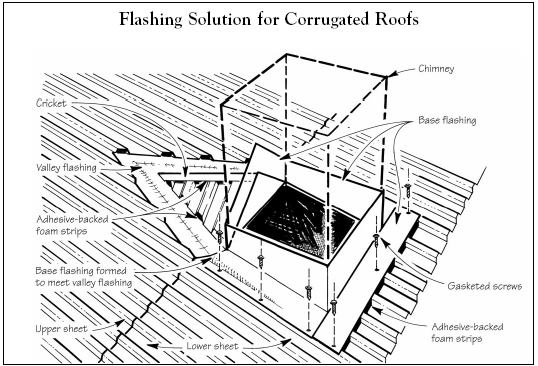
Fill the areas where the base flashing spans the flat portion of the roofing profile with the same closure strips that are used to seal off the metal ridge caps. These are adhesive-backed foam strips that conform to the profile of the metal roofing (see illustration, below).
When the chimney penetrates the roof below the ridge, use a cricket on the up-slope side to divert water around the chimney. The roofing, the cricket valley, and the chimney base flashing all come together at the chimney corners and must overlap in the proper order. First, fasten the lower sheet of roofing in place alongside the chimney, then install the base flashings at the bottom and sides of the chimney. As the side base flashing approaches the valley flashing, it will have to be shaped to lie in the lower, “trough” section of the roofing so that the second sheet of roofing will lie flat. This results in an oddly shaped piece of base flashing, which I form using painted aluminum coil stock and a fuss-’n’-fit approach. It’s not the most elegant piece of flashing, but it’s leak-free and is suitable for the types of buildings where I install metal roofs.
Next, install the cricket valley flashing so that it overlaps the side base flashing. Finally, lay the upper sheet of roofing over the valley flashing.
The roofing manufacturer can provide steel flat sheets that will match the color of the roof. However, these will most likely be tempered steel (like the roofing), and can be difficult to form, even when using a brake. On occasion, I’ve used painted aluminum coil stock for the flashing material. It’s much easier to form and can be painted to match the roofing steel.
Carl Hagstrom is an assistant editor at the Journal of Light Construction.
Q&A: Chimney Flashing for Metal Roofs
2 MIN READ