-
Q.
I designed an open-plan house with what I hoped would be an energy-efficient, maintenance-free roof. The house and its roof have performed well except for occasional annoying ceiling drips, which occur every winter. (A similar but not identical situation was discussed in your March ’99 On the House column.) The roof construction is 2×6 T&G planking, two layers of 3-inch rigid foam, 2×4 horizontal strapping, and a galvanized roof attached with neoprene-gasketed screws. There is a continuous ridge and soffit venting. There is no poly vapor barrier above the plank ceiling because I was assured that the double-layered foam insulation formed its own vapor barrier due to the closed cell structure of the foam. There is no felt above the insulation.
Dripping does not occur after heavy rains, but seems to occur most often during thaws after very cold weather, on both north- and south-facing roofs. The water accumulation is a couple of tablespoonsful from each of two or three drips.
Where is the water coming from — above or below? Is there a fix short of pulling off the roof or putting on a new ceiling? A.Corresponding editor Henri deMarne responds: The water is probably condensate forming on the underside of the metal roof on cold nights when night radiation causes the metal to become several degrees colder than the ambient air. The problem may start as frost that melts when the outside temperature rises above freezing or the sun shining on the roof heats the metal. It is also possible that moisture from the interior space is driven through the T&G ceiling boards by convective currents, finds its way through the joints between the rigid insulation panels (which will shrink somewhat as they age), and condenses on the underside of the metal roof. Then, when enough water accumulates, it drips onto the rigid insulation, is blocked by the 2×4 strapping and finds its way through the joints in the rigid insulation and the ceiling boards. I have seen both of these situations a number of times over the last 20 years.
Had you installed the recommended 6-mil plastic vapor retarder on top of the T&G ceiling, you would have accomplished two things. First, you would have prevented air leakage into the ceiling cavities — air that takes moisture with it. Second, any condensate generated from outside would have been prevented from leaking through the joints between the T&G boards, as long as the plastic were properly overlapped, as is done for roofing felt. However, that water would have been trapped by the 2-by blocking at the eaves and it could eventually have penetrated the walls below or rotted nearby lumber, which would be an invitation for carpenter ants.
The best way to have prevented the problem would have been to install #15 or #30 felt, which should always be installed under metal roofs, regardless of the type. However, the problem would not have been completely solved unless you had also first installed “vertical” strapping from the eaves to the ridge, so that water would have had channels to drain through.
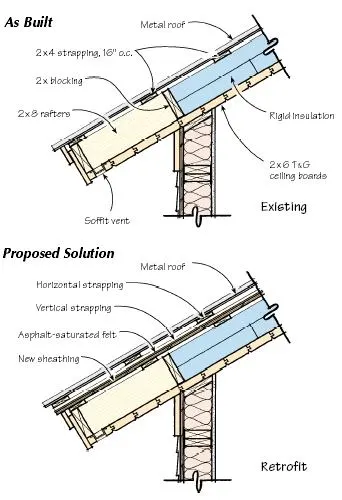
You mention ridge and soffit vents. How do they work with the strapping system you show on your drawing (see illustration) There is no continuous channel from soffits to ridge.
The best solution is to remove the metal panels and nail new sheathing over the existing horizontal strapping. Then apply #15 or #30 asphalt-saturated felt and strap vertically, then horizontally, to ensure a vent space. Though this may seem like a lot of extra work, screwing the metal directly to the sheathing through the felt would not allow the inevitable moisture that will form on the underside of the metal to evaporate. Instead, the condensate would wet the felt, and could pass through the sheathing around the roof’s fasteners where it could eventually cause problems.
Q&A: Condensation Dripping Under Metal Roof
Yet Another Raining Ceiling
3 MIN READ