- Q. On a recent basement remodel, I wanted to use steel studs to frame out the exterior walls, but my framer advised against it. He cited a similar project involving steel studs, where, after time, an outline of each steel stud appeared through the drywall and finish. Any idea what may have caused this “shadowing” effect?
A.Don Jackson, managing editor of JLC, responds: Steel studs are excellent conductors of heat (in other words, lousy insulators), so the surface of the drywall directly over the stud flange stays cooler than the surface of the drywall between the studs. As air moves across the surface of the drywall (chances are there’s forced-air heat in the house), dust and soot particles will stick to the cooler surface of the wall over the stud. Condensation may also form on the cooler surface, attracting dust and soot and even supporting mildew growth. The result will be dark streaks on the wall at the studs. The screw heads may also appear as dark spots.
If the stains seem to be sooty or oily, it’s time to have the furnace checked to see whether the burners are operating properly. Check also to see whether the insulation on the inside of the air handler housing is breaking down, or whether there’s a small crack in the heat exchanger. Oily stains might indicate that unburned atomized fuel oil is being carried through the ductwork.
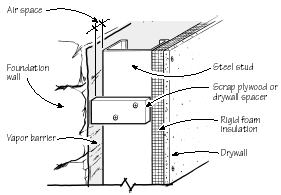
If you want to use steel studs — or even if you use wood — leave at least a
1/2-inch gap between the foundation wall and the back of the stud. This thermal break will prevent the stud from losing heat directly to the foundation wall by conduction. It will also prevent the steel studs from rusting over time as moisture wicks through the masonry or concrete wall. Even if the basement appears to be dry, it’s a good idea to install a poly vapor barrier over the foundation wall, especially if you plan to insulate the wall cavity. A layer of foil-faced rigid foam under the drywall should prevent striping.
Since steel studs can be flimsy when there isn’t drywall on both sides, use plywood or drywall scraps as spacers halfway up the wall to stiffen the studs (see illustration, below). Attach the spacers by screwing them to the web of the stud, using them like shims to ensure a flat wall plane.
Q&A: Steel Stud Striping on Drywall
Steel Stud Striping
2 MIN READ