When my wife and I started our company, Connor Homes, 36 years ago, it didn’t take us long to realize that buying assembled building components — or panels — made more sense than trying to stick build homes during Vermont’s long and frigid winters. We were fortunate to find a quality manufacturer and soon discovered that this was a more efficient way to build no matter what the season.
For 20 years we operated as successful home builders, producing high-quality colonial reproduction homes of our own design with panels from a major home manufacturer. Then, about five years ago, we decided we’d learned enough about the manufacturing side of the business to start producing our panelized homes for other builders. We felt that we could be more successful as a component manufacturer than as a builder.
At first, we framed our wall panels and precut our floor systems and rafters in a two-car garage. When we outgrew that space, we moved to a larger commercial building. Finally, last year we moved into a 10,000-square-foot manufacturing facility.
We expect to build between 50 and 60 panelized homes this year and ship them to builders all over the country.
Changes in the Industry
While many builders will never see the merit of building with panels, some formerly diehard stick builders I know have started doing at least some of their building off site. There are many reasons for their change in attitude, not the least of which is a gradual decline in the availability of skilled labor.
In addition, advances in technology make it cost-effective to produce panels for custom homes, and powerful computers and sophisticated CAD and estimating programs have eliminated much of the repetitive, high-skill drafting and estimating tasks that used to make the process so expensive. Just about every home we sell involves alterations to our standard floor plans; thanks to computers (with skilled operators), these changes are both possible and affordable.
Evolution of a Business
Our early efforts at building wall panels on sawhorses in a garage relied primarily on the same equipment and methods used by conventional stick builders. Our approach didn’t result in a lot of time savings, but at least we were able to work regardless of the weather. Plus we found that we could be framing a house while the excavation and concrete subs readied the foundation.
Once we moved from our garage factory to a larger facility, we could set up permanent framing tables that we didn’t have to tear down at the end of the day to make room for someone’s car.
During this time, we also explored ways to use off-site building and preassembling to produce our colonial trim details. After years of building historically accurate reproduction entryways and other complex architectural details while working on scaffolding with no protection from the elements, I knew there had to be a better way — which is why we started to work indoors to mass produce the period millwork and exterior details that make our homes popular (see “Exterior Trim for Period Homes,” 10/03).
To hold down costs and simplify the process, we standardized most of our exterior details. Now we can produce 3,000 to 5,000 feet of custom trim or dozens of preassembled corner boards at once.
Building Off Site
Off-site framing or home-building operations can be broken down into three general categories, or levels of sophistication: fully automated, semiautomated, and manual.
At one end of that spectrum, a fully automated manufacturing facility turns out hundreds or thousands of homes per year using high-tech software and expensive machinery that can be justified only by the huge volume.
At the other end is an manual operation, which is how we got started. An experienced builder already has most of the tools needed to start producing panels manually. The equipment can be as simple as two or three homemade framing tables built from 2x4s and plywood, a few pneumatic nail guns, and a pair of miter saws. The only other requirements are a truck large enough to get panels to the job, and a suitable building — which doesn’t have to be huge, since materials, finished panels, and components can be covered and stored outside, if necessary.
Today our company lies somewhere in the middle of the spectrum, in the semiautomated category. We use software specifically developed for the panelization industry, and specialty framing and assembly equipment not found on job sites. A common thread through all three methods is the need for a dedicated drafting department to design the framing components and panels.
Drafting and Design
One good draftsman who draws by hand can handle a dozen or so houses a year while doing other management tasks as well. Although we started out doing all our drafting by hand, we found CAD preferable within a few years because plan revisions can be made much more quickly. However, a fast CAD operator with limited design and building experience is no substitute for an experienced draftsman.
Several companies make design software for the panelization industry. We use BuildersCAD. Unlike conventional CAD software, BuildersCAD and the other dedicated software for panel producers operate in 3-D, which enables them to convert two-dimensional floor plans into three-dimensional framing plans. Previously established parameters tell the software exactly how to frame the building.
This software really is amazing. Once we’ve an established floor plan, BuildersCAD — with some input from the design team — creates a foundation plan, a floor plan, a 3-D framing/panelization plan, and a 3-D roof framing plan; it also adjusts the framing members so that the floor joists and wall studs are aligned.
It does automatic takeoffs, too, and gives us information that, though not necessarily relevant to us, is helpful to our builders — yards of concrete required for the foundation, for instance, and square footage of drywall and insulation. It even shows us how to stack the panels on the delivery truck so that they can be unloaded in the order of assembly at the job site.
Semiautomated Panelizing
If a builder is producing 30 or more homes a year, it might be worthwhile for him or her to consider a semiautomated manufacturing facility — the kind of operation we use. While a plant like ours can be profitable building around 30 units per year, it’s capable of doing as many as several hundred units.
For our company, we found this type of manufacturing operation ideal not only because of our size but because the approach requires actual carpenters, not factory workers. We need experienced carpenters to produce our sophisticated trim details, and we find their experience and problem-solving skills invaluable on our assembly line.
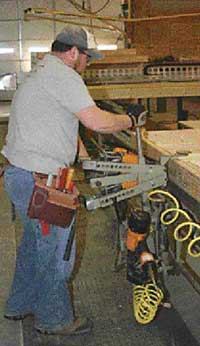
A significant jump in efficiency inevitably accompanies a move — such as ours — from a manual operation to a semiautomatic plant, mainly because panels start moving down an assembly line. When we made the switch, we began turning out wall panels about five times faster than previously; quality was as good as or better than it had been with manual methods.
The cost to fit up a semiautomatic operation, however, is significant. For one thing, the facility needs to be big enough to house the equipment. Eight thousand square feet is probably minimal. And for another, the equipment itself is not cheap. Most semiautomatic plants include the following components, which constitute “the line.”
Plate marker. The first machine is the all-important plate marker. This computer-driven cutoff saw with an automatic stop is programmed to recognize and keep track of every piece of cut framing lumber in the house. It also lays out the top and bottom plates, so one man can do the complete layout in a matter of hours. It’s our most essential tool; the speed of the entire assembly line depends on not getting bottlenecked at layout — just as with framing on the job site.