
by Eric Borden
We build along the Jersey shore, and whether a house fronts the ocean, the bay, or the river, our clients want to enjoy the view. To give them a good view from inside the house, we might have to go up three stories. But for the view from outside, we add a deck or two. The project discussed in this article is typical of most of our jobs, because the decks serve double duty — as both outside living space, and as a weatherproof cover for rooms below. At the rear of the house, we added a deck off the second-floor kitchen that overlooks the pool and creates a covered patio underneath. At the front of the house, we removed an existing first-floor exterior porch to make room for an enlarged great room. We extended this deck to one side to cover the entrance to the garage and to provide an additional 12×20-foot covered carport with access from the dining room through a new slider. We also extended this deck 8 feet to the other side to create a covered entrance to the house. Both of these decks had to protect the spaces below from water. We could have used EPDM single-ply rubber, which is easy to install, but has to be replaced eventually. And because EPDM can’t be walked on directly, we would have had to install deck boards on top of it. The option we prefer is fiberglass, which does not need any additional decking to protect it and, if re-coated every 7 to 10 years, will last forever. A fiberglass deck covering is also relatively inexpensive and, in most cases, can be completed in two days. Costs in our area range from $6.50 to $8.00 per square foot, including the second layer of plywood and all labor.
Sound Substrate
Polyester resin fiberglass has a solid track record — it’s been in use since the 1950s in the boating industry — but it’s messy and somewhat finicky to install. To avoid problems later, we spare no expense preparing a sound deck structure. First, we step up one size on our joist sizing, because we rip a pitch (1/8 inch per foot, minimum) into the deck framing. You can also create a pitch by adding sleepers to the top of the joists, but I feel that this increases the odds that the finished deck will squeak. Next, we sheathe the deck with 3/4-inch tongue-and-groove Douglas fir plywood, glued with construction adhesive and fastened with 8-penny ring-shank nails placed 8 inches on-center. If you use square-edge plywood, be sure to block all seams; any movement in the plywood substrate will stress the fiberglass. When the sheathing is complete, we through-bolt any railing posts to the framing at the intersection of the joists and the inside of the rim board. We add blocking so that the post is secured on three sides, because any movement could cause the fiberglass to crack and leak.
Applying the Resin
I leave the application of the fiberglass coating to the professionals. Former boat builders Dan and Rick Winkle take great pride in their finished product and are knowledgeable about the quirks of fiberglass. Polyester resin fiberglass is a two-part product. The general-purpose resin is mixed on site with a hardener (see Figure 1).
Figure 1. Fiberglass resin is mixed on site with a hardener (methyl ethyl ketone peroxide) in a ratio that can be varied to extend or shorten set time. The base coat is applied over plywood with reinforcing mesh at joints and penetrations, then finished with a gel coat. |
The mix ratio determines how long the resin remains workable, and may need to be adjusted for weather conditions and other variables. Humid weather will delay drying, so we increase the amount of hardener added; conversely, dry weather will cause the resin to set up too fast, so we use less hardener. Open time can also be affected by the surface area of the container used to make the mix; a larger container disperses the heat of the chemical reaction, delaying the chemical reaction and extending open time. The resin is applied over a fiberglass mat, which acts as a binder and adds strength to the coating. Essentially, the mat serves the same function as wire mesh does in a concrete slab. Various other components, such as ground silica and microballoons (small glass beads) can be added to the resin for filleting or patching. Double plywood layer.
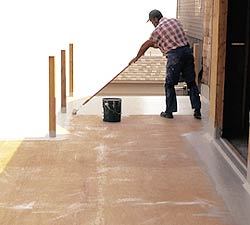
When Dan and Rick show up on site, they bring with them the second layer of plywood for the deck. They use 1/2-inch AC fir plywood, which provides a smooth surface for the resin to adhere to (Figure 2). Figure 2. On the day the fiberglass will be applied, a clean, dry layer of 1/2-inch AC plywood is laid over the base layer of 3/4-inch T&G plywood. Joints are staggered and the sheets are fastened with 8d ring-shank nails. They prefer to provide the plywood because they can be sure of the moisture content of the wood. Moisture is probably the biggest problem at this stage of the game. The resin does not soak into the wood very well, so any moisture in the pores of the wood prevents the resin from penetrating and destroys the bond. The key is to never install more plywood than can be covered with fiberglass in a day’s work: Two experienced workers can cover about 600 square feet in a day. Joints in the second layer are staggered over those of the first. The two layers of plywood are not glued together; they’re only nailed with 8-penny ring-shanks, 6 inches on-center at the joists and 4 inches on-center at the edges. This makes it easy to remove the top layer of plywood if there is a problem down the road.


