
Paying attention to how electricity is delivered to your jobs can save money — and maybe your life
I remember a particular temporary electrical service I installed on a commercial job site. The builder hadn’t given me a site plan, and didn’t show up to tell me where he wanted the service, so I put it where it was convenient for the power company. Turns out it was in the parking lot. When the paving contractor came along, he moved the temporary service out of his way. Luckily, no one got hurt, but had there been any damage or injury, the lawsuits could have put us all out of business. Builders have been jerry-rigging job-site power for years, but insurers, inspectors, and code officials have begun to take notice — and they don’t like it. In fact, the industry as a whole is finally getting serious about electrical safety. Even builders who make it a policy of leaving electrical work to the electrician are liable for electrical mishaps on their jobs, so it behooves you to show some interest in how power is used on site. That means making an effort to communicate with your electrician, and making sure your employees and subs understand what they can and can’t do. Besides helping prevent injury, thinking through the process of how power is used on your jobs will also save you time and money.
Power Pedestal
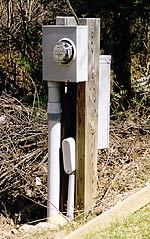
The first question you should ask is whether the job even needs temporary power. In many places, you can skip the temporary setup and put in the regular service at the beginning of the job. This usually means installing a pedestal — a permanent post to which the electric meter is mounted (see Figure 1).
Figure 1. You may be able to install permanent power at the beginning of a job using a pedestal. The meter and main disconnect are installed on a short permanent post, while the power cable runs underground to the house service panel. If the panel is planned for the basement, you can install it immediately after the foundation forms are stripped. A pedestal is more expensive than overhead service, but you save the temporary hookup charge. The power cable then runs underground to the service panel. If the plans call for the panel to be in the basement and if the foundation is poured, you can make the permanent hookup. If the panel is planned for the first floor, you can install a temporary panel near the house, then move it inside after the framing goes up. In either case, of course, the panel will have to be protected from the weather during construction. A pedestal will cost more than a conventional overhead power setup, but the cost will be offset by the fact that you don’t have to pay for a temporary service. Utilities have strict rules about pedestals, including where to place them. The pedestal becomes a permanent feature of the landscape, so make sure your clients can live with the placement. The utility will also have specs for the equipment it wants you to use. Be careful, because these rules can be tricky. One utility I worked with specced “a weatherproof weather socket with disconnect” on an underground service, so I got one that was listed for both overhead and underground use. The utility refused to hook it up, because they wanted one that was listed for underground use only. Correcting the “mistake” cost more than $1,000.
Cooking With Gas
Some builders forego a temporary setup in favor of a gas-powered generator (Figure 2). Figure 2. Generators save the temporary service charge, but they’re noisy and you’ll lose time gassing up and starting the engine on cold mornings. Depending on the size and number of power tools you use, you may also need a gas compressor, since a generator may not be able to supply enough amperage for an electric compressor. With power companies charging up to $350 for a temporary hookup, it only takes a few jobs to pay for a generator. And there are times when a generator is the only real option, such as in some remote areas where the electric utility has yet to run power poles. A generator will, however, take a toll on efficiency. On the few jobs I’ve done with a generator, I lost at least a half-hour every day stopping for gas in the morning and tanking up the generator during the day. On cold days, just starting the thing was a major chore. And if the combined amperage of the tools you’re running exceeds the generator’s output — which can easily happen if you have a compressor and a few saws — you can burn up the electric motors on your tools. To add insult to inefficiency, most generators are much too noisy; even the quieter ones make an irritating hum. The bottom line? If a job requires a generator, I raise my price accordingly.


