
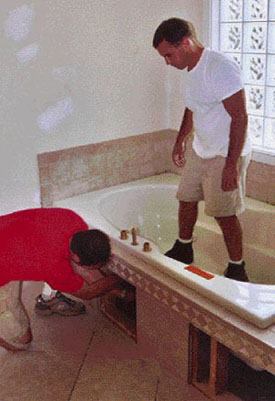
I don’t know of any residential construction process that requires more people than installing and tiling a whirlpool tub. As a tile setter, I’m among the last in a long line of tradespeople involved, including framers, finish carpenters, plumbers, electricians, and drywall finishers. With so many people on a project, it’s not unusual to encounter sequence problems. Adding to the complexity, jetted tubs have electric pumps and other mechanical systems that require periodic service and maintenance, so planning for future access is important.
With help from my plumber, I’ve learned how to get a good tile job with minimum disturbance. My approach also provides hidden access panels that allow the pump to be serviced. I know it’s possible to install a tub without going backward or undoing someone else’s work, but in my world that never seems to happen, so this is how we deal with a typical installation.
Tricky Details
Even though every installation is different, most whirlpool tubs have similar requirements for mechanical access and structural support. The tub bottom requires firm support to carry 30 to 50 gallons of water and two occupants. Equally important is the final elevation of the tub rim: It should be close enough to the finished tile surface that a small, neat caulk joint can provide a finished look and protection from water.
Some tubs have air jets (blowers) and heaters built in. Blowers require an air supply from outside the enclosure, and heaters also require periodic access. I always get a set of specs from the builder or tub manufacturer before starting any job. It’s not enough to assume that the other trades took everything into account.
The Chicken or the Egg?
When I arrive on site to look at a spa tub, I usually find that the framing, insulation, plumbing, and electrical work is done. Often the drywall has been installed and finished. Unfortunately, it’s typically not possible for me to install the tile without first addressing a few problems. Usually the rim of the tub is tight against the rough deck. If a space does exist, it’s rarely the proper thickness because the framing is often done before the tile is even selected. (I’ve seen tile cut around the tub lip, but running the tile underneath not only looks better, it also reduces the chance of water getting underneath the rim.) Access panels for the mechanical and plumbing components are sometimes there, but more often than not, the panel size and location are unrelated to the size and layout of the tile. So I almost always have to make new ones.
Pull the Tub
The first step in getting this job back on track is to disconnect and remove the tub. I usually gain access to the pipes by removing the drywall skirting, and I work with the plumber to undo the connections.
Once the tub is safely out of the way, I add 1/2-inch cement backerboard to the plywood deck, securing it with roofing nails in a bed of thinset. Adding elevation to the deck raises the tub bottom off the floor slightly, allowing room for a mortar bed that helps support the tub bottom.
I reinforce the seams and intersections of the deck and the backsplash with mesh tape covered with thinset. After the thinset cures, I apply two coats of liquid waterproofing to the deck and run it up the backsplash about 6 inches, so the tile will cover it. There are several liquid waterproofing products on the market that you can apply with a brush or roller; I use Bonsal WP-6000 (Bonsal, 800/334-0784, www.bonsal.com). The tile is then thinset directly to the waterproofing, once it has set up.
Magnetic Access Panels
I usually make access panels out of backerboard, securing them with strong magnets that make it easy to remove them. I pay careful attention to the tile layout, so I don’t end up with partial tiles on the access panel. Sometimes I have to move a stud or oversize the panel to make everything work out.
After the panel material is cut to size, I install four short lag screws in countersunk holes flush with the framing at the access panel corners. I stick a magnet on each screw head, with a dab of epoxy on the back. When I set the backerboard panel in place, the epoxy marks the magnet’s location. I then attach the magnets to the backerboard with an additional squeeze of epoxy. Once the epoxy sets up, I fine-tune the panel until it’s flush with the skirting by adjusting the lag screws in or out.
Ready for Tile
With the access panels in place, tile installation proceeds normally. I work from inside the tub opening because it’s far less strenuous on my back and knees and there’s no way I can damage the tub in the process. I can also mark the layout lines on the deck with the tub out of the way.
When applying tile to the access panels, it’s important to hold the thinset back from the panel edges. Otherwise, the panels may be glued in place permanently. I try to make the cuts tight and neat around the edges of the access panels so that the panel edges won’t require caulking, making the tub mechanicals accessible at all times. After tiling the deck, splash, and skirts, we can grout the tile. The access panels are grouted separately, and we pay special attention when grouting the edges, dressing them neatly so they’ll fit in the opening.
You don’t have to caulk the access panels in place, but it makes the panels blend in better and easier to clean. The only problem with caulking is that it makes removing the panels more challenging. To make it easier, we often attach a nylon “zip cord” and tuck it behind the caulking. When it’s time to remove a panel, the string is pulled, tearing the caulk and separating the panel from the magnets. If you don’t want the trouble of installing a zip cord, a suction cup or a pair of putty knives will also work.
Reinstalling the Tub
After the grout has cured, we reinstall the tub, setting it in a bed of nonshrinking grout like Sonogrout 10K (Sonneborn, 952/496-6000, www.chemrex.com/sonneborn) to provide continuous support from the bottom. It’s important to use a nonshrinking grout so it won’t pull away from the bottom of the tub as it dries. Before pouring the grout, we lay a piece of roofing felt or plastic sheeting on the subfloor to protect it from the moisture in the grout bed.
With the mortar bed in place, we lower the tub, gently sliding it back and forth until it barely grazes the deck tile. After a day or two, when the mortar under the tub has hardened, we fill the tub above the jets and test it. I check the plumbing connections for leaks and have the GC arrange for inspections if required. It’s important to get the inspections before the access panels are caulked in place; otherwise, you’ll do it twice.
Chris Daffer was a tile contractor for 20 years. He now works as a field rep for Schluter Systems.


