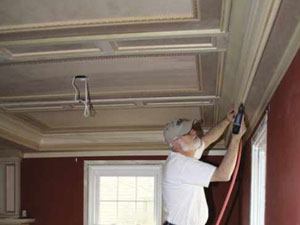
I’ve been building coffered ceilings for about 15 years; they’re great for transforming rooms into special places. My typical approach is to use built-up beams trimmed with crown molding to divide a room’s ceiling into a grid with nine paneled sections.
Over the years, I’ve tried a lot of different beam designs and panel details; sometimes I design the center section so that it’s larger than the others. But in general, the nine ceiling sections are of roughly equal size. In my experience, that means the room’s overall length and width have to be within about 5 feet of each other.
Recently, though, I was asked to upgrade a 24-foot-long by 14-foot-wide living room with a new coffered ceiling. My normal approach, I realized, would overemphasize the length of the room; instead I needed a design that would break up the ceiling and help focus attention on the fireplace centered along the room’s long outside wall.
My solution? I divided the ceiling into three main sections by running a pair of large beams across the room. Visually, breaking up the ceiling with major cross beams changed the room’s geometry and helped bring the fireplace — centered under the middle ceiling section — into focus.
In addition, I subdivided each ceiling section into thirds with a pair of secondary paneled “beams.” Wider and shallower than the primary members, these minor beams are oriented along the room’s long axis. The resulting ceiling is composed of nine recessed panels — same as the other projects I’ve done — but this grid works better in a long narrow room.
Adding to the challenge, the room was out of square, measuring several inches wider at one end than at the other. Fortunately, my technique for building coffered ceilings — highly detailed as they are — is relatively simple and allows me to prefabricate a lot of the parts. Because the parts go together with multiple levels, overlaps, and reveals, it’s easy to make minor adjustments as they are installed.
Planning and Layout
Every time I start a complex project like this one, I do a complete layout on a story pole. For this room, I marked the layout on one of the 16-foot-long 2x6s that would later be used for beam blocking.
For a ceiling that has a lot of parts, the story pole helps me think about how everything goes together. For example, the panels and beams are trimmed with Mon Reale architectural moldings (White River Hardwoods, 800/558-0119, www.mouldings.com), which have a repeating pattern. Since cuts on these moldings need to be precisely laid out so that their pattern is continuous at the corners, I had to adjust the size of frame and panel openings to match the molding.
Once I’d determined the basic beam design and locations and the rough panel size, it was easy to tweak the story-pole layout and adjust the frame and panel openings to make the cuts work out properly. I then made full-scale drawings of the critical intersections, tracing around the actual moldings and using a square to align the parts. Next I made rough drawings of any assemblies that could be prefabricated, like the ceiling panels and the minor beams. That made it easier to put together my cut list.
Blocking
Using the story pole, I transferred the beam layout to the ceiling, then snapped chalk lines everywhere a beam would be built to keep the blocking running straight. To allow room in case a wall is bowed, I always space the outside blocking an extra 1/4 inch away from the outside walls. Though there are five layers of 2-by blocking, only the top and bottom layers are continuous, to save material and weight.
The major beams crossed the ceiling joists, so we had plenty of solid framing to nail to. We glued the perimeter beams that ran with the joists to the ceiling with construction adhesive and toenailed them into the cross beams. Before installing any trim, I checked for high and low spots in the ceiling and shimmed the framing where necessary.
Building Up the Beams
Since the finished ceiling would be painted, I ripped the beam bottoms — which were installed first — from 16-foot-long MDF shelving material. I also used MDF baseboard stock flipped upside down for the sides of the beam. Some of the panel moldings I used to build out the beams were also made of MDF and had an embossed detail. This material looks great when painted and costs a lot less than wood moldings.
We installed the 4 1/4-inch-wide MDF baseboard sides with the bottom edge extending slightly proud of the bottom of the beam. A panel molding, installed later, would overlap this joint, helping to conceal it. Because the MDF baseboard comes in only 8-foot lengths, I had to make a few splices. I made sure the embossed pattern ran uninterrupted through the joint, and glued the lap joints so that they wouldn’t open up later.
Prefabricating the Panels
Next came the ceiling panels, which were made with MDF stiles and rails joined with pocket screws. There was nothing fancy about the joinery; the frame was backed with 1/4-inch birch plywood pinned in place with brads. The only trick to the panels was sizing them to fit the molding pattern, as mentioned above.
I also prefabricated the six shallow paneled beams that separate the main ceiling panels in each section, but I used 3/4-inch-thick poplar for the frames instead of MDF. Since these minor beams overlap the edges of the main ceiling panels, I used a 3/4-inch-thick MDF panel rather than 1/4-inch plywood.
Installation
After marking and cutting out the necessary holes in the panels for recessed lights and hvac ducts, I set the middle paneled frame in each of the three ceiling sections, using the snapped layout lines as a guide. A spacer block equal to the projection of the crown molding helped us position each frame properly, so that the reveals were roughly equal. A liberal dose of construction adhesive on the back ensured that the panels would stay in place as we nailed them up.
Then, working outward from the center, we installed the paneled minor beams, overlapping and pinning one edge to the installed field panel but leaving the other side floating so we could slip in the next ceiling panel. Working this way, we were able to adjust reveals as needed as we went, compensating for the room being out of square.
Applied Moldings
Once all the paneled sections were in place, we added a 3/4-inch-thick filler strip along the edges of the large panels to bring them flush to the minor paneled beams, then ran the crown. Instead of coping the wide poplar molding, I used open miters, which makes installation a lot faster. Coped joints are more forgiving, but mitered crown is fine when you’re working with hard, square corners.
I cut each section slightly long, relieved the back of the joint slightly with a block plane to help the molding slide into place, and tightened up the joints with shims where necessary.
The last three moldings were the easiest to run, but they tie all the parts together. The first panel molding butts into the minor beam and covers the filler block at the top edge of the crown molding. The second covers the joint between the baseboard side and the beam bottom. Finally, a thick molding runs around the room where the beam meets the wall.
Gary Striegler is a builder in Springdale, Ark.