I’ve been building and remodeling in northern Vermont for 30 years; my sons are the third generation to work in the family business. When my dad started, there was a higher level of craftsmanship in home building than we typically see today. When I took over the business, I promised him I’d maintain the high standards of quality that he established almost 35 years ago.
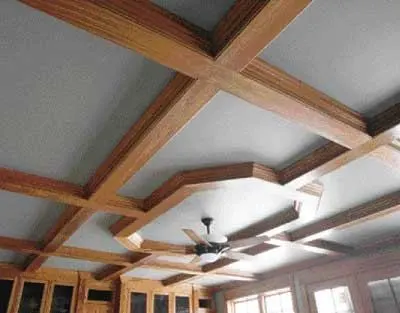
One of the ways we do that is by focusing on interior millwork — built-ins, staircases, fireplace surrounds, and so forth. The challenge has been to develop ways to install these elements efficiently without sacrificing quality. In this article, I’ll describe how we build a coffered ceiling.
Layout
Making a coffered ceiling fit the room — whether in a new house or a remodel — comes down to thorough planning. After discussing with the clients what size coffers they want, I start with a detailed drawing of the room. My drawings show the ceiling dimensions as well as all door, window, fireplace, and built-in locations. I work with the drawings to determine panel sizes, so there won’t be competition with existing architectural elements.
For example, when a fireplace is centered on the wall, I typically try to make the ceiling panels align symmetrically with the masonry. The key is not to draw attention to the ceiling but to make it look like all the elements were designed together. Sometimes symmetry doesn’t work, however — for instance, when there are several competing elements in a room. In that case, you have to decide which elements get priority. Because the first impression of the room happens on entering, I usually give priority to the entrance when laying out the coffers. When the layout gets difficult, I always get the clients’ input.
Sometimes the coffer has to cut in around built-ins or chimneys. In those situations, I try hard to size the coffers so as to prevent tiny 2- or 3-inch runs of crown.
A Good Base
We’ve found that installing a layer of plywood or OSB under the coffered ceiling is the fastest way to guarantee that we have nailing where we need it.
In new construction, we install the plywood before the drywall. In existing homes where everything is relatively level, we install the plywood directly over the drywall (see Figure 1). On older homes where the ceiling is out of level, we sometimes use furring strips and shims to level the surface before installing the plywood substrate. My rotary laser is the perfect tool for that task.
Figure 1.A continuous layer of plywood installed over the ceiling framing provides a solid base for dimension-lumber nailers. After the drywall has been hung and painted, the coffers are assembled from ripped strips of plywood, prefinished flat stock, and crown molding.
Layout and Nailers
After installing the plywood, we snap lines that mark the location of the beams. This is our last chance to critically look at the ceiling. We look for odd-shaped coffers and short runs of crown, while double-checking beam locations.
Once we’re sure everything is okay, we install dimensional lumber between our snapped lines. We resist the temptation to use short pieces of scrap, because long lengths of 2×4 or 2×6 can be more easily coaxed into a straight line. Some coffered ceilings have drywall panels; others are all wood. On a new home with a drywall ceiling, we’ll install the grid of nailers, then let the drywall contractor hang and finish the ceiling in between. We return after the drywall is painted to install the beams and coffers. For a wood ceiling, we install 1/4-inch veneer plywood between the nailers, securing it with construction adhesive and pneumatic brads. From that point on, the process is the same for both drywall and wood coffers.
Plywood Boxes
Once our grid of nailers is in place, we rip plywood into strips and screw them to the nailers to form the boxes that will support the finished material (Figure 2). The height of the crown, plus the reveal below, determines how tall to make the box.
Figure 2. Half-inch or 3/4-inch plywood strips screwed into the nailers form the sides of the beams. The bottoms of the plywood boxes are 3/4-inch for easier fastening. Because it is so dimensionally stable, the plywood substrate helps to prevent gaps in the finish lumber.