Q. We recently completed a residence with a basement garage and a single 20-foot-wide garage door. The door is equipped with a commercial opener attached directly to the framing. Because the homeowners — who have a master suite directly above the garage — have complained about the noise the door makes while in operation, I’ve been looking into quieter openers. But I’m also wondering if it would be better to try to isolate the working parts of the door from the structure of the building instead. What’s the best solution?
A. Bonnie Schnitta, owner of Sound Sense LLC, a full-service acoustic consulting firm and manufacturer of specialty sound-control products, responds: Most of the noise from a garage door is structure-borne and results from the opener motor being rigidly connected to the joists or ceiling of the garage. Typically, structure-borne noise from a garage door can range from as little as 5 decibels (dB) to as much as 20 dB above background noise levels; regardless of the amount of background noise, any 5 dB noise increase is considered significant and perceivable. Even a 5 dB noise-level increase represents more than a 50 percent energy-level increase, and can travel several stories above or several rooms adjacent to the garage. The solution is to decouple the motor from the structure.
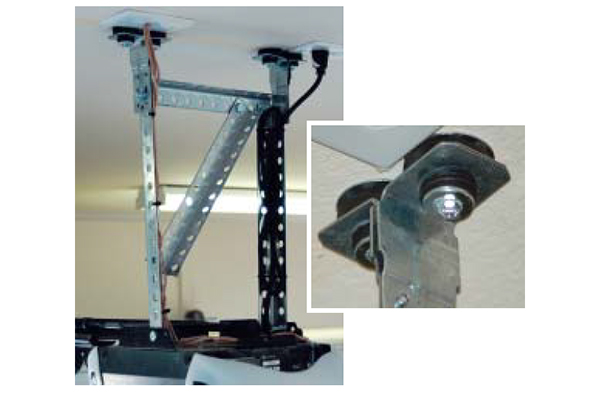
To isolate the motor’s vibration from the structure the motor is attached to, our company often installs decoupler clips (see photos, left). Depending on the horsepower of the motor and the weight of the garage door, these clips will typically reduce the vibration to only 2 dB (or less) above background, a level that’s barely perceivable. The ones we use (PAC International, 866/774-2100, www.pac-intl.com) have rubber mounting feet and can support approximately 36 pounds per clip; they cost about $15 apiece.
Depending on the garage-door opener motor, there can also be significant airborne noise. This can be reduced by enclosing the motor first with an absorber that has an NRC (noise reduction coefficient, a simplified rating of a material’s sound-absorbing properties) of .85 or greater, and second with a barrier that has an STC (sound transmission class, a measure of how effectively a material prevents sound transmission) of 27 or greater. For the barrier, we prefer a mass-loaded vinyl, since its flexibility — which inhibits the movement of the acoustic wave — aids in structure-borne decoupling. Some mass-loaded vinyls have a higher transmission loss than standard one-pound loaded vinyl, and are therefore more effective at reducing airborne garage-door motor noise, which is typically a low-frequency sound.
Some noise-control products function as both barrier and absorber, making installation easier and more cost-effective. For example, my company makes a quilted fiberglass insulation with a mass-loaded vinyl barrier backing. For more on sound-control techniques, see “Innovations in Sound Control” (3/06).