It used to be that on warm afternoons folks would sit out on the front porch to catch some air and chat with passersby strolling down the sidewalk. Nowadays, more and more of those porches face busy streets crammed with vehicles rather than pedestrians. Such porches may be prime candidates for enclosing, to create spaces where the sun can be enjoyed three seasons of the year without bothersome street noise, weather, or insects.
In this column, we’ll review several approaches to enclosing a porch on a small bungalow. The more successful designs balance the context of the main house with an enclosure that recalls the open porch that preceded it.
Original Porch
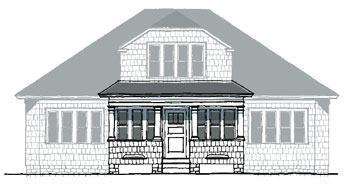
This New England bungalow displays the style’s trademark open front porch, composed of a shingle half wall on fieldstone piers with stout, square posts supporting the roof. The hipped roof and closed eaves are somewhat unusual for a bungalow and suggest the influence of the Prairie style. Because the open porch is rarely used, enclosing it to create a three-season room will add valuable space and daylight to the interior.
Enclosure With Double-Hungs
To enclose the porch, windows and trim are added above the half wall and in between the posts, while the existing exterior door is moved forward to give access to the new enclosure. Reusing the door helps maintain the building’s street-front character. An interior French door with narrow lights is an ideal replacement for the now-relocated exterior door. It’s wise to recess the front door and trim from the front of the posts to allow more of the post depth to be visible from the front, as in this example.
The shingled half wall that provided privacy to the open porch serves the same function in the enclosed porch. The windows let in plenty of daylight while keeping out wind and rain.
In this treatment, mulled double-hung windows with proportions similar to those of existing windows flank the door; four double-hungs of a slightly wider dimension fill in between the posts on the sides of the porch. The head and sill heights of the porch windows differ slightly from those of the house windows due to the existing porch frieze and rail heights.
Though this window choice seems logical, it creates a somewhat monotonous repetition of narrow double-hung windows, and it doesn’t acknowledge that the porch is an intrinsically different type of space than the rest of the house and should be treated accordingly.
Enclosure With Casements
Here, two casement windows that are approximately one and a half times the width of the existing narrow double-hung windows flank the door, while three casements of the same size as those on the front are used on the porch sides.
The choice of wider casement windows helps define the enclosed porch as an entity distinct from the rest of the house. The muntins further differentiate the space. The narrow window lights recall the narrow proportions of the existing windows — without literally reproducing those units.
Having fewer windows allows for a more open, porchlike feel. Since casement windows operate by swinging clear of the wall plane, they are typically less enclosing than double-hung windows, which operate within the plane of the wall. This scheme communicates that the enclosure was once an open porch and thus more clearly conveys the building’s evolution. Such an approach respects the original building while celebrating the new adaptation.
What If the Original Porch Had Full-Height Columns?
For the sake of discussion, suppose that instead of the more traditional half wall, the porch had full-height columns linked with a simple square-stock balustrade. If full-height columns were used here, they would most likely be square and tapered, though it’s possible they’d be round. Enclosing this type of porch — rather than the typical bungalow half-wall open porch — poses a different set of challenges. Assuming we don’t wish to preserve the balustrade, we will have more flexibility in selecting a sill height for the infill windows.
Double-Hung Windows and Panels
In this example, the porch window sills align with the existing window sills to increase the overall porch window height and better relate to the main house. As in an earlier example, multiple narrow double-hung windows are mulled together to infill between the columns and scribed trim.
Yet despite the lower sills, this window configuration is no more successful than the similar configuration was in the half-wall porch example. The MDO panels below the sills, which relate to the window sash sizes, are also fairly unsuccessful. For one thing, their formal appearance is out of keeping with a bungalow’s characteristically unadorned informality. Further, the paneling’s horizontal orientation conflicts with the vertical orientation of the existing and new windows.
Though not a glaringly bad solution, this approach leaves plenty of room for improvement.
Casements Work Better
In this case, too, the porch window sills align with the existing sills. The casement windows are the same width as those in the earlier casement example. The row of narrow lights across the top of the sashes recalls the narrow proportions of the existing double-hung windows while allowing for more unobstructed glazing below. This type of light division is not uncommon on Craftsman-style houses. Vertical V-groove trim below the sills is appropriately informal and properly oriented.
This overall treatment is pleasantly porchlike and well-suited to its three-season function, and it captures the spirit of the main building.
Vertically Mulled Windows, Low Sills
Here, to maximize daylight, the sills have been dropped to 9 inches above the porch floor; this distance provides a measure of kick protection, though the glazing will still have to be tempered. In addition, the entrance door has been changed to a glazed door with narrow top lights that echo the muntin pattern in the original door.
The front elevation incorporates one large picture window with three narrow casements above on each side of the entrance; the sides contain two picture units mulled together with a band of four casements above. The casements provide visual differentiation as well as ventilation. Their narrow proportions reflect those of the existing double-hung windows, but the horizontal and vertical dividing mullions seem too heavy and distracting, especially if the goal of this scheme is to create a more open enclosure.
Full-Height Windows
In this solution, the large picture window is topped with a row of narrow lights. For cross ventilation, the side elevations have two mulled double-hung windows that match the height of the front units, including upper-sash lights of the same proportion as the picture-unit lights.
While the use of fewer, larger windows helps to achieve a more open feel, all of this glazing increases the porch’s potential solar heat gain. It also makes the space much less private than the examples with the half wall. Certainly for a porch facing the street, this window arrangement could result in a fishbowl effect; for a porch overlooking a private yard, an exquisite water view, or a welcoming landscape, however, it could work well.
Katie Hutchisonis an architect and the owner of Earthlight Design in Salem, Mass.