- Q. As a general contractor in the Blue Ridge mountains of southwestern Virginia, we often build vacation homes higher than 4,000 feet altitude, where wind-driven rain is a regular weather feature. On one site, the wind regularly reaches 50 to 80-plus miles per hour and actually blows rain uphill. We have a south-facing window wall full of fixed-glass and awning windows. The wall has 2×6 studs,1/2-inch OSB sheathing, Tyvek housewrap, and 1×10 horizontal ship-lapped pine. With only a 3/8-inch lap on the siding, I can imagine that water might be driven behind it. But how is it getting past the Tyvek and OSB through the wall? Water drips from the interior window head jambs, and with the interior wall paneling removed, it can be seen on top of the sole plate. We had to replace some buckled hardwood flooring after a vicious storm last January, and before we repair it again, we want to make sure the wall won’t leak. Are there any methods or materials that you could recommend?
A.Patricia Hamilton responds: We build homes along the Delaware coast, where storms bring heavy rains and winds of 40 to 80 mph on a routine basis, plus the occasional hurricane. We take a few extra precautions to keep our houses dry:
- Use siding with an adequate overlap and avoid diagonal siding patterns. The scant 3/8-inch overlap you mention is most likely contributing to the problem. Avoid vinyl siding, as well as low grades of wood siding (they’re more prone to shrinkage and cracking).
- Use the best windows you can buy — Grade 60, if possible. We only use clad windows with integral nailing fins.
- The house should be weatherproof even without its siding. (The siding’s job is to hold paint and look good.) Always use housewrap, installing it from the bottom up so that water can’t get behind it, and tape all seams.
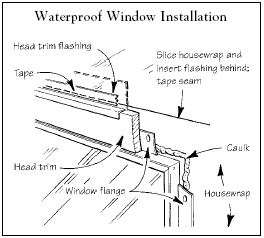
- Back-caulk your window flanges as you install the windows. Cut a slice in the wrap just above the window and install a piece of tar paper or metal flashing that goes behind the wrap and in front of the flange (see Figure 1). If there is trim above the window, extend the flashing over the trim, and tape the slice in the wrap.
- Under shingle siding, on the sides that get the worst weather (east and northeast for us), install tar paper over the wrap and tape all seams. Sidewall shingles let more water past than bevel siding.
- Watch out for step flashings, since they usually go on after the housewrap. It’s important to slice the housewrap and install the step flashings behind it. In tricky areas where valleys channel water up against sidewalls, we lift the housewrap out of the way and install a backup strip of Grace’s Ice and Water Shield over the step flashings and behind the housewrap (Figure 2).
- Caulk between the siding and the window trim.
- Hope for a bad storm before the drywall goes up to give your weatherproofing a test run.
Patricia Hamilton is owner of Boardwalk Builders in Rehoboth Beach, Del.
Q&A: Weathertight Windows for Wind-Driven Rain
Weathertight Windows for Wind-Driven Rain
3 MIN READ