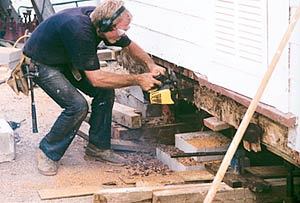
My company specializes in restoring turn-of-the-century and older homes in the Galveston Bay area of Texas. Period restoration may conjure up the image of an old man in a leather apron, spectacles, and visor, painstakingly refinishing gold striping on a fireplace pilaster. Since most stereotypes have a basis in fact, I won’t try to debunk this one, but I will say that a whole lot must happen before this fellow arrives on site. Many of the structures we work on have been neglected for years in a very unforgiving climate. On this end of the Gulf Coast, we have very damp, cool winters and hot, dry summers punctuated by torrential rain showers and occasional hurricanes or tropical storms. Humidity hovers around 90% at night, and by midday it drops to around 50%. Intense sun and salty air also come into play. Soil is also a big variable: It ranges from fairly stable sand at water’s edge to a hard clay silt just a few feet inland. We have a heavy black humus known as gumbo, which is very unstable: It shrinks and heaves, turning from a soupy mess when saturated to a rock-hard mass when baked dry. Building movement on this type of ground is a given, so structural repairs must always be addressed before other work can begin. Most of the houses I work on were built before ready-mix concrete was available. Many are supported on a grid of short brick piers spanned by 6×6 or 8×8 sills. In many cases, however, the sills were set directly on the ground. Even though they are made of bald cypress — a naturally decay-resistant wood — or creosoted yellow pine, after 50 or 60 years these timbers have rotted or been eaten by termites to the point of nonexistence.
Using the Right Jack
The first step in a structural overhaul is to raise the house up above grade. This allows air circulation underneath, which in turn alleviates many moisture-related problems and also makes access to plumbing and other house systems easier. I use three types of jacks: hydraulic bottle jacks, screw jacks, and hypoid gear jacks (see Figure 1).
Figure 1. The author uses three types of jacks (from left in top photo): hydraulic, screw, and hypoid gear. Steel angle slips, predrilled for attaching with duplex nails, spread the load over a larger bearing surface (bottom photo).
Most of my hydraulic jacks are rated at 10, 12, or 15 tons; the screw jacks I use have a 10-ton rating. I use the hydraulic jacks for lifting, backed up by the screw jacks for holding things up while I reblock the hydraulics. I have about 30 of each type. The hypoid gear jacks have either a 25- or 35-ton rating; they raise and lower with a 1-inch socket wrench. I have only a few of these, and use them at the heaviest points — usually at interior loadbearing partitions. The hypoid jacks are heavy and turn very slowly, so I use them only where I need their load capacity.