- Q. A foundation wall in my customer’s two-story home has a 2-inch bow in the middle of its 53-foot length and two stress cracks located 10 feet from either end, all probably caused by backfilling while the concrete was still green. As far as I know, no rebar was used in its construction, but at least the 8-inch-thick, 8-foot-high wall was built on sandy soil with good drainage. A driveway is planned that will butt up to the wall; is there any way to pin this wall to the driveway, or should the foundation wall be removed and replaced?
A.Tim Garrison of ConstructionCalc.com, a professional engineer, author, and software producer for the building industry, responds: While the 2003 IRC (Section R404.1.2) allows unreinforced concrete basement walls in some circumstances, I’ve seen far too many cracked and fractured unreinforced walls to think for a minute that it’s okay to leave rebar out. It’s possible to pin the wall to the proposed driveway slab, but it would do little good. Presumably the top of the wall is already connected to the first floor’s framing and thus restrained from further bowing.
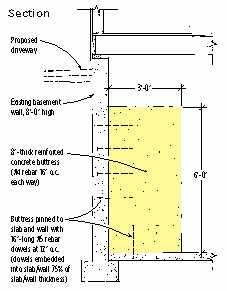
Reinforced concrete buttresses connected to the existing foundation wall and slab floor with epoxied rebar dowels should prevent further movement in this bowed basement wall.
But you also need to worry about the midsection of the wall. Soil is constantly pressing against it and tending to cause the inward bulge; adding driveway wheel loads will make it worse. Vertical rebar is normally used to resist this, but in its absence something else is needed.
While it might be best to tear out the wall and start over, another much less expensive and intrusive option would be to build four reinforced concrete buttresses in the basement (see illustration, previous page). Connected to the wall and slab with epoxied rebar dowels, these buttresses would likely stop further structural distress. Plus, the homeowner could use them for shelving or closets.
Fixing a Bowed Basement Wall
2 MIN READ