How often do you pass a residential construction project in your town and think, “Now, that’s a good design”? And how often do you pass a project and shake your head in disbelief? Or, almost as bad, pass a site and not even look twice at what’s going on, it’s so bland and generic.
If your experience is like mine, you’ll agree that the quality of residential design in America is not high. Although both professions are responsible, the blame belongs more with contractors than with architects, because, for the most part, when prospective clients want some residential construction work done, they call a contractor, not an architect.
So we’re usually the first ones in and, as such, should take our responsibility to good design seriously. Like it or not, that means that for any significant project, we contractors need to make sure the client gets a good design professional on board.
Design by Designers
It’s a mistake for the business owner to be the principal designer. Establish project parameters? Definitely. Encourage a style or a look or a design direction? Yes. Take primary responsibility for producing and troubleshooting that design on paper? Almost certainly not.
Remember, except in the smallest companies, it’s the nature of the role of president or owner not to allow time for much in the way of tangible work. An owner acting as principal designer often sees late hours, slow progress, and reduced effectiveness in other areas of the business. Too often, I hear of contractors doing their design work late at night, after the kids have gone to bed and all the pleasure and inspiration have long since faded. Contractors should be just as ready to outsource design as they are to outsource other special skills.
I’m keenly aware that I’m trying to reverse the historic and still prevalent reluctance of contractors to work with architects. Builders as a group tend to regard architects as nonessential, complicating entities whose primary skill seems to be shifting responsibility away from themselves when the budget goes awry. I also know, however, that those builders who’ve overcome this mistrust and learned to collaborate with good design professionals not only provide a superior service but also gain a formidable, competitive advantage over those builders who haven’t. (See “Buying In to Design-Build.”)
A Team Effort
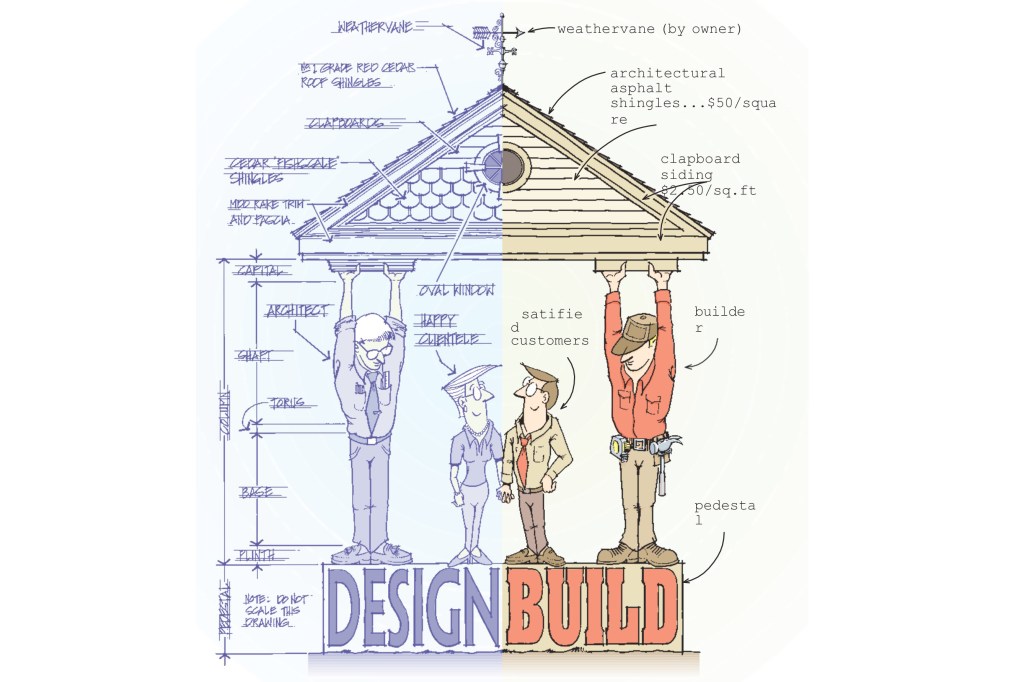
What I’m describing, of course, is design-build, defined as an arrangement in which the design professional and the construction professional collaborate with each other as a team and as an entity, working on behalf of the client from the earliest stages of the design process all the way to completion of construction. This is the most effective strategy I know to improve the quality of residential construction in this country.
It wasn’t until I decided to get out of competitive bidding altogether (see “Farewell to Competitive Bidding,” 7/97) that I started picking up speed in the direction of design-build. I focused my marketing on getting prospective clients to call before they had plans. This I accomplished by working to earn a reputation as an effective “go-to” person — someone you call when you want something done (“Call Paul; he’ll figure out how to get your addition built”).
That strategy worked extremely well; soon most of the people who called me about a project were calling me first, before any design professional was on board. Initially, I gave clients names of a few architects they might hire; eventually, I narrowed the list to one. Doug Ruther was a friend who did residential design on a moonlighting basis, and we had worked together as an informal team. The day after he was laid off from his day job, I hired him, and Byggmeister was born as a bona fide design-build firm.
The Right Relationship
Although there are four basic ways to create a design-build team — de facto partnership, legal partnership, architect as subcontractor, and architect as employee (see “Partnering With Architects“) — I’d already felt my way through enough professional relationships to develop a preference for the employee option. In that option, accountability for the success of the job is clear cut — all fingers point to me. I can hire exclusively for design skills, rather than have to find a candidate with business skills, as I would in a partnership or subcontractor relationship. I believe that, in general, design skills and business skills don’t readily mix. Larger architectural firms acknowledge this maxim with the position of managing partner. Fundamentally, a design-build firm, like any firm, needs to be a good business to be of much benefit to anyone.
Doug is an employee, but his employee status includes some special employer responsibilities. In our company, the architect has as much say about what goes on the punch list as the client does, and that’s how it should be. The staff architect needs to have ultimate authority over design issues — total veto power. The integrity of the arrangement hinges on this veto power.
At my company, even within the employer-employee relationship, we nurture and manage, rather than eliminate, the historic tension between architect and contractor. Properly handled, this tension works to our clients’ benefit. A good collaboration requires dialogue and disagreement, advocacy and compromise, not subservience.
If this sounds to you like too much of a stretch, either you don’t have the right architect candidates in mind, or you’re not the right contractor to be hiring an architect.
Charging for Design
To start, I created a business plan and budget for the position. Doug and I reviewed cost data for a series of jobs we’d done together and calculated that, on average, design fees ran about 6% of construction costs. We agreed that we wanted to produce more thorough documentation than we’d had previously, and so we pegged future design fees at 8% of the construction budget.
We quickly found it useful for Doug to handle full product selection for each job. Clients found it helpful, of course, but happiest of all were my lead carpenters. They were able to start a job knowing everything that would go into it. We now place all special orders as soon as the contract is signed. With near 100% reliability of supply, my crews have everything required to finish the job at least a week before it’s needed.
Product selection proved time consuming, however, so after some further analysis, we bumped the design fee up to 12% of construction costs. On average, this worked well, but we found that some jobs (and clients) took more time than others. To cover that contingency, we moved to straight hourly billing. We now develop a design budget based on 12% of construction costs — and do periodic compare-to-budget calculations for the client — but we bill by the hour (see “Design-Build Fees,” below).
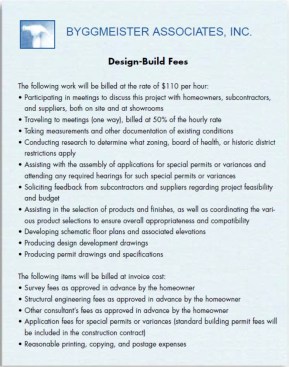
The author's contract details the billing rate for design.
Practical Strategies
Regardless of the legal or practical structure of the design-build arrangement, several things must happen:
* Clients must understand that they’re buying the whole package — design and build — and that, unless the contractor screws up, at the end of the design phase he or she will be the one building the job. This should be specifically laid out in the contractor’s part of the design agreement. Contractors make their money not as consultants during the design phase, but by keeping their crews busy and building jobs. That’s where the focus needs to be.
* The contractor needs to set good budget and schedule parameters up front, based not on wishful thinking but on real-world comparisons with similar, completed projects. There also needs to be a clear description of project goals.
* That being said, clients and architect need to understand the difficulty of estimating a project before it has been fully designed and documented. My design agreement has a clause that says exactly that.
* The contractor should be responsible for keeping the project on budget by providing financial updates throughout the design process. The architect should honor that responsibility and not sabotage it with off-the-wall requests or expectations. It’s all right to offer the client more costly options, but they need to be just that: options.
* There should be a target design and construction schedule that’s agreed to by architect, contractor, and clients. But clients should be clear about their influence over the schedule: If they delay a decision, the project will be delayed.
* The architect and contractor should meet to discuss the job at least monthly during the design process and at least weekly during the construction process.
Care and Feeding
The constant temptation for any good architect employee — especially one who sees the difference between billing rate and compensation rate without really understanding why there needs to be such a difference — is to go off and start his or her own practice. To minimize that likelihood, my job is to come up with a steady flow of interesting projects and good clients, and to maintain a high-quality, highly professional crew that can do full justice to the architect’s designs. I strive to handle all the administrative and overhead tasks pleasantly and reliably so that the architect need focus only on design work.
Even after meeting these standards, you may find that the architect employee you’ve been training and grooming for many years will one day go off on his or her own.
However you handle the immediate need to replace an architect who decides to leave, your overall approach should be the same as for staffing any position at your company. To begin with, your company should be a good employer; your organization should have no truly indispensable personnel; you should have a variety of social and business networks that bring a steady flow of prospective employees to your door; and you should always be on the lookout for talent to supplement or replace what you’ve already got on board.