Needs Source for Adjustable Braces
To the Editor:
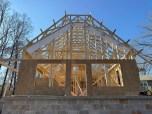
On page 102 of the July 2004 issue (Pouring a Structural Slab) there is a photo of adjustable wall braces. I was wondering where such braces would be sold. I am a framing carpenter in Massachusetts.
John P. Lynch
Via email
Those braces came from A.H. Harris, a supplier of products and equipment for the concrete industry with several locations in Massachusetts (617/269-4800 in Boston; www.ahharris.com). The braces are made by concrete form manufacturer Symons Corp. (847/298-3200; www.symons.com). — The Editors
Fee Impact
To the Editor:
I recently came across two stories you might be interested in: (1) How home affordability in California is at an all-time low (San Diego Union-Tribune); and (2) How local governments in Orange County, Calif., and other places are fighting to increase fees on new homes (Los Angeles Times).
Hmm, I wonder if there is any connection between higher fees and more expensive homes?
Naaahh….
Jane Manchester
Los Angeles, Calif.
Decimal Pitch Conversion
To the Editor:
When I first got my Tajima slant tool (Time-Saving Tools, 8/04), I was disappointed to find that it didn’t have a scale for roof pitch, so I figured out an easy way to convert the percentage measurement to pitch-over-12: I set the short side — the side labeled “measuring face for construction work” — on the roof deck, level the vial, and read the corresponding rise. Then I simply multiply that rise by 12 to convert the percentage into a 12 pitch. If the scale reads .58, for example, multiplying by 12 makes the conversion to a 7-in-12 pitch (.58 x 12 = 6.96).
John Carroll
Durham, N.C.
More About Markup
To the Editor:
Gary Katz brought up a subject of vital importance at the end of his article on estimating finish carpentry (6/04). Katz stated, “10% to 15% markup is all the market will bear.” But a small remodeling company with a minimal office staff can have easily $160K to $200K in annual fixed costs: owner and staff salaries, benefits, and general office overhead. Note that I am not including here profit that a business should be earning on top of all costs.
To capture $160K in fixed costs at 15% markup, the company would need $1.067 million in sales ($160K/ 15%). Now assume materials for a company like Katz’s is about 25% of the annual gross sales, or $267,000; with no profit, that means he would need a total of $1.33 million from labor billings. A $45 hourly labor-billing rate would require 29,630 billable hours. At 2,000 hours per field employee per year, the company would need about 15 field employees. That crew size is not manageable in a small-office scenario.
However, using similar calcs, a markup of 67% would require only three or four field employees, a much more manageable crew size. While these numbers are only hypothetical, they illustrate the power of a higher markup in producing a better product and a healthier, more stable company. Choosing the right clients and selling the benefits of a well-managed company can actually overcome the retail market “barrier” that Katz mentioned.
Joe Allen
Joseph G. Allen General Contractor
Walnut Creek, Calif.
Gary Katz responds: Thanks for your comments; I agree completely! Maybe I used the wrong phrase and should have said “profit.” And I definitely should have said something in the article about overhead. I guess I concentrated too much on the finish carpentry part of my job in that article, which is the mistake a lot of carpenters make when they go into business for themselves. You’ll go broke fast if you don’t figure a percentage of your annual overhead costs into every job. I divide my previous year’s overhead expenses (office expenses, licenses, tools, trucks, fuel, and insurance — but not employee expenses, because those are added to employee hourly rates) by my annual income. The resulting fraction, after moving the decimal to the right two places, is the percentage I add to all jobs for overhead expenses. Like a lot of contractors, I sometimes cringe when I total up the bid, knowing that in my competitive market I won’t get the job or be able to keep my employees working if I come in too high. While there are times when I can choose my clients, after working through two major recessions (1980-82 and 1990) and other feast-and-famine cycles, there are times when I have to take what I can get.
Looking for Compact Saw
To the Editor:
I thoroughly enjoyed this month’s issue (7/04), especially the miter saw survey. I’ve been using a Makita LS1011 for about 10 years now and am ready to advance to a dual-bevel saw. In addition to the points reviewed in the article, one important factor I consider is not so much the weight of the saw but its footprint in the transport position. In a shop setting this is not much of a consideration, but in the backseat of my supercab pickup, or even in a van, a saw with the capacity of my Makita that is not much larger than a standard chop saw was at the time and still is a beautiful thing. I will use the info in Mr. Hark’s article and take my ruler to the store when I’m ready to buy.
Tony Cruz
Jackson, N.J.
Backerboard as Heat Shield
To the Editor:
Regarding “Reducing Clearance to Woodstove Pipe” (Q&A, 7/04): When building a ceramic tile stove platform, we set the stove on a mortar bed base, then furr out the wall one inch, as in your diagram, and install cement backerboard panels. We keep the panels off the floor one inch for venting. Using the cement backerboard panels provides a heat-resistant installation material that we can attach marble, slate, or tile to with thinset.
Daniel Dixon
Ceramic Tile Professionals
El Cerrito, Calif.
Hidden Soffit Vent Revealed
To the Editor:
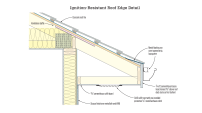
I don’t understand the article “Subtle Soffit Vent” (Backfill, 7/04); I guess the directions were too subtle for me to understand! Or I could be missing something simple about the illustration. I can’t see any “1/2-inch space between the first and second fascia members.” Do you mean “frieze” members? I’d really like to understand this idea; after all, designing a well-vented soffit without ugly vents is a great achievement.
Gary Katz
Reseda, Calif.
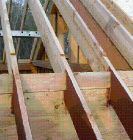
Oops, you’re right: We should have said “frieze,” not “fascia.” Plus, a section drawing without an elevation can be tricky to read. I agree with you about the “achievement” part, so we’ll try again, this time with the help of some additional photos provided by author John Seifert (see below). Thanks for your interest. — The Editor
1. The blocking between the exposed rafter tails is dropped below the top of the rafters to permit airflow.
2. Pieces of strapping, painted black so as to disappear from view, are nailed in place with sections of brake-bent screen.
3. The frieze boards install flush with the top edges of the rafters, snug to the sheathing, but allow air to enter at the bottom.
4. Another example, on a round tower. Here, frieze vents are supplemented by routed slots near the soffit’s outer edge.